The Shallows

The Shallows: A Movie That’s Like … Whatever

Reviewed by Janelle Palmer for TheHumbleHeckler.com.

(Editor’s note: Janelle Palmer, a 17-year-old high school senior, is filling in for her mother, Janette, one of our resident film critics, who is currently recovering from rhinoplasty.)

Okay, so, like, The Shallows is this big, like, shark movie or whatever. Blake Lively plays this super-smart girl who’s all, “I wanna be a doctor someday,” or something. She’s super annoying, but I’d kill for her stomach—OMG, have you seen that thing. Flat as one of those ironing board thingies I see my mom using. BTDubs, my mom always smokes when she’s ironing, and she thinks I don’t know about it, but it’s like—hello, I can totally smell your gross ciggies. You’re not fooling anyone. Anyway, Blake Lively (hate her!) decides to go out on the ocean to, like, surf and get a tan and stuff. Oh, I almost forgot that Blake Lively, in real life, is married to Deadpool, so that’s pretty cool, but I still haaaaate her.

So, anyway, Blake Lively goes on her board thingy and starts, like, really surfing those waves. Then my phone started vibrating (I set it to vibrate cuz I’m, like, courteous as balls). It was my friend Kara, whose tan is so completely out of control it’s insane. So, Kara tells me that she’s going shopping and asks me to come with, and I’m all “I can’t. I have to watch this stupid shark movie so my mom won’t, like, get fired or something.” And then Kara’s all, “That blows.” And then I’m all, “I know, right? It’s not my fault you decided to get a nose job and flake out on your work.” So then I went to get a Diet Coke, and that skeevy kid Jeremy was working at the food place. He was looking right at my nips, not even trying to hide it. So I said, “The theater’s cold, okay, Jeremy. Act like you’ve seen nips before, loser.”

When I got back to my cold-ass seat, Blake Lively was freaking out about some giant-ass shark. I don’t know for sure, but I think she pissed it off while she was surfing, and I’m pretty sure sharks don’t like that. So then the movie is all about the shark beefing with Blake Lively. They go back and forth. Blake wins some, the shark wins some … I don’t know, I guess some of it wasn’t too bad. That skank Melissa from English class was sitting two rows ahead of me, and she seemed to like it pretty well. Maybe you have to be a skank to really like this movie.

I don’t really like sharks. They’re stupid and ugly and it’s like, “do something besides swimming and attacking Deadpool’s lady, already!” Since I don’t like sharks, there’s no reason why I should like shark movies. So I guess I should say that you probably shouldn’t see this movie … unless you’re completely skanky like Melissa or something. Although, it isn’t the worst movie. I mean, I didn’t bail or anything. I watched it all the way to the end, which I’ve been told I’m not supposed to spoil. Whatevs, it’s not such a special ending anyway. So, I guess I’ll just say that The Shallows is kinda bad, and I don’t recommend it. But, then again, my friend Tessa says it looks good and she wants to see it, and Tessa has super-good taste, so I don’t know. I guess I have no opinion.

I’ll give it 5 stars out of, like, 5 million. But I reserve the right to change my score after Tessa sees it and we talk about it.

(The Shallows is rated PG-13 for, like, scary shark stuff, bloody water, open wounds and stuff, and I think Blake Lively drops the F-bomb once or twice, but I don’t remember for sure or anything.)

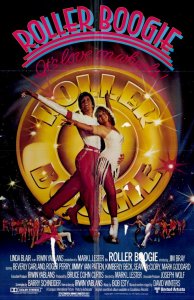
Roller Boogie (1979)

 Roller Boogie (1979)roller-boogie-poster

                                By Andrew Neil Cole

Roller Boogie is a bit of an anomaly in the world of B-movies, in that the film was actually relatively popular and commercially successful when it was released at the end of 1979. Unfortunately, popularity is not always a signifier of quality. At the same time, the film’s so-bad-it’s-good reputation is arguably the one and only reason it is remembered at all. After all, had the film even been regarded as just another mediocre popcorn flick featuring disenfranchised ’70s youth, Roller Boogie would have withered and died as abruptly as the disco-skating fad the film was engineered to exploit. Luckily, for generations of fans who love truly bad movies, Roller Boogie is a cinematic turd-on-wheels so epically inept its position in the pantheon of B-movie treasures is assured.

A surprising number of now-classic B-movies either tell simplistic stories that reflect a social trend associated with American youth, or they simply string together a series of easily recognizable narrative clichés. Roller Boogie manages to do both. Audiences are treated to (or subjected to) countless roller-dancing sequences set to an assaultive soundtrack of disco tunes that almost never stops. Without these sequences, the film would be approximately seven minutes long. But the most astounding thing about Roller Boogie is the sheer volume of clichés employed within the story structure; in fact, the film unfolds—literally—in one pot-boiled, contrived character trope and story cliché after another until it finally collapses beneath the weight of its own predictability.

At the core of Roller Boogie is a tale of budding romance between Terry, a spoiled rich girl who wants to rebel against her uppity conservative parents by immersing herself in the local roller-disco culture, and Bobby, a scrappy poor boy from the wrong side of town who just happens to be the best skater on the boardwalk. Believe it or not, these two star-crossed lovers don’t really get along at first. To make things worse, Terry’s snooty upper-class friends and Bobby’s uncouth working-class friends don’t get along, either. Matters are further complicated by the fact that Terry’s parents want her to settle down with—gasp!—a preppie little letch from a wealthy family named Franklin. But before long, Terry and Bobby fall prey to their throbbing teen libidos—class differences be damned! Bobby accepts Terry’s request to teach her how to roll like a champ, and after an extended montage of training mishaps, they decide to partner-up and enter the roller boogie contest at Jammers, the local skating rink owned by a beloved former roller derby legend. But wait … Just as things are starting to go well for Terry and Bobby, they overhear a conversation between Jammer and some generic thugs. Turns out, the thugs want to turn Jammer’s rink into—get this—a shopping mall, and they threaten to burn the place down (even if it’s filled with innocent kids) if poor Jammer doesn’t agree to their terms. Will Jammer sell out? Is the roller boogie contest cancelled? Will Terry and Bobby survive as a couple? Will Terry’s parents learn some important lessons about acceptance?

Do you really have to ask?

As the movie hurtles toward its inevitable conclusion, we are assailed by one mind-numbingly predictable moment after another. Take, for example, a scene in which Bobby and his working-class friends attend a fancy-schmancy recital (Terry is supposedly a genius flautist) on the perfectly manicured grounds of Terry’s family mansion. Of course, Bobby’s friends don’t fit in with this crowd, and every awkward joke and embarrassing moment is easily anticipated by the audience. Hors d’oeuvres are devoured with gluttonous glee, the word hors d’oeuvres is mispronounced, a comedic chase through the crowd ensues, masses of formally dressed people are knocked into the swimming pool, and, of course, someone face-plants directly into a decorative, multi-tiered cake. This scene is a perfect representation of the film as a whole. There is simply not one single moment of narrative innovation to be found in this movie.

Equally amazing is the film’s total lack of subtext. Every word, every intention, every moment is made perfectly clear through the use of exaggerated facial expressions, audible sighs, and clunky expositional dialogue. In one scene, to prove that the musical prodigy Terry is bored by her life of privilege, she exasperatedly exclaims, “So what! I’m a musical genius. What a drag! What a bummer!” Later in that same scene, Terry’s mother makes a hasty exit after hearing of Terry’s desire to win a roller boogie contest at the beach. Terry sits alone in the silence of the now-empty house, stares forlornly into the distance and says to absolutely no one: “She didn’t understand a thing I said.” The film goes out of its way to fill every moment with stilted dialogue, loud music, skating/action scenes, or a cacophonous combination of all of the above. We are never invited to intuit what the characters are feeling in quiet moments; instead, we are always told, point blank.

All in all, Roller Boogie is so bad you can’t believe that you’re actually watching it, and yet you can’t stop watching it because you’re having so much fun finding out just how much worse it can get. And, like virtually every great B-movie, Roller Boogie is fun to watch because of its shortcomings, rather than in spite of them. As Terry, Linda Blair does her damndest to erase the grotesque, split pea soup-spewing image she inadvertently cultivated as the bedeviled Regan in The Exorcist, and she mostly succeeds. The problems with her character are clearly not her fault. The same can be said for Jim Bray as Bobby. Bray is one of the most talented and accomplished skaters ever to lace ’em up. It does, however, become quite clear quite quickly that he is not a professional actor, but that, too, is not his fault, and, to be fair, every scene that features his skating is infectiously fun to watch (the guy really is an exceptionally talented skater). Roller Boogie may not work as a drama, a character study, or even as a realistic representation of the skate culture of that era, but it does capture the atmosphere and energy of summer nights at the roller rink in the late ’70s and early ’80s, and if that isn’t good enough for some people, they probably shouldn’t be watching a movie called Roller Boogie in the first place.

Ghost of Dragstrip Hollow (1959)

Ghost of Dragstrip Hollow (1959) ghost-of-dragstrip-hollow-movie-poster-1959-1020174212

  By Andrew Neil Cole

     Like so many great B-movie classics, Ghost of Dragstrip Hollow, a teen hot-rodder horror-comedy, regales its audience with a tale that leaves any sense of narrative logic in its dust-speckled rearview mirror right from the moment it begins. The film starts with a drag race between two seemingly rebellious ’50s teen gals. These crazy hellcats zip haphazardly through the rear-projected streets of Los Angeles, their dazzling speed the result of a primitive filmmaking technique called undercranking (which is achieved by filming fewer frames per second to create the illusion of speed). The cops snag one of the racers, but the other, Lois, the film’s lead, gets away. This, by the way, is the film’s first and last drag race, which is strange for a film about drag-racing teens called Ghost of Dragstrip Hollow. Anyhoo … Lois returns to her hot-rod club’s hangout to find a middle-aged writer interviewing her fellow hot-rodders for an article of some sort, to be published … somewhere … sometime in the not-too-distant future … or something (details really don’t matter in this movie). So, anyway … for some reason Lois’s hot-rod club is about to be kicked out of their usual hangout. The rest of the movie documents the indescribably bizarre confluence of events that leads to the gang finding a new place to make their official hang.

The movie is so slipshod in its construction, so baffling in its lack of coherence, so ultimately nonsensical that it must be seen to be believed. That said, it’s also infectiously silly and undeniably fun. Part of the fun is trying to figure out exactly what movie-going demographic the good folks at American International Pictures had in mind as their target audience for this lemon. For starters, the rebellious teens aren’t rebellious at all. They dress conservatively, respect their parents and all adult authority figures, and belong to hot-rod clubs that disallow rumbling with rival clubs. There is even a scene in which Lois’s sort-of boyfriend talks her into confessing a recent lapse in ladylike behavior to her parents. How rebellious! And, for the record, the “horror” portion of the film doesn’t kick in for almost 45 minutes; this is important because the film is only 65 minutes long. So … we have a drag racing film with only one drag race, a horror film in which horror is an afterthought, and a teen-angst film in which the teens are as docile and contented as Stepford wives after a tray of hash brownies. So … what the hell, man?

Here are a few things we know for sure, even though they make little or no sense. We know that Lois’s father wants Lois to be on her best behavior because a client of his—an old bag of bones named Anastasia Abernathy—is coming to stay with them for a couple of weeks, a scenario which raises some obvious questions: What the hell does Lois’s father do for a living? What occupation forces you to open your home to clients for weeks at a time? And what does that say about these “clients”? None of this is ever explained. At all. Not a hint. Oh, and by the way, Anastasia has a wise-cracking parrot named Alfonso, whose vocabulary would be the envy of many college students. Also, we know that teens love rock music and dancing. They dance at their hangout to a song called “Geronimo” performed by a band that frequently fires pistols into the air as they play. We hear this song again—in its entirety (even the gunshots)—during a party at Lois’s house, which is chaperoned by Lois’s parents, the middle-aged writer, and, of course, Anastasia Abernathy. We also know that Anastasia used to live in a haunted house that she decides might be the perfect place for Lois’s club to use as its new hangout. Oh, and we also know that one of Lois’s fellow club members has invented a sentient car, complete with a soul and the ability to talk, which he unveils during a monster-themed party at the haunted house … a party chaperoned by the middle-aged writer and, of course, Anastasia Abernathy … a party in which there is plenty of rock music and dancing and a completely inexplicable performance by ’50s rock singer Jimmie Maddin. These are facts. No kidding.

But unusual, confounding facts aside (or possibly because of them), the film is still a blast. By far the most entertaining aspect of Ghost of Dragstrip Hollow is the dialogue. This is one those hot-rod movies where the dialogue is so drenched in gear-head patois that it ultimately drowns every single opportunity for clever wordplay in a fetid pool of hacky euphemisms and forced catch phrases. Here are a few favorites: “He’s got static in his attic. Completely zonk.” “My draggin’ wagon’s lagin’. Might be the transmission.” “Take your flippers off me, seal!” In one scene, before kissing Lois goodnight, her sort-of boyfriend says, “I’d better go. It’s Labor Day tomorrow.” What the hell! Labor Day? And here’s how Lois explains a slumber party to her father: “After the he-cats go home, the she-cats nap.” Finally, during the party scene at Lois’s house, one of the teen boys (Bonzo) asks Lois’s mother to dance. When her response suggests that he shouldn’t feel obligated to ask her, he says, “It’s not a chop, kitten. I purr you. I’m not just makin’ sound waves. If you weren’t jacketed, I’d move in. Cuz you’re a dap—I mean a real dap.” You have to kind of respect any movie that shows this much disrespect for the English language. Hell, even this movie’s end credit suffers a linguistic indignity: THE ENDEST MAN. That’s really how it ends. (Isn’t that just the ginchiest!)

Ghost of Dragsrip Hollow is a good time—an endlessly silly, gleefully stupid, totally inoffensive good time for any B-movie enthusiast. So shut off your brain, pop open a cold one, and enjoy. If you’re too cynical to see the entertainment value in this movie, you must have static in your attic. You’re totally zonk, man. Totally zonk.

theedndestman

More than Meets the Eye: Robocop (1987)

More than Meets the Eye: Robocop (1987)

By Andrew Neil Cole

(The following contains SPOILERS. It is intended for people who have seen Robocop, The Terminator, and Aliens.)     robocop

In 1984, director James Cameron’s The Terminator rewrote the rules of science fiction cinema. By injecting high-tech futurism, doomsday mythology, and white knuckle action sequences into a classically structured film noir narrative, Cameron metamorphosed the traditional man vs. monster(s) sci-fi paradigm into the modern techno-thriller. Arnold Schwarzenegger’s Model 101, Series 800 Terminator (a metal endoskeleton surrounded by living tissue) is portrayed as both machine and monster. Two years later, Cameron would continue his exploration of the relationship between man and machine while reintroducing perhaps the most iconic of all sci-fi villains: the alien from another world. 1986’s Aliens is, at its core, a classic man vs. monster narrative, with a modern techno edge and distinct horror-movie vibe. However, unlike Schwarzenegger’s killer cyborg, whose destruction is only accomplished after its human exterior is burned away, exposing its metal endoskeleton, Sigourney Weaver’s Ripley only triumphs over the Alien queen when she cocoons her very vulnerable human exterior within the metallic exoskeleton of a futuristic cargo-loader before engaging in the climactic final battle. So … considering the massive, genre-altering success of The Terminator in 1984 and Aliens in 1986, it’s understandable that so many people see 1987’s Robocop—another sci-fi/action exploration of the man-machine relationship—as little more than a gimmick-film engineered to sell tickets from the relative safety of James Cameron’s ample coattails.

Those people could not have been more wrong.

Beyond the gun fights, explosions, and all the graphic bloody violence, Robocop is a cutting satirical portrait of American greed and its role in the death of the American dream. Corporate America is arguably the film’s primary target. In the cinematic universe of Robocop, a megacorporation called Omni Consumer Products (OCP) owns and operates the Detroit Metropolitan Police Department. With this one simple story point, the film is transfigured from an ultraviolent summer popcorn feature into a cinematic allegory of the dangers faced by society when giant corporations and their highest-ranking executives are literally above the law. In fact, the film’s top villain, OCP Senior President Dick Jones, benefits (albeit temporarily) from a programming caveat that disallows Robocop from arresting any OCP executives. This may have been intended to satirize unrestrained corporate power in the ’80s, but it remains relevant today, in the wake of the 2008 collapse of the housing market, when words and phrases like bailout and too big to fail have become permanent additions to the average American’s lexicon.

And yet, the average American is portrayed neither as victim nor hero in the film; instead, Robocop deftly (but not at all subtly) insinuates the average American’s willing participation in the greedy, materially gluttonous lifestyle promulgated by corporate America by depicting suburban malaise as symptomatic of rampant consumerism. This is achieved through the use of broadcast news coverage of earth-shattering events interspersed with commercials shamelessly promoting completely superfluous products. A news story about the potential use of nuclear weapons as a deterrent against a minority uprising in an apartheid-ravaged city-state is counterpoised by a commercial for a board game called Nukem, in which mutually assured destruction via nuclear weaponry is fodder for game-night kicks for a stereotypically white suburban family pretending to be warring factions on the international stage. The commercial ends with the family patriarch proclaiming, “That’s it, buster! No more military aid for you!” Someone hits the Red Button, and the family cackles gleefully as an F/X mushroom cloud rises portentously from the game board. Then comes the tagline: “Nukem: Get them before they get you.” In another news story, a laser-canon misfires, instantly scorching “10,000 acres of wooded residential land” in Santa Barbara, while a commercial for a ridiculous gas-guzzling automotive behemoth called the 6,000 SUX boastfully proclaims: “Big is back, because bigger is better.” Here the film is clearly identifying a correlation between the American consumer culture and the average American’s utter indifference to the world beyond his or her own experience.

Besides criticizing Wall Street corruption and Main Street apathy, Robocop also manages to take steady aim at topics such as gentrification and the physical and moral dangers inherent in the pursuit of technological advancement, without becoming heavy-handed or pedantic. In one succinct, perfectly rendered scene, the film’s top white-collar villain (OCP’s Dick Jones) casually discusses his plan to gentrify a low-income neighborhood by erecting high-end restaurants and shopping centers, displacing the neighborhood’s cash-poor residents and freeing him to then install the film’s top blue-collar sociopathic villain (Clarence Boddicker) as the neighborhoods unquestioned drug kingpin/criminal overlord. While this scene speaks to the villains’ lack of humanity and morality, a parallel scene depicts Robocop reconnecting to his humanity by dreaming of his wife and child, an act that sends him racing back to the streets to do what he knows is morally right: fight crime.

It is important to remember that, unlike Schwarzenegger’s singularly focused kill-bot, Robocop is part human. The human side of Robocop (a.k.a. Alex Murphy) allows the film to explore the man-machine relationship much more intimately than either The Terminator or Aliens because Alex Murphy/Robocop is literally both man and machine. It should also be remembered that the cyborg Robocop (part-man, part-machine) only comes to exist in the film because a robot-cop prototype called ED-209 (all-machine, no-man) blows a circuit and executes an OCP employee during a boardroom presentation. Here’s where the film’s portrayal of the man-machine relationship gets interesting. ED-209, a hulking machine with high-caliber machine guns for arms, proves that machine-without-man is dangerous to man. However, as Robocop begins to self-identify more as Murphy, his inability to be a fully realized human being despite the knowledge of his partial humanity suggests that machine-and-man is inhumane to man. And yet, when ED-209 is enlisted to destroy Robocop, endangering the very human populace, Robocop triumphs over ED-209, suggesting that machine-and-man is superior to machine-without-man. But … Robocop’s obliteration of ED-209 leads to a final confrontation with ED-209’s human creator, Dick Jones. Of course, Robocop destroys Jones, suggesting, finally, that machine-and-man is every bit as dangerous to man as is machine-without-man. In other words, entrusting technology to protect human lives and human interests is inherently fraught with danger, regardless of the form that technology may take.

Robocop’s victory in battle over ED-209 is the only instance in which the film’s exploration of the man-machine relationship coincides with the same relationship in The Terminator and Aliens. Robocop (part-man, part-machine) defeats the robot (or machine) Ed-209. Similarly, in The Terminator, Sarah Conner is only victorious when she (a human) utilizes a hydraulic press (a machine) to crush the life out of the terminator. And the same is true in Aliens. Ellen Ripley’s conquest of the Alien queen is only accomplished with the aid of that now-legendary mechanical cargo-loader.

So maybe Robocop does actually share some of the same cinematic DNA as James Cameron’s now-iconic ’80s sci-fi classics. But to be fair, the film also borrows liberally from a number of film genres and established narrative templates. Beyond the obvious connections to science fiction, action, and satire, the film overtly references westerns, as evidenced when Robocop twirls and holsters his custom-made hand-cannon in homage to T.J. Lazer, the hero of his son’s favorite show. The influence of horror films on Robocop is also evident in the film’s over-the-top use of graphic, bloody violence, and in its revenge-from-beyond-the-grave storyline. After all, it isn’t much of a stretch to view the Robocop character as a zombie, seeing as Alex Murphy was slaughtered then resurrected as Robocop to perform slaughter, just as people who are killed by zombies are resurrected as zombies in order to kill and create more zombies. And, of course, Robocop can be interpreted as yet another appropriation of the Frankenstein metaphor. Like Frankenstein’s monster, Robocop will never be accepted as a human being, despite the parts of him that are distinctly human. And, like Frankenstein, Robocop’s narrative plays as a stern warning against the hubristic pursuit of utilizing scientific achievement to play God.

Regardless of how one chooses to interpret the film, it should by now be inarguable that Robocop is not, as some will contend, just a cheap retread of concepts made popular by The Terminator and Aliens. In fact, Robocop is a unique, indispensable, genre-mashing classic whose brand has endured, and even flourished, despite the release of two ill-conceived sequels, a short-lived TV series, and a completely unnecessary remake. So even if the film never gets the respect it rightly deserves from those fans and critics who see it only as The Terminator’s little brother, Robocop will remain, for generations of film fans, so much more than the sum of its human and metallic parts.


Halloween Every Day (for a Month) Day 1: Intro/The Cabin in the Woods

Halloween Every Day (for a Month)

By Andrew Neil Cole

Introduction:

Like a lot of cinephiles, I believe that Halloween is less about trick-or-treating, costumes, candy, and parties than it is about reclaiming a small piece of yesteryear through watching (or more likely re-watching) our favorite horror movies. In fact, Halloween is, for horror fans, much more than one single day denoted by a grinning jack-o’-lantern in the final calendar square for the month of October. No, Halloween begins on the first day of October and doesn’t end until the sun rises on the first day of November. That gives us 31 glorious days to bask in the warm, nostalgic glow that can only be created (or recreated) by our favorite cinematic boogeymen. After all, what better way to feel like a kid again then to relive what it felt like the first time you saw a movie that made you sleep with the lights on and the covers pulled tightly over your head?

So, in the true spirit of Halloween (as defined by us movie fans), I, your Humble Heckler, have decided to take on a challenge: I will watch one horror movie every day throughout the month of October and faithfully record my experiences here. The idea to do this comes from an assignment I was once given as a film student in college. A professor I greatly respected required his students to watch two films a week and simply respond to them in a diary of sorts. What did we like about each film? What didn’t we like? Did a certain film remind us of other films? If so, how?  He was looking for gut reactions—but informed, well-considered gut reactions. The assignment forced me to get out of my head, set all academic pretense aside, and simply let a movie happen to me. As a result, I found greatness in movies that had been written off by the critical community, and I found that I didn’t particularly care for certain films and filmmakers that had been universally adored. It was a great lesson. Therefore, the movies I choose to view will not necessarily be my favorites. My goal will not be to watch specific horror movies but to have a larger, more complete experience with the horror genre as a whole by watching a lot of movies in a relatively short period of time. I will not be making a “best of” list, nor will I be assigning films a rank or a grade of any kind. I’ll do my best to select a wide variety of horror types and classifications. I’ll also do my best to select movies from different eras and to avoid choosing too many obvious titles—there will be no Friday the 13th movies, no Scream movies, no Saw movies, and no sequels of any kind. What follows will not be a series of reviews but rather a collection of subject-specific responses, reflections, and musings.

Enough said. Let’s get started!

Day 1: The Cabin in the Woods (2012).  CabWoods

In the years following John Carpenter’s 1978 classic Halloween, the horror genre took a turn for the worse. In fact, it can be argued that Halloween represents the genre’s definitive line of demarcation, in that virtually every horror film since 1978 has an appreciable pre-Halloween or post-Halloween feel to it. After Carpenter proved that a low-budget slasher flick could make untold millions for its producers, businessmen with absolutely no interest in film, let alone horror, saw an opportunity to cash in and pounced like carrion birds on a fresh carcass. To this assemblage of heartless capitalists, an investment of a few hundred thousand could mean tens of millions in profit, and soon the market was flooded with Halloween wannabes. Every weekend a new masked assailant stalked a collection of sexually promiscuous teens at a theater near you. Interesting, fleshed-out characters and strong, driving suspense narratives were instantly jettisoned and replaced by archetypal caricatures heedlessly meandering through a loose collection of slaughter scenarios. The horror genre would never be the same.

With The Cabin in the Woods, director Drew Goddard and co-writer/producer Joss Whedon seem to be pointing an accusatory finger directly at the kind of filmmaking that occurred on the post-Halloween side of that line of demarcation. Genre conventions are both openly mocked yet necessary to the film’s overall structure. Torture porn and the excessive use of graphic violence as entertainment in horror cinema are clearly criticized while the film dumps buckets of blood and goo on everyone and everything in sight. Characters are written to satirize the preordained fates of modern horror film caricatures (the dumb blonde, the jock, the virgin, etc …), and yet, in the end, these characters live and/or die by the same rules as the lazy, clichéd, cardboard characters they were created to lampoon—and all of this is intentional. It is also a lot of fun. I’m glad I decided to begin this month-long exploration of the horror genre with a movie that is clearly conducting an exploration of its own.

Day 2: Hausu (House)

Halloween Every Day (for a month)

By Andrew Neil Cole

Day 2: Hausu (House) (1977).    houseposter_500

Hausu is a Japanese horror film that tells the relatively pedestrian tale of seven teen girls spending their vacation in a creepy old house; however, there’s probably never been a haunted house movie quite like this. This is an outrageous, hyper-stylized, unpredictable little horror gem that viewers will either love or hate. There is no middle ground.

Sometimes the film’s style can be overwhelming: animation, stop-motion animation, black-and-white photography, sepia-tones, pink tones (yes, pink), lap dissolves, matte paintings, etc … Every single frame of this film seems to be screaming YOU ARE WATCHING A MOVIE! The constant visual fireworks are complemented (if you can call it that) by an intrusive musical score that almost never stops. But if you can see through the film’s overbearingly cartoony style, Hausu delivers on a rather audacious conceit, in that the film works as both a horror film and a commentary on horror tropes and clichés (and it does this decades before films like Scream and The Cabin in the Woods would mine similar thematic territory). For example, all of the principal characters are literally named after character types, as if their behavior has been genetically predestined. I’m not kidding. The attractive girl is named Gorgeous. The girl with an overactive imagination is named Fantasy. The studious, bespectacled girl is named Prof. The hearty girl who likes to eat is named Mac. The music-lover/pianist is named Melody. The ridiculously companionable, eager-to-please girl is named Sweet. And, my personal favorite, the martial arts enthusiast is named Kung Fu. Subtlety is clearly not this film’s forte. Nonetheless, Hausu is a movie experience that really feels like an experience. This is a movie that, once seen, must be talked about with anyone who will listen.

Much has been made of the film’s impact on future filmmakers, specifically Sam Raimi and his Evil Dead films, so I won’t bother to stir that pot again. Nor will I bother to comment on certain sexist aspects of the movie that have confounded and angered so many viewers over the years. It should be remembered that this movie, like any movie, is a product of its time and place. It is what it is and nothing more. (Although, to modern sensibilities, it is pretty sexist.)

Day 3: The Addiction

Halloween Every Day (for a month)

By Andrew Neil Cole

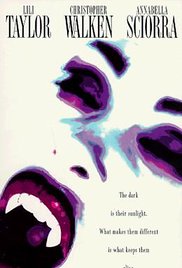
Day 3: The Addiction (1995).

Addiction

Abel Ferrara’s vampire film is a strange viewing experience, compelling and frustrating in equal measure. With its gloomy urban set pieces, stark black-and-white photography, hip-hop soundtrack, and a cast of rhetoric-spouting intellectuals, The Addiction feels like Bram Stoker by way of Noah Baumbach. Lili Taylor (one of my all-time favorites) stars as Kathleen Conklin, a graduate student who, early in the film, is attacked and bitten by a mysterious stranger. From that point onward the movie plays like a fever dream, riding the physical and emotional extremes of Kathleen’s transformation from likable Ph. D. candidate to insufferable narcissist/monster. For the most part, the film succeeds wildly. The story deftly appropriates vampire lore as an allegory for all manner of modern addictive behaviors. Subtle similarities between heroin addiction and vampirism are cleverly drawn: both require the penetration of flesh and an exchange of bodily fluids that leads to an altered or euphoric state in the user (addict) or the attacker (vampire). Of course, there is also an obvious sexual metaphor attached both to heroin addiction and vampirism, one that is also made manifest (and not by coincidence) through physical penetration and fluid exchange—a process that requires the use of phallic instruments (hypodermic needles for addicts) or dental anatomy (teeth or fangs for vampires) in order to attain completion. Okay, maybe some of this stuff isn’t so subtle, after all. But it is still immensely effective.

Kathleen’s academic pursuits are unpacked in a creative, thought-provoking manner that simultaneously illustrates her evolution as a killer and her de-evolution as a humanitarian. For example, early conversations between Kathleen and a classmate/friend named Jean (played by Edie Falco) suggest that the intense study of war atrocities has enhanced and sharpened Kathleen’s innate regard for the whole of humanity; she feels very deeply for those who have been victimized. However, after she is attacked and begins to change, it becomes apparent that the continued study of war atrocities has splintered Kathleen’s natural capacity for empathy or sympathy, perhaps even making her a more proficient predator. This portrayal of Good and Evil as two sides of the same coin is a recurring theme in The Addiction: Kathleen, the student of particularly violent atrocities, is inherently good. But when an atrocity is inflicted upon her, she steadily becomes more capable of evil. By becoming a vampire, Kathleen quite literally loses her humanity. In turn, vampires need to take human lives (or commit atrocities, if you will) in order to survive. And the continued survival of a vampire depends on the perversion of the natural world (or the perversion of all things Good). In other words, the sun nourishes human life but inflicts fiery death upon a vampire, who, unlike most of the natural world, thrives in the dark. (By the way, this ever-raging thematic battle between the forces of light and dark is also represented visually in the film’s the use of black-and-white photography.)

In the spirit of complete honesty and fairness, I will say that this film, though mostly excellent, does come with a ready supply of nits to be picked. By far my biggest problem with this movie is the dialogue. Consider a scene in a coffee house between Kathleen and one of her professors. After a prolonged silence, the professor asks if something is wrong. This is her response: “Silence has two aspects. One according to Sartre, the other to Max Picard. Why don’t you guess why I’m quiet?” The whole movie is like that—snotty, judgmental commentary delivered in disinterested monotone voices by pale, sunglass-clad self-proclaimed intellectuals. And that includes all of the vampires. Be prepared for a frenetic tirade performed by a vamped-out Christopher Walken, in which the myriad virtues to be found for newly transformed vampires within the drug-addled pages of William S. Burroughs’s Naked Lunch are extolled with the subtlety of a coked-up giraffe in church. It’s as if the film is saying: “Here’s an intelligent idea—let’s jam it into the movie any way we possibly can, even if it doesn’t make sense, even if it isn’t germane to the story, even if we have to use a tube of Vaseline and a sledgehammer to make it fit!”

Which brings me to another minor but annoying flaw on display in The Addiction: the characters constantly quote other people to make their own points. Whenever I see this in a movie or a TV show I’m reminded of something a creative writing professor of mine once said: “Simply quoting intelligent people does not mean that your characters are intelligent people.” She was right, and the characters in The Addiction spend way too much time playing the quotation game.

But other than these mostly forgivable quibbles, this is a fascinating, exciting, challenging movie that provides a truly unique filmic experience for the viewer. While this might not be what most casual movie fans and traditional vampire enthusiasts are looking for in a horror film, it is exactly what more discerning fans have been waiting for—a horror movie that is defined by substance rather than a need to pander to modern popular sensibilities. (For what it’s worth, casual fans who stick it out all the way to the end will have their patience rewarded with one of the greatest full-blown horror scenes of the ’90s.)

Day 4: Creepshow

Halloween Every Day (for a Month)

By Andrew Neil Cole

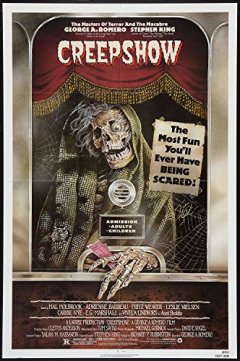
Day 4: Creepshow (1982). cree[

Every now and then I’ll hear or read something concerning the difference between a great horror movie and a great Halloween movie. The broad-strokes definition of a great Halloween movie is any horror movie that people look forward to watching around Halloween time. These movies are usually a little more fun and a little less intense, a little more focused on atmosphere and a little less focused on slaughter. Of course, the precise definition of what is and what is not a Halloween movie will change from person to person, but the overall point remains the same: It is possible for a horror movie to be great without being a great Halloween movie, and vice versa. For example, a friend of mine loves The Texas Chainsaw Massacre, but finds the film’s tone much too dark and ominous to be a great Halloween movie. At the same time, this same friend loves the outrageously silly fun of Fright Night (the original 1985 version, of course), but only feels like watching it in the month of October, when the nostalgia factor will be significantly amped up.

Creepshow, at least for me, works as both a great horror movie and a great Halloween movie. Written by Stephen King and directed by George A. Romero, the movie couldn’t have a better pedigree for pure horror, while the subject matter (a portmanteau-style homage to ’50s horror comics) clearly draws on the kind of nostalgia that makes Halloween (and Halloween movies) so much fun. The five short films that define the corpus of the anthology play like a walking tour of a horror-story museum: revenge from the beyond the grave, unstoppable terror from outer space, shambling corpses proving that love never dies, a ravenously wild creature in a crate, and cockroaches by the ton. The film plays out in a series of cleverly crafted, highly stylized vignettes that themselves resemble the panels of the great EC horror comics—canted angles, strikes of purple, blue, pink, and green light, a wraparound voodoo story that includes a skeletal creature leering through a boy’s bedroom window, and animated comic book-style introductions to each story.

For anyone who likes old-school horror tales, Creepshow works like gangbusters, even if, in my opinion, the final story (a cockroach infestation nightmare called “They’re Creeping Up on You), feels totally unnecessary. Also, I won’t bother blathering on about the outstanding cast, but I will say that it is refreshing to watch an entire anthology film in which none of the stories features sullen teens in peril or angst-ridden vampires.

Day 5: Them!

Halloween Every Day (for a Month)

By Andrew Neil Cole

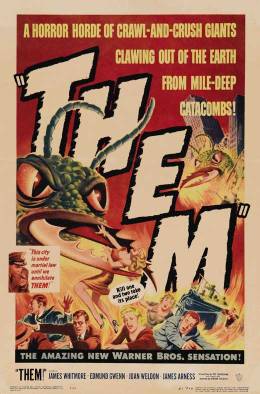
Day 5: Them! (1954). them-movie-poster-1954-1020544319

There exists, among horror fans and historians, a need to illuminate the ways in which the socioeconomic and political factors of a specific era have influenced the genre. This comes from an inherent need within those who love horror to legitimize the genre, make it appear more relevant and weighty to those who snootily dismiss the very idea that something meant to be scary can also be germane to a larger societal discussion. Unfortunately, this need to assign intrinsic cultural value to horror cinema often leads to some wild hypothesizing. For example, I agree that the zombies in Night of the Living Dead are more indelibly terrifying because they represent revolution in a time of social discord; however, I do not agree that the killer rabbits in Night of the Lepus (1972) are somehow scarier because, according to some, they symbolize the American people’s fear of government power run amuck in the wake of the Attica prison riot and the Kent State shootings. I mean, think about it: If you were trying to create a lasting, powerful metaphor for the government using violence against its own people to suppress individual thought and impose its own evil agenda, would you choose killer rabbits? I doubt it. Some horror films are just silly—or even stupid—and that’s the way it should be.

The one era that has had arguably the most obvious impact on the horror genre began when the end of World War II gave birth to the Cold War and all of its attendant hostilities and paranoia. Fear of atomic obliteration signified the inevitable dawn of mutant, giant monsters in the movies. In my opinion, the best of these atomic-age nightmares is Them!, the giant mutant atomic ant movie from 1954. As silly as this movie may seem at first blush (the exclamation point in the title certainly doesn’t instill in the viewer a sense of gravitas), the potential dangers of atomic energy are actually unpacked with great care, and the actors bring real life and much-needed urgency to characters that could have easily become genre clichés. James Whitmore is the local cop who first realizes the danger. Edmund Gwenn is the scientist called upon to solve the problem before the ants spread uncontrollably and kill us all! James Arness is the dashing, heroic G-man (a not-so-subtle reminder that the government employs its share of good guys). And Joan Weldon plays a scientist, who, while strikingly beautiful, is no screaming damsel in distress or wilting flower. No, she willingly plunges headfirst into the path of encroaching danger; moreover, she’s actually respected for her intellect, which is pretty rare for a female character in a horror film of this era. Of course, the ants look ridiculous—with their rubbery thoraxes and crooked mandibles in a state of constant shimmy—but, to be honest, even if this production had had access to the most amazing, groundbreaking, state-of-the-art special effects, we’re still talking about giant ants here. How cool could they possibly look?

Perhaps Them!’s crowning achievement is that it succeeds as a worthy and watchable giant-ant horror film despite the lack of believable giant ants—the rest of the movie is just that good. And, in the spirit of complete honesty, I have to admit to kind of loving the ants, no matter how cheesy.