Day 28: One Dark Night (1983)

Halloween Every Day (for a Month)

By Andrew Neil Cole

Day 28: One Dark Night (1983).              OneDarkNight
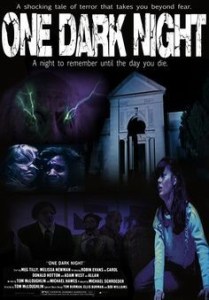
One Dark Night is a movie with an identity problem—but an identity problem that actually works in its favor. The film bears all the hallmarks of early-’80s horror but is also clearly inspired by the Gothic horror tradition. This cinematic schizophrenia is exemplified by a screenplay that revels in rather violent shifts in tone and style, from boardwalk bumper cars to ornate mausoleum corridors, to create a unique stylistic fusion that could be describes as … I don’t know … ’80s Gothic?

The story concerns a teen “good girl” who wants to join a clique of not-so-good girls called The Sisters. Before officially joining The Sisters, Julie (the “good girl”) has to spend a night alone in a mausoleum. Unbeknownst to Julie and The Sisters, a Russian occultist/telekinetically gifted psychopath was interred in that very mausoleum earlier that very day … so … horrific shenanigans are just bound to ensue. The primary characters are straightforward ’80s teen-horror stereotypes (the “good girl,” the bitchy/sexy antagonist, the snotty girls who blindly follow the bitchy/sexy girl, and the hunky jock boyfriend with a heart of gold) whose converging storylines play out in a setting steeped in the iconography of Gothic horror cinema (coffins, candles, shadowy corridors, well-tended cemetery grounds).

This juxtaposition of ’80s-style teen-horror imagery and Gothic horror imagery is also made evident in the film’s production design and sound design. The kinetic/sonic chaos and flashing, multicolored madness of an ’80s video arcade is complemented by the overt stillness of a somber funeral scene set amid a muted visual landscape populated by mourners respectfully clad in black. Likewise, screaming teens in a speeding car with the radio volume maxed-out counterpoises the quiet echoing of light footfalls on the percussive floor of a mausoleum hallway, which in turn amplifies the fear-induced, labored breathing of a solitary teen surrounded by—literally—the stillness of the grave.

It’s also worth mentioning that One Dark Night is reminiscent of both ’80s horror and Gothic horror in terms of adult content, or, in this case, the lack of adult content. Despite the inclusion of numerous ’80s horror tropes, including too many story and character cliché’s to enumerate here, One Dark Night is, unlike virtually all of its contemporaries, a mostly bloodless, nudity-free, totally sexless film. Even the use of profanity is ratcheted way, way down. (In one scene, the bitchy/sexy girl refers to someone as a “turkey.”) Even during the climactic final 20 minutes, when coffins start popping open and dead bodies become featured players, the film never turns ghastly. There are no decapitations or disembowelments; no arterial spurting, no protruding shards of exposed bone. Instead, the final horrific rampage features flickering candles, swirling spirals of smoke and dust, and a recurring, strangely ethereal pink light—all of which is distinctly (and intentionally) Gothic. And it all works relatively well.

While the film’s unconventional mix of contrasting styles suggests innovation, the story and the characters offer absolutely nothing new. The idea of forcing (character name here) to spend a night alone in (name of spooky location here) in order to (win a contest/appease a blackmailer/pass a rite of initiation) is a narrative construct that has been repeated ad nauseam and needs to be put down like a wounded animal. As for the characters … Well, let’s just say that One Dark Night trades in character types rather than actual characters. We have “good” characters that we are supposed to like and “bad” characters that we are supposed to dislike. Actually, there is one exception. One of the bitchy/sexy girl’s friends has a change of heart and decides not to participate in the tormenting of the film’s “good girl” protagonist. However, this change-of-heart character is also a bit of a horror cliché, and when this moment of reconsideration occurs it is in no way revelatory.

Nonetheless, One Dark Night is a solid, entertaining movie with a truly interesting visual style and a finale that should satisfy most true horror fans, even those who will likely be irritated by the film’s deliberate pacing and slowly evolving narrative.

Day 29: The Howling (1981)

Halloween Every Day (for a Month)

By Andrew Neil Cole

Day 29: The Howling (1981).          TheHowling

The vast majority of werewolf movies tell basically the same story: The main character is attacked by a werewolf but survives; the main character then slowly comes to realize that he or she is now a werewolf as well, a discovery that normally leads to the realization that they, too, have taken lives, which, in turn, leads to the pursuit of resolution—i.e. finding a way to break the werewolf curse and return to normal life, or, more likely, the death of the main character. Music swells. Credits roll. Blah, blah, blah …

This is not the case with Joe Dante’s The Howling. Released in 1981, this surprisingly tight, well-crafted werewolf thriller mercilessly skewers the irresponsible nature of the media, the impact of television on the culture, and the self-help/pop psychology movement of the early ’80s that elevated countless academic/celebrity blowhards to the status of “guru,” all while doling out generous portions of fur-and-fang-induced mayhem. Dee Wallace stars (and rocks!) as Karen White, a TV news anchor who is traumatized by a terrifying confrontation with a serial killer. Her therapist/self-help author of some renown ships her off to The Colony, a remote treatment facility comprised of a collection of rustic cabins beneath a dense canopy of forest foliage. But the woodsy charm of The Colony quickly turns menacing. This is where The Howling really starts to howl.

The Howling is funny and intense in equal measure. The film’s satirical edge is by no means subtle, but it is also never preachy or pedantic; there is no political axe to grind, no moral judgments to render. Above all else, The Howling always remembers that its primary function is to be fun. Every role is perfectly cast; there are even some undeniably smile-inducing casting choices, such as the one and only Slim Pickens as the local law man, and genre favorite (and Dante regular) Dick Miller as the obligatory bookstore owner with a fully stocked occult section and, as luck would have it, a tray of silver bullets on display near the cash register.

Of course, you can’t have a successful werewolf movie without memorable werewolves. Thank the movie gods for the work of F/X makeup genius Rob Bottin. Bottin’s werewolves perfectly combine the physical attributes of both man and wolf to create tall, lean, hairy, bipedal beasts that stand nearly nine feet tall. These werewolves are so much more detailed and intimidating than the traditional lap-dissolve wolf-man hybrid creations introduced in the ’40s,   and they are leagues ahead of the snarling balls of computer-generated fur with glowing eyes that Hollywood seems so found of today. These werewolves feel like actual characters, like the primal, animal versions of their human selves. And the film’s iconic transformation sequence—elevated by a soundtrack of snapping bones and popping cartilage—deserves a position of honor in the Werewolf Hall of Fame. However, the F/X do occasionally remind you that this film was released in 1981. One shot depicts an extremely cartoony animated werewolf baying at the moon while having sex. Another shot focuses on a collection of old-school stop-motion werewolves that look so out of place Dante tries to hide them in the final seconds of a scene-ending dissolve. To my way of thinking, these instances of dated F/X work only add to the film’s overall charm. After all, the film was released in 1981, so there’s no shame in actually looking like a film released in 1981, since capturing and preserving moments in time is what cinema does best.

The only real problem that I have with The Howling is its rampant fanboyism. We get a cameo from horror legend (and Dante’s former employer) Roger Corman, who pokes fun at his reputation as a cheapskate in a scene where he enters a phone booth and makes sure to check the coin return for any forgotten change before placing his call. There’s also a cameo from Forrest J. Ackerman, the science fiction world’s original fanboy and the man responsible for the legendary magazine Famous Monsters of Filmland. Dante’s camera lingers on good ole’ Forry as he casually strolls the aisles of Dick Miller’s bookstore toting a few copies of Famous Monsters, their covers clearly visible within the frame. And then there are the incessant wolf and werewolf references. Werewolf cartoons and movies play on TVs in the background. A copy of Allen Ginsberg’s poetry collection Howl and Other Poems is prominently displayed on a characters desk. And, of course, many of the characters are named after directors of prominent werewolf films. For a movie that boasts one of the most original werewolf stories ever, The Howling spends an absurd amount of time doffing its cap to the Ghosts of Werewolves Past. There’s just something about the combination of the clever, often socially critical storyline and Rob Bottin’s groundbreaking werewolf creations that just doesn’t quite jibe with all of the insider genre references and cutesy personal tributes.

That said, The Howling is still a terrific piece of filmmaking and easily one of the best werewolf movies ever made.


(A portion of this article is excerpted in an essay by the same author.)

Day 30: Sugar Hill (1974)

Halloween Every Day (for a Month)

By Andrew Neil Cole

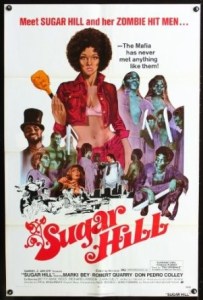
Day 30: Sugar Hill (1974).      SugarHill

In the 1950s, American International Pictures began making a name for itself as the premiere distributor of schlocky horror/sci-fi/creature features (like It Conquered the World and Invasion of the Saucer Men), rebellious teen films (like Dragstrip Girl and Rock All Night), and, of course, the inevitable combination of schlocky horror/sci-fi/creature features with rebellious teen films (like I Was a Teenage Werewolf and I Was a Teenage Frankenstein). Something similar occurred at AIP in the ’70s. Thanks in no small part to the throngs of fans descending upon drive-ins and grindhouses, the distributor enjoyed continued success with its line of outrageous schlock horror films, although now the films often came with heavy doses of ’70s-era psychosexual/weirdo vibes (films like The Incredible 2-Headed Transplant and A Lizard in a Woman’s Skin). By 1972 AIP had managed to locate and successfully mine a rich new vein of urban moviegoers by producing a slew of blaxploitation crime thrillers (like Black Caesar and Coffy). And so the continued popularity of AIP horror films and the rising popularity of AIP blaxploitation films led to the inevitable: the creation of the blaxploitation horror film.

When you consider the success of early blaxploitation horror films like Blacula (1972) and the sequel Scream, Blacula, Scream (1973) along with the continued success of gritty blaxploitation action films, particularly 1973’s Coffy, starring Pam Grier, it shouldn’t come as a surprise that AIP would make a movie like Sugar Hill, a film that attempts (and succeeds) to fuse all of the elements of blaxtoitaion action and crime cinema with the creature feature/horror elements that made the Blacula films successful. Being that Pam Grier’s star power was becoming undeniable, as was the ever-swelling fan enthusiasm for Coffy, it should also not come as a surprise that Sugar Hill is essentially Coffy with zombies. Both Coffy and Sugar Hill tell stories of strong, independent women taking the law into their own hands after a loved one is attacked by the criminal element in their respective cities, and both film titles refer to the street names by which the lead characters are known. The only major difference: While Pam Grier’s Coffy character seeks revenge through the use of traditional weaponry and street smarts, Marki Bey’s Sugar Hill character seeks the help of a voodoo overlord, Baron Samedi, to sic an unstoppable horde of flesh-eating zombies on the gangsters who killed her man and now want to take away her nightclub.

As an overall viewing experience, the influence of Coffy on Sugar Hill really doesn’t matter. Regardless of how it came to be, Sugar Hill still feels like a complete original. By combining a classic revenge thriller with a classic voodoo/zombie chiller, the film manages to create an atmosphere and vibe that is distinctly its own. Of course, like most zombie movies (and like just about all revenge thrillers, for that matter), the story, once properly set up, is quite predictable, and many of the characters are nothing more than by-the-numbers baddies or clueless friendly acquaintances. But, while so many similarly themed films grow tedious or even unwatchable, Sugar Hill is a blast from start to finish, providing a definitive example of the difference between simply following the formula and the formula done right.

Marki Bey is a strong, sexy, charismatic lead, whose toughness seems genuine and not at all like a caricature of a tough girl gone rogue. Mama Maitresse and Baron Samedi, the voodoo practitioners, are wonderful creations, blessed with heaping mounds of joyful charisma and ice-cold menace. And, finally, the zombies in this movie shamble, stalk, and steal every scene they’re in. Their eyes are bulging shiny orbs that create a haunting, lifeless stare. They are often draped in cobwebs and wear rusty chains and manacles beneath a layer of tattered clothing, a constant reminder to the audience that they are actually the resurrected corpses of slaves, adding a little extra historical and sociopolitical pop to the proceedings.

Sugar Hill’s blaxploitation pedigree may make it seem, to some, as a relic of the ’70s and nothing more. However, if the goal of a horror film is to make the world of make-believe believable, to create an escape from the mundane, day-to-day realities of life, and to tell a compelling story, then Sugar Hill is so much more than a relic—it’s timeless.

Day 31: Curse of the Demon (1957)

Halloween Every Day (for a Month)

By Andrew Neil Cole

Day 31: Curse of the Demon (1957).           CursePoster

(The following contains SPOILERS. You might not want to read beyond this point if you have not seen Curse of the Demon or Drag Me to Hell.)

Every time I watch Curse of the Demon I am struck by the same two things. The first is the numerous unmistakable similarities between this film and Sam Raimi’s Drag Me to Hell (2009), specifically in terms of story and structure. In both films the main character is cursed by someone who feels they’ve been wronged. In CotD, the main character is a world-renowned professor who is ultimately cursed by a Satanist who believes his reputation has been sullied by nonbelievers in the world of academia; while in DMtH our lead is a loan officer at a bank (her steady boyfriend is, not coincidentally, a professor) who is cursed by an elderly gypsy woman with a rotten set of chompers when she refuses the woman a mortgage extension. In both films, the actual curse consists of three days of psychological/supernatural torment, culminating in the victim’s death at the hands of an unstoppable demon. In both films, the victim unknowingly possesses a cursed object (a cursed parchment inscribed with a runic incantation in CotD; a cursed coat button in DMtH). Both films feature sequences in which the victims attend a séance intended to supernaturally ablate the curse … and in both films the séance fails, though for very different reasons. And, finally, both films execute their respective finales at train stations, where prominent characters are horrifically killed by a demon as a speeding train approaches—but here is also where the films differ. In CotD, our hero, Professor John Holden, escapes his horrible fate by returning the cursed parchment to the film’s satanic antagonist, who in turn suffers the demon’s wrath; however, Christine Brown, the bedeviled bank loan officer from DMtH is not so lucky. Her three days of torment conclude with her being literally dragged, kicking and screaming, to hell, right through the train tracks she believed would whisk her away to a better life, as her boyfriend looks on in abject horror.

While these two films are clearly ripe for comparison from a narrative standpoint, they couldn’t be less similar from a stylistic standpoint. It hardly needs to be stated that Sam Raimi’s film is the much more kinetic, visually daring, F/X-heavy cinematic experience, while Jacques Tourneur’s Curse is a moody, intentionally quiet film that distills many of its creepiest moments from its inherent stillness. In any case, watching these two distinctly different stylistic interpretations of basically the same material serves as proof that a good story, regardless of how it is told, is without question the foundation on which all successful movies are built.

Oh, yeah … The second thing that always strikes me when I watch Curse of the Demon is just how good Curse of the Demon really is. It’s not going to scare anyone into cardiac arrest or test the structural integrity of your Fruit of the Looms. And, okay, maybe some people will find the rubber demon suit a little hokey. But something about it just works. It’s a movie that feels like a campfire tale, like a nightmare projected in glorious black and white; it’s a movie that exists in a world of cobwebs and starless nights, where people conjure demons to do their bidding and no one’s soul is safe. So … rubber suit or not, Curse of the Demon feels like the perfect way for a film fan to end a Halloween night. It also feels like the perfect way to end my month-long exploration of the world of horror cinema.

Day 2: Hausu (House) 1977

Halloween Every Day (for a month)

By Andrew Neil Cole

Day 2: Hausu (House) (1977).    houseposter_500

Hausu is a Japanese horror film that tells the relatively pedestrian tale of seven teen girls spending their vacation in a creepy old house; however, there’s probably never been a haunted house movie quite like this. This is an outrageous, hyper-stylized, unpredictable little horror gem that viewers will either love or hate. There is no middle ground.

Sometimes the film’s style can be overwhelming: animation, stop-motion animation, black-and-white photography, sepia-tones, pink tones (yes, pink), lap dissolves, matte paintings, etc … Every single frame of this film seems to be screaming YOU ARE WATCHING A MOVIE! The constant visual fireworks are complemented (if you can call it that) by an intrusive musical score that almost never stops. But if you can see through the film’s overbearingly cartoony style, Hausu delivers on a rather audacious conceit, in that the film works as both a horror film and a commentary on horror tropes and clichés (and it does this decades before films like Scream and The Cabin in the Woods would mine similar thematic territory). For example, all of the principal characters are literally named after character types, as if their behavior has been genetically predestined. I’m not kidding. The attractive girl is named Gorgeous. The girl with an overactive imagination is named Fantasy. The studious, bespectacled girl is named Prof. The hearty girl who likes to eat is named Mac. The music-lover/pianist is named Melody. The ridiculously companionable, eager-to-please girl is named Sweet. And, my personal favorite, the martial arts enthusiast is named Kung Fu. Subtlety is clearly not this film’s forte. Nonetheless, Hausu is a movie experience that really feels like an experience. This is a movie that, once seen, must be talked about with anyone who will listen.

Much has been made of the film’s impact on future filmmakers, specifically Sam Raimi and his Evil Dead films, so I won’t bother to stir that pot again. Nor will I bother to comment on certain sexist aspects of the movie that have confounded and angered so many viewers over the years. It should be remembered that this movie, like any movie, is a product of its time and place. It is what it is and nothing more. (Although, to modern sensibilities, it is pretty sexist.)

Intro/Day 1: The Cabin in the Woods (2012)

Halloween Every Day (for a Month)

By Andrew Neil Cole

Introduction:

Like a lot of cinephiles, I believe that Halloween is less about trick-or-treating, costumes, candy, and parties than it is about reclaiming a small piece of yesteryear through watching (or more likely re-watching) our favorite horror movies. In fact, Halloween is, for horror fans, much more than one single day denoted by a grinning jack-o’-lantern in the final calendar square for the month of October. No, Halloween begins on the first day of October and doesn’t end until the sun rises on the first day of November. That gives us 31 glorious days to bask in the warm, nostalgic glow that can only be created (or recreated) by our favorite cinematic boogeymen. After all, what better way to feel like a kid again then to relive what it felt like the first time you saw a movie that made you sleep with the lights on and the covers pulled tightly over your head?

So, in the true spirit of Halloween (as defined by us movie fans), I, your Humble Heckler, have decided to take on a challenge: I will watch one horror movie every day throughout the month of October and faithfully record my experiences here. The idea to do this comes from an assignment I was once given as a film student in college. A professor I greatly respected required his students to watch two films a week and simply respond to them in a diary of sorts. What did we like about each film? What didn’t we like? Did a certain film remind us of other films? If so, how?  He was looking for gut reactions—but informed, well-considered gut reactions. The assignment forced me to get out of my head, set all academic pretense aside, and simply let a movie happen to me. As a result, I found greatness in movies that had been written off by the critical community, and I found that I didn’t particularly care for certain films and filmmakers that had been universally adored. It was a great lesson. Therefore, the movies I choose to view will not necessarily be my favorites. My goal will not be to watch specific horror movies but to have a larger, more complete experience with the horror genre as a whole by watching a lot of movies in a relatively short period of time. I will not be making a “best of” list, nor will I be assigning films a rank or a grade of any kind. I’ll do my best to select a wide variety of horror types and classifications. I’ll also do my best to select movies from different eras and to avoid choosing too many obvious titles—there will be no Friday the 13th movies, no Scream movies, no Saw movies, and no sequels of any kind. What follows will not be a series of reviews but rather a collection of subject-specific responses, reflections, and musings.

Enough said. Let’s get started!

Day 1: The Cabin in the Woods (2012).  CabWoods

In the years following John Carpenter’s 1978 classic Halloween, the horror genre took a turn for the worse. In fact, it can be argued that Halloween represents the genre’s definitive line of demarcation, in that virtually every horror film since 1978 has an appreciable pre-Halloween or post-Halloween feel to it. After Carpenter proved that a low-budget slasher flick could make untold millions for its producers, businessmen with absolutely no interest in film, let alone horror, saw an opportunity to cash in and pounced like carrion birds on a fresh carcass. To this assemblage of heartless capitalists, an investment of a few hundred thousand could mean tens of millions in profit, and soon the market was flooded with Halloween wannabes. Every weekend a new masked assailant stalked a collection of sexually promiscuous teens at a theater near you. Interesting, fleshed-out characters and strong, driving suspense narratives were instantly jettisoned and replaced by archetypal caricatures heedlessly meandering through a loose collection of slaughter scenarios. The horror genre would never be the same.

With The Cabin in the Woods, director Drew Goddard and co-writer/producer Joss Whedon seem to be pointing an accusatory finger directly at the kind of filmmaking that occurred on the post-Halloween side of that line of demarcation. Genre conventions are both openly mocked yet necessary to the film’s overall structure. Torture porn and the excessive use of graphic violence as entertainment in horror cinema are clearly criticized while the film dumps buckets of blood and goo on everyone and everything in sight. Characters are written to satirize the preordained fates of modern horror film caricatures (the dumb blonde, the jock, the virgin, etc …), and yet, in the end, these characters live and/or die by the same rules as the lazy, clichéd, cardboard characters they were created to lampoon—and all of this is intentional. It is also a lot of fun. I’m glad I decided to begin this month-long exploration of the horror genre with a movie that is clearly conducting an exploration of its own.