Don’t Breathe

Don’t Breathe; Moreover, Don’t Buy a Ticket to This Dreck

Reviewed by Doris Goldfarb for HumbleHeckler.com.

(Editor’s note: Film critic Doris Goldfarb is an octogenarian who rarely sees modern films. Keep this mind when reading the following review.)

Don’t even get me started! Oy gevalt, what a terrible movie Don’t Breathe is. I mean, my God, with the violence and the potty mouth … What the hell happened to movies anyway? This one is even worse than that disaster with the foul-mouthed cartoon hot dog. Ah, the whole thing’s a shanda, I tell ya’. If my Irving—God rest his soul—had seen this movie, he would’ve plotzed, hand to God. Now, I may just be a yenta who loves to kvetch, but I’m sorry, this movie caused me great tsoriss, and I want restitution. Thank God I didn’t have to pay for my ticket. But thirteen dollars for popcorn and a Coke! Thirteen dollars it cost, hand to God. For a nosh? Are you kidding? What am I, made of gelt? Ah, the whole system’s fercockt.

So, anyway, Don’t Breathe tells the story of a troubled shiksa named Rocky (what a pretty name for a girl, am I right?) whose parents neglect her and her baby sister. So now Rocky wants to run away with her sister, but she needs money. By the way, what is it with these young girls today? Rocky dresses like a real nafka, always with the shirts that expose her pupik and the tight pants that highlight the roundness of her tuches. And don’t even get me started on the tattoos. Hand to God, these girls today look like walking comic strips. These little pishers should show off their healthy skin while they have it, not hide it beneath a layer of vulgar graffiti hastily carved into their hides by a bunch of derelicts with electric needles. But I digress.

In order to get the money she needs to run away, Rocky commiserates with her boyfriend, a real shmegegge named—get this—Money. Anyway, Money’s brilliant idea is to break into the house of a blind man who, rumor has it, has a safe just waiting to be burgled. So, with the help of Money’s friend Alex (a total schlemiel, hand to God), Rocky and Money set out to steal their fortune. One problem: the broken-down blind man they’re supposed to steal from is no shmendrick. He may be old and blind, but he’s tough as balls and steady as a moyl at the moment of truth. Soon these ungrateful little bastards are running for their pathetic little lives from this blind gonif with a pair of balls like a Holstein bull and the shvantz of a Triple Crown winner. Sure he may be a violent psychopath, but he doesn’t take crap from teens and he doesn’t sweat the small stuff, and that’s a nice way to live. Good for him.

So, anyway, there’s really no reason for anyone to sit through this whole megillah. It’s really nothing but potty-mouthed kids and violence, and I can see plenty of that any day of the week on the D train, and for free. Bottom line, Don’t Breathe stinks like my friend Gerda’s water closet after a brisket-and-beets lunch from Katz Deli—you know, the one on 53rd across from that place that makes all the pies. Anyway, my point is, don’t bother wasting your time and your money on Don’t Breathe. Just thinking about this movie makes me grepse.

I give Don’t Breathe zero stars, and may it bring shame to those who aided in its creation.

(Don’t Breathe is rated R for just horrible language and some of the most ridiculous violence I’ve seen. Is this really the kind of thing people find entertaining? If so, it’s time for me shuffle off this mortal coil and be with my Irving, hand to God.)

Lights Out

Lights Out: A Scary Movie for People Who Suck

Reviewed by Shirley Franks for TheHumbleHeckler.com

(Editor’s note: Film critic Shirley Franks is an insanely busy soccer mom who hasn’t had a vacation in more than three years.)

Lights Out is a sometimes-clever, often-spooky horror film that absolutely drips with atmosphere. It’s the kind of shriek-fest that I would’ve loved 15 years ago, back in those halcyon days before I met my ass-bag husband and started pumping out ungrateful children by the bucket load. However, now that life has crapped on my dreams, blackened my heart, and shriveled my once-beautiful body, I find this movie endlessly annoying and relentlessly un-scary.
The story of Lights Out concerns a mysterious ghost-lady with Medusa hair and terrible posture who appears in the dark and disappears in the light. Oooh, I’m sooooooo scared! Shadowy ghost bitches aren’t scary … Five kids and 1 bathroom—now that’s scary. The appearance of varicose veins at 35—now that’s scary. Working 40 hours a week reviewing idiotic movies aimed at mouth-breathing teenagers, only to come home to a filthy house where I’m greeted by a sea of dirt-smudged faces screaming, “What’s for dinner?”—now that’s scary.

Teresa Palmer stars as the film’s sweet little cutie, who always looks daisy-fresh and is decades from worrying about stretch marks and episiotomies. So, basically … UP YOURS, TERESA! Enjoy that tight body and that silky-smooth skin while you can, sweetheart, because one day—maybe even soon—you’re gonna wake up in a bed filled with potato chip crumbs, next to a snoring, wheezing, ass clown that tricked you into getting married and then effectively stole every ounce of your youth, beauty, and zest for life, leaving you a soulless husk with prematurely gray hair and the disposition of a demon in church.

About 25 minutes into this obnoxious teen spookshow, I realized that I was still wearing my slippers and a pair of sweatpants dotted with scores of oozy, drippy stains whose origins are as mysterious and frightening as the identity of Jack the Ripper. Not to mention the fact that my ass-bag husband (in fact, let’s just refer to him as Ass Bag from here on out) forgot to fill the station wagon with gas, so I basically coasted to my critics’ screening of this film on fumes. Thanks, Ass Bag. Love Ya’. Oh, and I haven’t slept more than two hours straight in about six months. And I’m supposed to find this movie scary? Really? Give me a freakin’ break, Hollywood!

The only truly positive thing I can say about Lights Out is that I fell asleep for about a third of the film and woke up feeling more refreshed than I’ve felt in weeks. Not refreshed enough to recommend this garbage movie, mind you, but refreshed nonetheless. So, in conclusion, if you’re under 40, single, and childless, I’m just certain you’ll love Lights Out. Why the hell wouldn’t you? Life is a parade for you people. Every movie is a celebration. Every breath is a joy. You people make me sick. So, go ahead, see Lights Out and have a ball—and then choke on it.

I give Lights Out one stink-filled diaper out of four and every ounce of bile my liver can produce.

(Lights Out is rated PG-13 for “adult” language and “adult” situations … As if these people have any idea what it means to be an adult. It also contains prancing nubile bodies, the overt flaunting of youth, and the potential to induce rage in anyone with a pulse and half a brain.)

The Purge: Election Year

The Purge: Election Year: Absolutely the Greatest Movie Ever

Reviewed by Marcus Wells for DecimalPointless and HumbleHeckler.com.

(Editor’s note: Film critic Marcus Wells is an insufferably sarcastic man whose The_Purge_Election_Yearfather donates a lot of money to DecimalPointless.)
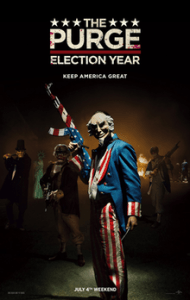
I was soooooo thrilled when I heard there was going to be another Purge film. Who wouldn’t be? After all, how could any cinephile possibly resist the opportunity to sit through another 105 minutes of completely gratuitous violence, infantile dialogue, and shot after ever-loving shot of psychos in stupid masks brandishing weapons as they cock their heads to one side in an attempt to appear more menacing? Not me. That’s for sure. And that brilliant storyline—you know the one. The one where all crime is legal for one full night. Genius!!! A story like this is in no way gimmicky or stupid at all, and it clearly possesses the narrative heft to accommodate multiple sequels. I wasn’t surprised at all to learn that Michael Bay—the creative mastermind behind Transformer and Bad Boys—is one of the producers of this masterpiece. And let’s not forget to give a shout-out to everybody at Platinum Dunes, the production company that just never ever stops innovating and creating original, groundbreaking movies. Let’s see … so far this collection of Rhodes scholars has produced such original classics as the remake of Friday the 13th, the remake of A Nightmare on Elm Street, the remake of Carrie, the remake of The Texas Chainsaw Massacre, and Ouija, a movie based on a board game from the good folks at Hasbro. So, with this group of cinematic/storytelling pioneers in charge, there’s just no way that The Purge: Election Year could be anything other than an all-time champ of a movie. Right?

Well, there’s no need to worry. I’m here to tell ya’ that this movie is—and I say this without hyperbole—the greatest, most important work of art ever rendered by any living organism in any solar system since the Big Bang started this whole crazy mess. This time around, the story turns on a senator whose entire family was killed during a previous Purge. Anyway, the senator is now running for president, and the largest plank in her platform just happens to be doing away with the annual Purge. But guess what? Some people don’t like her. Bet ya’ didn’t see that mind-blowing twist coming.

From that point onward, we are treated (and, man do I mean treated) to a dystopian nightmare of extreme violence that just doesn’t ever seem to end. And when the credits do finally roll, we walk out of the theater feeling refreshed and alive, secure in the belief that all people are psychopaths who relish every opportunity to inflict violence upon those who can’t protect themselves, and for nothing more than shits and giggles and financial gain. And isn’t that the perfect message to convey to audiences in these times of political divisiveness, overt bigotry, and fear. You bet it is! Nice job, Platinum Dunes. You’re a real class act!

I give The Purge: Election Year an A+++, and I can’t wait to see who’ll be senselessly slaughtered during next year’s Purge. Just terrific!

(The Purge: Election Year is rated R, but, for the life of me, I can’t understand why. This film should be seen—and celebrated—by people of all ages. It should be shown in grade schools and taught in film schools. Simply put, we are a better species for this film’s existence. So take the whole family and have a ball. I’m sure you won’t regret it.)

The Shallows

The Shallows: A Movie That’s Like … Whatever

Reviewed by Janelle Palmer for TheHumbleHeckler.com.

(Editor’s note: Janelle Palmer, a 17-year-old high school senior, is filling in for her mother, Janette, one of our resident film critics, who is currently recovering from rhinoplasty.)

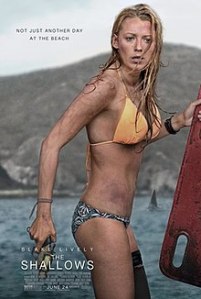
Okay, so, like, The Shallows is this big, like, shark movie or whatever. Blake Lively plays this super-smart girl who’s all, “I wanna be a doctor someday,” or something. She’s super annoying, but I’d kill for her stomach—OMG, have you seen that thing. Flat as one of those ironing board thingies I see my mom using. BTDubs, my mom always smokes when she’s ironing, and she thinks I don’t know about it, but it’s like—hello, I can totally smell your gross ciggies. You’re not fooling anyone. Anyway, Blake Lively (hate her!) decides to go out on the ocean to, like, surf and get a tan and stuff. Oh, I almost forgot that Blake Lively, in real life, is married to Deadpool, so that’s pretty cool, but I still haaaaate her.

So, anyway, Blake Lively goes on her board thingy and starts, like, really surfing those waves. Then my phone started vibrating (I set it to vibrate cuz I’m, like, courteous as balls). It was my friend Kara, whose tan is so completely out of control it’s insane. So, Kara tells me that she’s going shopping and asks me to come with, and I’m all “I can’t. I have to watch this stupid shark movie so my mom won’t, like, get fired or something.” And then Kara’s all, “That blows.” And then I’m all, “I know, right? It’s not my fault you decided to get a nose job and flake out on your work.” So then I went to get a Diet Coke, and that skeevy kid Jeremy was working at the food place. He was looking right at my nips, not even trying to hide it. So I said, “The theater’s cold, okay, Jeremy. Act like you’ve seen nips before, loser.”

When I got back to my cold-ass seat, Blake Lively was freaking out about some giant-ass shark. I don’t know for sure, but I think she pissed it off while she was surfing, and I’m pretty sure sharks don’t like that. So then the movie is all about the shark beefing with Blake Lively. They go back and forth. Blake wins some, the shark wins some … I don’t know, I guess some of it wasn’t too bad. That skank Melissa from English class was sitting two rows ahead of me, and she seemed to like it pretty well. Maybe you have to be a skank to really like this movie.

I don’t really like sharks. They’re stupid and ugly and it’s like, “do something besides swimming and attacking Deadpool’s lady, already!” Since I don’t like sharks, there’s no reason why I should like shark movies. So I guess I should say that you probably shouldn’t see this movie … unless you’re completely skanky like Melissa or something. Although, it isn’t the worst movie. I mean, I didn’t bail or anything. I watched it all the way to the end, which I’ve been told I’m not supposed to spoil. Whatevs, it’s not such a special ending anyway. So, I guess I’ll just say that The Shallows is kinda bad, and I don’t recommend it. But, then again, my friend Tessa says it looks good and she wants to see it, and Tessa has super-good taste, so I don’t know. I guess I have no opinion.

I’ll give it 5 stars out of, like, 5 million. But I reserve the right to change my score after Tessa sees it and we talk about it.

(The Shallows is rated PG-13 for, like, scary shark stuff, bloody water, open wounds and stuff, and I think Blake Lively drops the F-bomb once or twice, but I don’t remember for sure or anything.)

Ghost of Dragstrip Hollow (1959)

Ghost of Dragstrip Hollow (1959) ghost-of-dragstrip-hollow-movie-poster-1959-1020174212

  By Andrew Neil Cole

     Like so many great B-movie classics, Ghost of Dragstrip Hollow, a teen hot-rodder horror-comedy, regales its audience with a tale that leaves any sense of narrative logic in its dust-speckled rearview mirror right from the moment it begins. The film starts with a drag race between two seemingly rebellious ’50s teen gals. These crazy hellcats zip haphazardly through the rear-projected streets of Los Angeles, their dazzling speed the result of a primitive filmmaking technique called undercranking (which is achieved by filming fewer frames per second to create the illusion of speed). The cops snag one of the racers, but the other, Lois, the film’s lead, gets away. This, by the way, is the film’s first and last drag race, which is strange for a film about drag-racing teens called Ghost of Dragstrip Hollow. Anyhoo … Lois returns to her hot-rod club’s hangout to find a middle-aged writer interviewing her fellow hot-rodders for an article of some sort, to be published … somewhere … sometime in the not-too-distant future … or something (details really don’t matter in this movie). So, anyway … for some reason Lois’s hot-rod club is about to be kicked out of their usual hangout. The rest of the movie documents the indescribably bizarre confluence of events that leads to the gang finding a new place to make their official hang.

The movie is so slipshod in its construction, so baffling in its lack of coherence, so ultimately nonsensical that it must be seen to be believed. That said, it’s also infectiously silly and undeniably fun. Part of the fun is trying to figure out exactly what movie-going demographic the good folks at American International Pictures had in mind as their target audience for this lemon. For starters, the rebellious teens aren’t rebellious at all. They dress conservatively, respect their parents and all adult authority figures, and belong to hot-rod clubs that disallow rumbling with rival clubs. There is even a scene in which Lois’s sort-of boyfriend talks her into confessing a recent lapse in ladylike behavior to her parents. How rebellious! And, for the record, the “horror” portion of the film doesn’t kick in for almost 45 minutes; this is important because the film is only 65 minutes long. So … we have a drag racing film with only one drag race, a horror film in which horror is an afterthought, and a teen-angst film in which the teens are as docile and contented as Stepford wives after a tray of hash brownies. So … what the hell, man?

Here are a few things we know for sure, even though they make little or no sense. We know that Lois’s father wants Lois to be on her best behavior because a client of his—an old bag of bones named Anastasia Abernathy—is coming to stay with them for a couple of weeks, a scenario which raises some obvious questions: What the hell does Lois’s father do for a living? What occupation forces you to open your home to clients for weeks at a time? And what does that say about these “clients”? None of this is ever explained. At all. Not a hint. Oh, and by the way, Anastasia has a wise-cracking parrot named Alfonso, whose vocabulary would be the envy of many college students. Also, we know that teens love rock music and dancing. They dance at their hangout to a song called “Geronimo” performed by a band that frequently fires pistols into the air as they play. We hear this song again—in its entirety (even the gunshots)—during a party at Lois’s house, which is chaperoned by Lois’s parents, the middle-aged writer, and, of course, Anastasia Abernathy. We also know that Anastasia used to live in a haunted house that she decides might be the perfect place for Lois’s club to use as its new hangout. Oh, and we also know that one of Lois’s fellow club members has invented a sentient car, complete with a soul and the ability to talk, which he unveils during a monster-themed party at the haunted house … a party chaperoned by the middle-aged writer and, of course, Anastasia Abernathy … a party in which there is plenty of rock music and dancing and a completely inexplicable performance by ’50s rock singer Jimmie Maddin. These are facts. No kidding.

But unusual, confounding facts aside (or possibly because of them), the film is still a blast. By far the most entertaining aspect of Ghost of Dragstrip Hollow is the dialogue. This is one those hot-rod movies where the dialogue is so drenched in gear-head patois that it ultimately drowns every single opportunity for clever wordplay in a fetid pool of hacky euphemisms and forced catch phrases. Here are a few favorites: “He’s got static in his attic. Completely zonk.” “My draggin’ wagon’s lagin’. Might be the transmission.” “Take your flippers off me, seal!” In one scene, before kissing Lois goodnight, her sort-of boyfriend says, “I’d better go. It’s Labor Day tomorrow.” What the hell! Labor Day? And here’s how Lois explains a slumber party to her father: “After the he-cats go home, the she-cats nap.” Finally, during the party scene at Lois’s house, one of the teen boys (Bonzo) asks Lois’s mother to dance. When her response suggests that he shouldn’t feel obligated to ask her, he says, “It’s not a chop, kitten. I purr you. I’m not just makin’ sound waves. If you weren’t jacketed, I’d move in. Cuz you’re a dap—I mean a real dap.” You have to kind of respect any movie that shows this much disrespect for the English language. Hell, even this movie’s end credit suffers a linguistic indignity: THE ENDEST MAN. That’s really how it ends. (Isn’t that just the ginchiest!)

Ghost of Dragsrip Hollow is a good time—an endlessly silly, gleefully stupid, totally inoffensive good time for any B-movie enthusiast. So shut off your brain, pop open a cold one, and enjoy. If you’re too cynical to see the entertainment value in this movie, you must have static in your attic. You’re totally zonk, man. Totally zonk.

theedndestman

Halloween Every Day (for a Month) Day 1: Intro/The Cabin in the Woods

Halloween Every Day (for a Month)

By Andrew Neil Cole

Introduction:

Like a lot of cinephiles, I believe that Halloween is less about trick-or-treating, costumes, candy, and parties than it is about reclaiming a small piece of yesteryear through watching (or more likely re-watching) our favorite horror movies. In fact, Halloween is, for horror fans, much more than one single day denoted by a grinning jack-o’-lantern in the final calendar square for the month of October. No, Halloween begins on the first day of October and doesn’t end until the sun rises on the first day of November. That gives us 31 glorious days to bask in the warm, nostalgic glow that can only be created (or recreated) by our favorite cinematic boogeymen. After all, what better way to feel like a kid again then to relive what it felt like the first time you saw a movie that made you sleep with the lights on and the covers pulled tightly over your head?

So, in the true spirit of Halloween (as defined by us movie fans), I, your Humble Heckler, have decided to take on a challenge: I will watch one horror movie every day throughout the month of October and faithfully record my experiences here. The idea to do this comes from an assignment I was once given as a film student in college. A professor I greatly respected required his students to watch two films a week and simply respond to them in a diary of sorts. What did we like about each film? What didn’t we like? Did a certain film remind us of other films? If so, how?  He was looking for gut reactions—but informed, well-considered gut reactions. The assignment forced me to get out of my head, set all academic pretense aside, and simply let a movie happen to me. As a result, I found greatness in movies that had been written off by the critical community, and I found that I didn’t particularly care for certain films and filmmakers that had been universally adored. It was a great lesson. Therefore, the movies I choose to view will not necessarily be my favorites. My goal will not be to watch specific horror movies but to have a larger, more complete experience with the horror genre as a whole by watching a lot of movies in a relatively short period of time. I will not be making a “best of” list, nor will I be assigning films a rank or a grade of any kind. I’ll do my best to select a wide variety of horror types and classifications. I’ll also do my best to select movies from different eras and to avoid choosing too many obvious titles—there will be no Friday the 13th movies, no Scream movies, no Saw movies, and no sequels of any kind. What follows will not be a series of reviews but rather a collection of subject-specific responses, reflections, and musings.

Enough said. Let’s get started!

Day 1: The Cabin in the Woods (2012).  CabWoods

In the years following John Carpenter’s 1978 classic Halloween, the horror genre took a turn for the worse. In fact, it can be argued that Halloween represents the genre’s definitive line of demarcation, in that virtually every horror film since 1978 has an appreciable pre-Halloween or post-Halloween feel to it. After Carpenter proved that a low-budget slasher flick could make untold millions for its producers, businessmen with absolutely no interest in film, let alone horror, saw an opportunity to cash in and pounced like carrion birds on a fresh carcass. To this assemblage of heartless capitalists, an investment of a few hundred thousand could mean tens of millions in profit, and soon the market was flooded with Halloween wannabes. Every weekend a new masked assailant stalked a collection of sexually promiscuous teens at a theater near you. Interesting, fleshed-out characters and strong, driving suspense narratives were instantly jettisoned and replaced by archetypal caricatures heedlessly meandering through a loose collection of slaughter scenarios. The horror genre would never be the same.

With The Cabin in the Woods, director Drew Goddard and co-writer/producer Joss Whedon seem to be pointing an accusatory finger directly at the kind of filmmaking that occurred on the post-Halloween side of that line of demarcation. Genre conventions are both openly mocked yet necessary to the film’s overall structure. Torture porn and the excessive use of graphic violence as entertainment in horror cinema are clearly criticized while the film dumps buckets of blood and goo on everyone and everything in sight. Characters are written to satirize the preordained fates of modern horror film caricatures (the dumb blonde, the jock, the virgin, etc …), and yet, in the end, these characters live and/or die by the same rules as the lazy, clichéd, cardboard characters they were created to lampoon—and all of this is intentional. It is also a lot of fun. I’m glad I decided to begin this month-long exploration of the horror genre with a movie that is clearly conducting an exploration of its own.

Day 2: Hausu (House)

Halloween Every Day (for a month)

By Andrew Neil Cole

Day 2: Hausu (House) (1977).    houseposter_500

Hausu is a Japanese horror film that tells the relatively pedestrian tale of seven teen girls spending their vacation in a creepy old house; however, there’s probably never been a haunted house movie quite like this. This is an outrageous, hyper-stylized, unpredictable little horror gem that viewers will either love or hate. There is no middle ground.

Sometimes the film’s style can be overwhelming: animation, stop-motion animation, black-and-white photography, sepia-tones, pink tones (yes, pink), lap dissolves, matte paintings, etc … Every single frame of this film seems to be screaming YOU ARE WATCHING A MOVIE! The constant visual fireworks are complemented (if you can call it that) by an intrusive musical score that almost never stops. But if you can see through the film’s overbearingly cartoony style, Hausu delivers on a rather audacious conceit, in that the film works as both a horror film and a commentary on horror tropes and clichés (and it does this decades before films like Scream and The Cabin in the Woods would mine similar thematic territory). For example, all of the principal characters are literally named after character types, as if their behavior has been genetically predestined. I’m not kidding. The attractive girl is named Gorgeous. The girl with an overactive imagination is named Fantasy. The studious, bespectacled girl is named Prof. The hearty girl who likes to eat is named Mac. The music-lover/pianist is named Melody. The ridiculously companionable, eager-to-please girl is named Sweet. And, my personal favorite, the martial arts enthusiast is named Kung Fu. Subtlety is clearly not this film’s forte. Nonetheless, Hausu is a movie experience that really feels like an experience. This is a movie that, once seen, must be talked about with anyone who will listen.

Much has been made of the film’s impact on future filmmakers, specifically Sam Raimi and his Evil Dead films, so I won’t bother to stir that pot again. Nor will I bother to comment on certain sexist aspects of the movie that have confounded and angered so many viewers over the years. It should be remembered that this movie, like any movie, is a product of its time and place. It is what it is and nothing more. (Although, to modern sensibilities, it is pretty sexist.)

Day 3: The Addiction

Halloween Every Day (for a month)

By Andrew Neil Cole

Day 3: The Addiction (1995).

Addiction

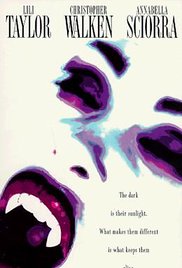
Abel Ferrara’s vampire film is a strange viewing experience, compelling and frustrating in equal measure. With its gloomy urban set pieces, stark black-and-white photography, hip-hop soundtrack, and a cast of rhetoric-spouting intellectuals, The Addiction feels like Bram Stoker by way of Noah Baumbach. Lili Taylor (one of my all-time favorites) stars as Kathleen Conklin, a graduate student who, early in the film, is attacked and bitten by a mysterious stranger. From that point onward the movie plays like a fever dream, riding the physical and emotional extremes of Kathleen’s transformation from likable Ph. D. candidate to insufferable narcissist/monster. For the most part, the film succeeds wildly. The story deftly appropriates vampire lore as an allegory for all manner of modern addictive behaviors. Subtle similarities between heroin addiction and vampirism are cleverly drawn: both require the penetration of flesh and an exchange of bodily fluids that leads to an altered or euphoric state in the user (addict) or the attacker (vampire). Of course, there is also an obvious sexual metaphor attached both to heroin addiction and vampirism, one that is also made manifest (and not by coincidence) through physical penetration and fluid exchange—a process that requires the use of phallic instruments (hypodermic needles for addicts) or dental anatomy (teeth or fangs for vampires) in order to attain completion. Okay, maybe some of this stuff isn’t so subtle, after all. But it is still immensely effective.

Kathleen’s academic pursuits are unpacked in a creative, thought-provoking manner that simultaneously illustrates her evolution as a killer and her de-evolution as a humanitarian. For example, early conversations between Kathleen and a classmate/friend named Jean (played by Edie Falco) suggest that the intense study of war atrocities has enhanced and sharpened Kathleen’s innate regard for the whole of humanity; she feels very deeply for those who have been victimized. However, after she is attacked and begins to change, it becomes apparent that the continued study of war atrocities has splintered Kathleen’s natural capacity for empathy or sympathy, perhaps even making her a more proficient predator. This portrayal of Good and Evil as two sides of the same coin is a recurring theme in The Addiction: Kathleen, the student of particularly violent atrocities, is inherently good. But when an atrocity is inflicted upon her, she steadily becomes more capable of evil. By becoming a vampire, Kathleen quite literally loses her humanity. In turn, vampires need to take human lives (or commit atrocities, if you will) in order to survive. And the continued survival of a vampire depends on the perversion of the natural world (or the perversion of all things Good). In other words, the sun nourishes human life but inflicts fiery death upon a vampire, who, unlike most of the natural world, thrives in the dark. (By the way, this ever-raging thematic battle between the forces of light and dark is also represented visually in the film’s the use of black-and-white photography.)

In the spirit of complete honesty and fairness, I will say that this film, though mostly excellent, does come with a ready supply of nits to be picked. By far my biggest problem with this movie is the dialogue. Consider a scene in a coffee house between Kathleen and one of her professors. After a prolonged silence, the professor asks if something is wrong. This is her response: “Silence has two aspects. One according to Sartre, the other to Max Picard. Why don’t you guess why I’m quiet?” The whole movie is like that—snotty, judgmental commentary delivered in disinterested monotone voices by pale, sunglass-clad self-proclaimed intellectuals. And that includes all of the vampires. Be prepared for a frenetic tirade performed by a vamped-out Christopher Walken, in which the myriad virtues to be found for newly transformed vampires within the drug-addled pages of William S. Burroughs’s Naked Lunch are extolled with the subtlety of a coked-up giraffe in church. It’s as if the film is saying: “Here’s an intelligent idea—let’s jam it into the movie any way we possibly can, even if it doesn’t make sense, even if it isn’t germane to the story, even if we have to use a tube of Vaseline and a sledgehammer to make it fit!”

Which brings me to another minor but annoying flaw on display in The Addiction: the characters constantly quote other people to make their own points. Whenever I see this in a movie or a TV show I’m reminded of something a creative writing professor of mine once said: “Simply quoting intelligent people does not mean that your characters are intelligent people.” She was right, and the characters in The Addiction spend way too much time playing the quotation game.

But other than these mostly forgivable quibbles, this is a fascinating, exciting, challenging movie that provides a truly unique filmic experience for the viewer. While this might not be what most casual movie fans and traditional vampire enthusiasts are looking for in a horror film, it is exactly what more discerning fans have been waiting for—a horror movie that is defined by substance rather than a need to pander to modern popular sensibilities. (For what it’s worth, casual fans who stick it out all the way to the end will have their patience rewarded with one of the greatest full-blown horror scenes of the ’90s.)

Day 4: Creepshow

Halloween Every Day (for a Month)

By Andrew Neil Cole

Day 4: Creepshow (1982). cree[

Every now and then I’ll hear or read something concerning the difference between a great horror movie and a great Halloween movie. The broad-strokes definition of a great Halloween movie is any horror movie that people look forward to watching around Halloween time. These movies are usually a little more fun and a little less intense, a little more focused on atmosphere and a little less focused on slaughter. Of course, the precise definition of what is and what is not a Halloween movie will change from person to person, but the overall point remains the same: It is possible for a horror movie to be great without being a great Halloween movie, and vice versa. For example, a friend of mine loves The Texas Chainsaw Massacre, but finds the film’s tone much too dark and ominous to be a great Halloween movie. At the same time, this same friend loves the outrageously silly fun of Fright Night (the original 1985 version, of course), but only feels like watching it in the month of October, when the nostalgia factor will be significantly amped up.

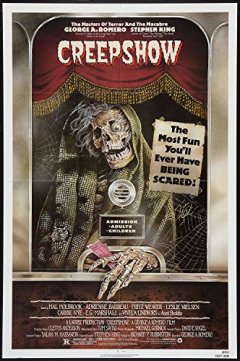
Creepshow, at least for me, works as both a great horror movie and a great Halloween movie. Written by Stephen King and directed by George A. Romero, the movie couldn’t have a better pedigree for pure horror, while the subject matter (a portmanteau-style homage to ’50s horror comics) clearly draws on the kind of nostalgia that makes Halloween (and Halloween movies) so much fun. The five short films that define the corpus of the anthology play like a walking tour of a horror-story museum: revenge from the beyond the grave, unstoppable terror from outer space, shambling corpses proving that love never dies, a ravenously wild creature in a crate, and cockroaches by the ton. The film plays out in a series of cleverly crafted, highly stylized vignettes that themselves resemble the panels of the great EC horror comics—canted angles, strikes of purple, blue, pink, and green light, a wraparound voodoo story that includes a skeletal creature leering through a boy’s bedroom window, and animated comic book-style introductions to each story.

For anyone who likes old-school horror tales, Creepshow works like gangbusters, even if, in my opinion, the final story (a cockroach infestation nightmare called “They’re Creeping Up on You), feels totally unnecessary. Also, I won’t bother blathering on about the outstanding cast, but I will say that it is refreshing to watch an entire anthology film in which none of the stories features sullen teens in peril or angst-ridden vampires.