Day 29: The Howling (1981)

Halloween Every Day (for a Month)

By Andrew Neil Cole

Day 29: The Howling (1981).          TheHowling

The vast majority of werewolf movies tell basically the same story: The main character is attacked by a werewolf but survives; the main character then slowly comes to realize that he or she is now a werewolf as well, a discovery that normally leads to the realization that they, too, have taken lives, which, in turn, leads to the pursuit of resolution—i.e. finding a way to break the werewolf curse and return to normal life, or, more likely, the death of the main character. Music swells. Credits roll. Blah, blah, blah …

This is not the case with Joe Dante’s The Howling. Released in 1981, this surprisingly tight, well-crafted werewolf thriller mercilessly skewers the irresponsible nature of the media, the impact of television on the culture, and the self-help/pop psychology movement of the early ’80s that elevated countless academic/celebrity blowhards to the status of “guru,” all while doling out generous portions of fur-and-fang-induced mayhem. Dee Wallace stars (and rocks!) as Karen White, a TV news anchor who is traumatized by a terrifying confrontation with a serial killer. Her therapist/self-help author of some renown ships her off to The Colony, a remote treatment facility comprised of a collection of rustic cabins beneath a dense canopy of forest foliage. But the woodsy charm of The Colony quickly turns menacing. This is where The Howling really starts to howl.

The Howling is funny and intense in equal measure. The film’s satirical edge is by no means subtle, but it is also never preachy or pedantic; there is no political axe to grind, no moral judgments to render. Above all else, The Howling always remembers that its primary function is to be fun. Every role is perfectly cast; there are even some undeniably smile-inducing casting choices, such as the one and only Slim Pickens as the local law man, and genre favorite (and Dante regular) Dick Miller as the obligatory bookstore owner with a fully stocked occult section and, as luck would have it, a tray of silver bullets on display near the cash register.

Of course, you can’t have a successful werewolf movie without memorable werewolves. Thank the movie gods for the work of F/X makeup genius Rob Bottin. Bottin’s werewolves perfectly combine the physical attributes of both man and wolf to create tall, lean, hairy, bipedal beasts that stand nearly nine feet tall. These werewolves are so much more detailed and intimidating than the traditional lap-dissolve wolf-man hybrid creations introduced in the ’40s,   and they are leagues ahead of the snarling balls of computer-generated fur with glowing eyes that Hollywood seems so found of today. These werewolves feel like actual characters, like the primal, animal versions of their human selves. And the film’s iconic transformation sequence—elevated by a soundtrack of snapping bones and popping cartilage—deserves a position of honor in the Werewolf Hall of Fame. However, the F/X do occasionally remind you that this film was released in 1981. One shot depicts an extremely cartoony animated werewolf baying at the moon while having sex. Another shot focuses on a collection of old-school stop-motion werewolves that look so out of place Dante tries to hide them in the final seconds of a scene-ending dissolve. To my way of thinking, these instances of dated F/X work only add to the film’s overall charm. After all, the film was released in 1981, so there’s no shame in actually looking like a film released in 1981, since capturing and preserving moments in time is what cinema does best.

The only real problem that I have with The Howling is its rampant fanboyism. We get a cameo from horror legend (and Dante’s former employer) Roger Corman, who pokes fun at his reputation as a cheapskate in a scene where he enters a phone booth and makes sure to check the coin return for any forgotten change before placing his call. There’s also a cameo from Forrest J. Ackerman, the science fiction world’s original fanboy and the man responsible for the legendary magazine Famous Monsters of Filmland. Dante’s camera lingers on good ole’ Forry as he casually strolls the aisles of Dick Miller’s bookstore toting a few copies of Famous Monsters, their covers clearly visible within the frame. And then there are the incessant wolf and werewolf references. Werewolf cartoons and movies play on TVs in the background. A copy of Allen Ginsberg’s poetry collection Howl and Other Poems is prominently displayed on a characters desk. And, of course, many of the characters are named after directors of prominent werewolf films. For a movie that boasts one of the most original werewolf stories ever, The Howling spends an absurd amount of time doffing its cap to the Ghosts of Werewolves Past. There’s just something about the combination of the clever, often socially critical storyline and Rob Bottin’s groundbreaking werewolf creations that just doesn’t quite jibe with all of the insider genre references and cutesy personal tributes.

That said, The Howling is still a terrific piece of filmmaking and easily one of the best werewolf movies ever made.


(A portion of this article is excerpted in an essay by the same author.)

Day 30: Sugar Hill (1974)

Halloween Every Day (for a Month)

By Andrew Neil Cole

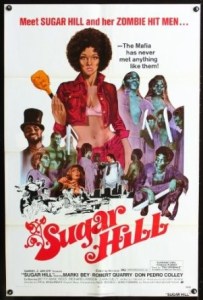
Day 30: Sugar Hill (1974).      SugarHill

In the 1950s, American International Pictures began making a name for itself as the premiere distributor of schlocky horror/sci-fi/creature features (like It Conquered the World and Invasion of the Saucer Men), rebellious teen films (like Dragstrip Girl and Rock All Night), and, of course, the inevitable combination of schlocky horror/sci-fi/creature features with rebellious teen films (like I Was a Teenage Werewolf and I Was a Teenage Frankenstein). Something similar occurred at AIP in the ’70s. Thanks in no small part to the throngs of fans descending upon drive-ins and grindhouses, the distributor enjoyed continued success with its line of outrageous schlock horror films, although now the films often came with heavy doses of ’70s-era psychosexual/weirdo vibes (films like The Incredible 2-Headed Transplant and A Lizard in a Woman’s Skin). By 1972 AIP had managed to locate and successfully mine a rich new vein of urban moviegoers by producing a slew of blaxploitation crime thrillers (like Black Caesar and Coffy). And so the continued popularity of AIP horror films and the rising popularity of AIP blaxploitation films led to the inevitable: the creation of the blaxploitation horror film.

When you consider the success of early blaxploitation horror films like Blacula (1972) and the sequel Scream, Blacula, Scream (1973) along with the continued success of gritty blaxploitation action films, particularly 1973’s Coffy, starring Pam Grier, it shouldn’t come as a surprise that AIP would make a movie like Sugar Hill, a film that attempts (and succeeds) to fuse all of the elements of blaxtoitaion action and crime cinema with the creature feature/horror elements that made the Blacula films successful. Being that Pam Grier’s star power was becoming undeniable, as was the ever-swelling fan enthusiasm for Coffy, it should also not come as a surprise that Sugar Hill is essentially Coffy with zombies. Both Coffy and Sugar Hill tell stories of strong, independent women taking the law into their own hands after a loved one is attacked by the criminal element in their respective cities, and both film titles refer to the street names by which the lead characters are known. The only major difference: While Pam Grier’s Coffy character seeks revenge through the use of traditional weaponry and street smarts, Marki Bey’s Sugar Hill character seeks the help of a voodoo overlord, Baron Samedi, to sic an unstoppable horde of flesh-eating zombies on the gangsters who killed her man and now want to take away her nightclub.

As an overall viewing experience, the influence of Coffy on Sugar Hill really doesn’t matter. Regardless of how it came to be, Sugar Hill still feels like a complete original. By combining a classic revenge thriller with a classic voodoo/zombie chiller, the film manages to create an atmosphere and vibe that is distinctly its own. Of course, like most zombie movies (and like just about all revenge thrillers, for that matter), the story, once properly set up, is quite predictable, and many of the characters are nothing more than by-the-numbers baddies or clueless friendly acquaintances. But, while so many similarly themed films grow tedious or even unwatchable, Sugar Hill is a blast from start to finish, providing a definitive example of the difference between simply following the formula and the formula done right.

Marki Bey is a strong, sexy, charismatic lead, whose toughness seems genuine and not at all like a caricature of a tough girl gone rogue. Mama Maitresse and Baron Samedi, the voodoo practitioners, are wonderful creations, blessed with heaping mounds of joyful charisma and ice-cold menace. And, finally, the zombies in this movie shamble, stalk, and steal every scene they’re in. Their eyes are bulging shiny orbs that create a haunting, lifeless stare. They are often draped in cobwebs and wear rusty chains and manacles beneath a layer of tattered clothing, a constant reminder to the audience that they are actually the resurrected corpses of slaves, adding a little extra historical and sociopolitical pop to the proceedings.

Sugar Hill’s blaxploitation pedigree may make it seem, to some, as a relic of the ’70s and nothing more. However, if the goal of a horror film is to make the world of make-believe believable, to create an escape from the mundane, day-to-day realities of life, and to tell a compelling story, then Sugar Hill is so much more than a relic—it’s timeless.

Day 31: Curse of the Demon (1957)

Halloween Every Day (for a Month)

By Andrew Neil Cole

Day 31: Curse of the Demon (1957).           CursePoster

(The following contains SPOILERS. You might not want to read beyond this point if you have not seen Curse of the Demon or Drag Me to Hell.)

Every time I watch Curse of the Demon I am struck by the same two things. The first is the numerous unmistakable similarities between this film and Sam Raimi’s Drag Me to Hell (2009), specifically in terms of story and structure. In both films the main character is cursed by someone who feels they’ve been wronged. In CotD, the main character is a world-renowned professor who is ultimately cursed by a Satanist who believes his reputation has been sullied by nonbelievers in the world of academia; while in DMtH our lead is a loan officer at a bank (her steady boyfriend is, not coincidentally, a professor) who is cursed by an elderly gypsy woman with a rotten set of chompers when she refuses the woman a mortgage extension. In both films, the actual curse consists of three days of psychological/supernatural torment, culminating in the victim’s death at the hands of an unstoppable demon. In both films, the victim unknowingly possesses a cursed object (a cursed parchment inscribed with a runic incantation in CotD; a cursed coat button in DMtH). Both films feature sequences in which the victims attend a séance intended to supernaturally ablate the curse … and in both films the séance fails, though for very different reasons. And, finally, both films execute their respective finales at train stations, where prominent characters are horrifically killed by a demon as a speeding train approaches—but here is also where the films differ. In CotD, our hero, Professor John Holden, escapes his horrible fate by returning the cursed parchment to the film’s satanic antagonist, who in turn suffers the demon’s wrath; however, Christine Brown, the bedeviled bank loan officer from DMtH is not so lucky. Her three days of torment conclude with her being literally dragged, kicking and screaming, to hell, right through the train tracks she believed would whisk her away to a better life, as her boyfriend looks on in abject horror.

While these two films are clearly ripe for comparison from a narrative standpoint, they couldn’t be less similar from a stylistic standpoint. It hardly needs to be stated that Sam Raimi’s film is the much more kinetic, visually daring, F/X-heavy cinematic experience, while Jacques Tourneur’s Curse is a moody, intentionally quiet film that distills many of its creepiest moments from its inherent stillness. In any case, watching these two distinctly different stylistic interpretations of basically the same material serves as proof that a good story, regardless of how it is told, is without question the foundation on which all successful movies are built.

Oh, yeah … The second thing that always strikes me when I watch Curse of the Demon is just how good Curse of the Demon really is. It’s not going to scare anyone into cardiac arrest or test the structural integrity of your Fruit of the Looms. And, okay, maybe some people will find the rubber demon suit a little hokey. But something about it just works. It’s a movie that feels like a campfire tale, like a nightmare projected in glorious black and white; it’s a movie that exists in a world of cobwebs and starless nights, where people conjure demons to do their bidding and no one’s soul is safe. So … rubber suit or not, Curse of the Demon feels like the perfect way for a film fan to end a Halloween night. It also feels like the perfect way to end my month-long exploration of the world of horror cinema.

Day 2: Hausu (House) 1977

Halloween Every Day (for a month)

By Andrew Neil Cole

Day 2: Hausu (House) (1977).    houseposter_500

Hausu is a Japanese horror film that tells the relatively pedestrian tale of seven teen girls spending their vacation in a creepy old house; however, there’s probably never been a haunted house movie quite like this. This is an outrageous, hyper-stylized, unpredictable little horror gem that viewers will either love or hate. There is no middle ground.

Sometimes the film’s style can be overwhelming: animation, stop-motion animation, black-and-white photography, sepia-tones, pink tones (yes, pink), lap dissolves, matte paintings, etc … Every single frame of this film seems to be screaming YOU ARE WATCHING A MOVIE! The constant visual fireworks are complemented (if you can call it that) by an intrusive musical score that almost never stops. But if you can see through the film’s overbearingly cartoony style, Hausu delivers on a rather audacious conceit, in that the film works as both a horror film and a commentary on horror tropes and clichés (and it does this decades before films like Scream and The Cabin in the Woods would mine similar thematic territory). For example, all of the principal characters are literally named after character types, as if their behavior has been genetically predestined. I’m not kidding. The attractive girl is named Gorgeous. The girl with an overactive imagination is named Fantasy. The studious, bespectacled girl is named Prof. The hearty girl who likes to eat is named Mac. The music-lover/pianist is named Melody. The ridiculously companionable, eager-to-please girl is named Sweet. And, my personal favorite, the martial arts enthusiast is named Kung Fu. Subtlety is clearly not this film’s forte. Nonetheless, Hausu is a movie experience that really feels like an experience. This is a movie that, once seen, must be talked about with anyone who will listen.

Much has been made of the film’s impact on future filmmakers, specifically Sam Raimi and his Evil Dead films, so I won’t bother to stir that pot again. Nor will I bother to comment on certain sexist aspects of the movie that have confounded and angered so many viewers over the years. It should be remembered that this movie, like any movie, is a product of its time and place. It is what it is and nothing more. (Although, to modern sensibilities, it is pretty sexist.)

Intro/Day 1: The Cabin in the Woods (2012)

Halloween Every Day (for a Month)

By Andrew Neil Cole

Introduction:

Like a lot of cinephiles, I believe that Halloween is less about trick-or-treating, costumes, candy, and parties than it is about reclaiming a small piece of yesteryear through watching (or more likely re-watching) our favorite horror movies. In fact, Halloween is, for horror fans, much more than one single day denoted by a grinning jack-o’-lantern in the final calendar square for the month of October. No, Halloween begins on the first day of October and doesn’t end until the sun rises on the first day of November. That gives us 31 glorious days to bask in the warm, nostalgic glow that can only be created (or recreated) by our favorite cinematic boogeymen. After all, what better way to feel like a kid again then to relive what it felt like the first time you saw a movie that made you sleep with the lights on and the covers pulled tightly over your head?

So, in the true spirit of Halloween (as defined by us movie fans), I, your Humble Heckler, have decided to take on a challenge: I will watch one horror movie every day throughout the month of October and faithfully record my experiences here. The idea to do this comes from an assignment I was once given as a film student in college. A professor I greatly respected required his students to watch two films a week and simply respond to them in a diary of sorts. What did we like about each film? What didn’t we like? Did a certain film remind us of other films? If so, how?  He was looking for gut reactions—but informed, well-considered gut reactions. The assignment forced me to get out of my head, set all academic pretense aside, and simply let a movie happen to me. As a result, I found greatness in movies that had been written off by the critical community, and I found that I didn’t particularly care for certain films and filmmakers that had been universally adored. It was a great lesson. Therefore, the movies I choose to view will not necessarily be my favorites. My goal will not be to watch specific horror movies but to have a larger, more complete experience with the horror genre as a whole by watching a lot of movies in a relatively short period of time. I will not be making a “best of” list, nor will I be assigning films a rank or a grade of any kind. I’ll do my best to select a wide variety of horror types and classifications. I’ll also do my best to select movies from different eras and to avoid choosing too many obvious titles—there will be no Friday the 13th movies, no Scream movies, no Saw movies, and no sequels of any kind. What follows will not be a series of reviews but rather a collection of subject-specific responses, reflections, and musings.

Enough said. Let’s get started!

Day 1: The Cabin in the Woods (2012).  CabWoods

In the years following John Carpenter’s 1978 classic Halloween, the horror genre took a turn for the worse. In fact, it can be argued that Halloween represents the genre’s definitive line of demarcation, in that virtually every horror film since 1978 has an appreciable pre-Halloween or post-Halloween feel to it. After Carpenter proved that a low-budget slasher flick could make untold millions for its producers, businessmen with absolutely no interest in film, let alone horror, saw an opportunity to cash in and pounced like carrion birds on a fresh carcass. To this assemblage of heartless capitalists, an investment of a few hundred thousand could mean tens of millions in profit, and soon the market was flooded with Halloween wannabes. Every weekend a new masked assailant stalked a collection of sexually promiscuous teens at a theater near you. Interesting, fleshed-out characters and strong, driving suspense narratives were instantly jettisoned and replaced by archetypal caricatures heedlessly meandering through a loose collection of slaughter scenarios. The horror genre would never be the same.

With The Cabin in the Woods, director Drew Goddard and co-writer/producer Joss Whedon seem to be pointing an accusatory finger directly at the kind of filmmaking that occurred on the post-Halloween side of that line of demarcation. Genre conventions are both openly mocked yet necessary to the film’s overall structure. Torture porn and the excessive use of graphic violence as entertainment in horror cinema are clearly criticized while the film dumps buckets of blood and goo on everyone and everything in sight. Characters are written to satirize the preordained fates of modern horror film caricatures (the dumb blonde, the jock, the virgin, etc …), and yet, in the end, these characters live and/or die by the same rules as the lazy, clichéd, cardboard characters they were created to lampoon—and all of this is intentional. It is also a lot of fun. I’m glad I decided to begin this month-long exploration of the horror genre with a movie that is clearly conducting an exploration of its own.

The Jerk (1979)

More than Meets the Eye: The Jerk

By Andrew Neil Cole

(The following contains spoilers. It is intended only for people who have seen The Jerk.)  The_Jerk

Regardless of the legendary status it would eventually merit, The Jerk remains one of most misunderstood and underappreciated comedies ever made, which shouldn’t be surprising, considering that Steve Martin, the film’s star/co-writer/co-producer, was the most misunderstood and underappreciated comedian of the ’70s, despite the legendary status he, too, would eventually merit. Martin’s comedy both defined a generation and became symbolic of a gargantuan generation gap. People under the age of 50—those who were raised in the crucible of Cold War paranoia to then come of age as young adults in the blood-soaked shadow of the Vietnam War—regarded Martin’s outrageously silly, intentionally nonpolitical brand of comedy a salve for years of emotional turmoil. Martin was a counterculture comedian who never seriously spoke to the counterculture; he never opined on Watergate or government mistrust, never burned a flag on stage, and never—ever—protested against or advocated for any political ideology or philosophy through his comedy. He simply made people laugh and laugh hard, and in doing so, he made people forget the War and the political scandals and the assassinations of Kennedy and King and the horrors of Attica and Kent State—and the younger generations loved him for it. Meanwhile, people over the age of 50—those who came home from World War II and rebuilt the country with steely eyed determination and a no-nonsense attitude toward life—regarded Martin as a buffoon whose clownish antics suggested a superficial style of comedy; the kind of comedy that was only funny on the surface and lacked any true depth, social commentary, intellectual heft, or emotional resonance. They just didn’t get it, and by the end of the ’70s they were done trying.

Strangely enough, the vast majority of those who loved Martin’s comedy and virtually all of those who hated it had one thing in common: they didn’t really understand it. Consider the following staple of Martin’s stand-up act: Clad in a retina-dissolving white suit with a black tie and black socks, Martin stands at the microphone with his banjo at the ready. He wears a pair of fake bunny ears atop his head and a fake arrow through his head at the temples. A pair of Groucho Marx-style glasses (complete with an attached rubber nose, a set of bushy eyebrows, and an equally bushy mustache) covers most of his face. He begins to play a tune on the banjo, and the crowd howls with gleeful laughter. To those who loved Martin (the under-50 crowd), the overt silliness of a crazy-looking man playing a weird-looking instrument was, in itself, screamingly funny. To those who despised Martin (the over-50 crowd), the overwhelming silliness of such an act was intrinsically insipid and irredeemably stupid. But here is what most people, adorers and haters alike, didn’t fully appreciate or fully comprehend: The joke wasn’t just a goofy-looking man playing a tune on the banjo; the joke was a goofy-looking man playing an extremely difficult tune on the banjo with the precision and talent of a world-class musician. Yes, the visual presentation of the joke was clearly silly, but the execution of the joke suggested a classic comedic juxtaposition. By looking ridiculously goofy while performing at a highly accomplished level, Martin simultaneously plays the heel and the straight man, the idiot and the genius, Oscar and Felix. This is a recurring theme in Martin’s act. He performs complex, multilayered magic tricks, he juggles like a seasoned vaudevillian, he plays the bumbling klutz with balletic grace, and he weaves deeply philosophical concepts into seemingly harebrained monologues—all while ostensibly playing the fool. The problem for Martin was that the surface of his comedy was just too shiny; the act (and Martin himself) was so fresh and new and unlike anything that had come before it that it was difficult for people to see beyond the funny nose and the bunny ears. They loved or hated the first impression and never quite managed to grasp the totality of the act. So, it’s no wonder that The Jerk, a film that perfectly articulated Martin’s comedic modus operandi, would be so misunderstood for so long.

Martin’s propensity to juxtapose seemingly disparate subjects, concepts, and visual iconography for comedic effect remained steadfastly at the core of The Jerk’s comedic aspirations. In fact, the film’s goofball façade was erected upon a narrative foundation capable of supporting insightful satire that spoke directly to post-Vietnam American cynicism. Nothing was sacred. In the universe of The Jerk, little boys wear T-shirts with “Bull Shit” emblazoned in big block letters across the chest, churches are ripped from their foundations and dragged out into traffic, adorable dogs are named Shithead, and psychopaths hunt human beings randomly selected from the phonebook. But the film also openly mocks socioeconomic issues such as income disparity. Don’t forget that the film opens on a theater in the midst of a red-carpet style premiere. Tuxedoed men and beautiful women in designer dresses mingle without a care in the world. The camera then pans to an adjacent stairwell where Martin (as Navin Johnson) sits surrounded by street trash, penniless, homeless, covered in tattered rags and a visible layer of grit. The perfect juxtaposition of the Haves and the Have-nots is accomplished in a single shot. The same can be said for the film’s take on the 1979 oil crisis that created widespread panic and led to absurdly long lines at gas stations countrywide. The camera lingers for a brief moment on a sign in the window of Hartounian’s Gas Station, where Navin finds his first ever job. The sign reads: “GAS PRICES: IF YOU HAVE TO ASK, YOU CAN’T AFFORD IT.” Again, one shot says it all.

But soon enough Navin Johnson becomes filthy rich himself, a device that allows the film to appropriate the classic rags-to-riches paradigm to once again accommodate the theme of juxtaposition while simultaneously commenting on the culture of the period: broken, poor, simple Navin transforms into the embodiment of the nouveau riche just as the economic darkness of the ’70s is about to give way to the absurd financial excesses of the ’80s. Only Navin doesn’t make his money on Wall Street; instead, he hits the jackpot with an invention called the Opti-Grab, a silly piece of plastic attached to the frames of eye glasses that anchors the frames to the bridge of the wearer’s nose. Here The Jerk is actually predictive of the explosive greed and financial malfeasance that would become prevalent (and eventually ruinous) in the ’80s; in fact, the film explores the same pitfalls of extreme wealth run amok years before films like Oliver Stone’s Wall Street and novels such as Tom Wolfe’s The Bonfire of the Vanities and Bret Easton Ellis’s American Psycho. In lieu of engaging in Faustian episodes of insider trading (Wall Street), exposing the impact of class warfare and racial intolerance on American jurisprudence,  (The Bonfire of the Vanities), or executing status-motivated serial killings (American Psycho), The Jerk portrays the evils of gluttonous wealth in a series of comedic set pieces, one-liners, and visual gags. When, for example, Navin becomes a multimillionaire, he moves into possibly the most vulgar, ostentatious mansion ever captured on film. Among the sprawling grounds and perfectly trimmed hedge gardens there exists a tennis court with a water station that dispenses rare wine from gigantic jugs to be served in crystal wine goblets plucked from a modified Dixie Cup dispenser. The interior of the house features a rotating bed, a billiard room occupied by a giant stuffed camel (just because), and a disco room complete with mood lightning, overhead disco ball, and a hardwood dance floor. Then, in a satisfying twist, the film manages to comment on the increasingly litigious nature of Americans when Navin loses everything in a lawsuit brought against him by the millions of people who’ve gone cross-eyed after purchasing the Opti-Grab.

Beyond satirizing the socioeconomic shortcomings of ’70s America, The Jerk playfully hints at the demise of Route-66 Americana while cleverly lampooning hero iconography in classic adventure literature and more modern travelogues, touching upon everything from Homer and Cervantes to Kerouac and Steinbeck. After all, The Jerk is, at its heart, a road movie. It is also a play on all things Homeric. Like Homer’s Odyssey, The Jerk is the story of a man overcoming numerous trials and tribulations in his attempt to find his way home (or to find a place to call home, as is the case for Navin Johnson). However, unlike Odysseus, the intrepid hero of Homer’s epic, Navin Johnson is, from the first moments of the film, a parody of a hero. Consider the scene in which Navin first sets out see the country for himself. He stands at the front gate of the house in which he was “born a poor black child” (more socioeconomic/sociopolitical commentary). Clad in a leather helmet, goggles, and a flowing scarf, like a misplaced WWI fighter pilot, Navin visually represents both the classic adventure hero and an over-the-top caricature of a hero—yet another example of comedic juxtaposition within a single image. This concept was clearly lost on Pulitzer Prize-winning film critic Roger Ebert, who, in his 1979 review, wrote: “Why is he wearing the goggles? So we will laugh. There’s no plot point to be made, and nothing is being said about his character—except, of course, that he’s a jerk.” With all due respect to Roger—he was a truly great critic—he couldn’t have been more wrong. There absolutely was a point. In fact, the parody-of-a-hero theme is revisited and amplified in a scene in which Navin meets with a group of businessmen who turn out to be terrible bigots. When these men begin casually dropping the N-word, Navin, who still self-identifies as African American despite the knowledge of his adoption, flies into a rage, tears off his shirt, and systematically takes out the bigots one at a time in a ridiculously absurd exploitation-style kung-fu sequence. This is as close to the heroic image of Odysseus as the Navin Johnson character ever gets, but the American landscape into which Navin ventures could be interpreted as a modern comedic version of what was encountered by Odysseus. While Odysseus is besieged by treacherous sirens, a hungry Cyclops, and vengeful gods, Navin finds an America beset by rifle-toting lunatics, sexually aggressive female daredevils, and travelling carnival hucksters.

Considering his lack of outwardly noticeable heroic attributes and his penchant for misadventure rather than adventure, it is arguable that Navin Johnson’s journey in The Jerk is more comparable to Don Quixote’s journey in The Ingenious Gentleman Don Quixote of La Mancha (as imagined by Miguel de Cervantes) than it is to that of Odysseus in The Odyssey. There is little doubt that Martin and director Carl Reiner saw both the Navin Johnson character and the film’s overall story to be quintessentially quixotic. Both The Jerk and Don Quixote feature lead characters who, through a series of comic misadventures, deride the image of classic adventure heroes and blatantly display contempt for traditional hero narratives. Unlike the more classic men-of-action characters throughout the history of narrative art—everyone from Achilles to Zorro—any successes attained or goals achieved by either Navin Johnson or Don Quixote can be attributed solely to dumb luck. To wit: Navin Johnson becomes a multimillionaire after he invents the Opti-Grab to assist a gas station customer who just happens to be a successful entrepreneur. Similarly, Don Quixote becomes a knight, but only as the result of a phony ceremony performed by an innkeeper who has grown weary of his presence and hopes a knighthood will hasten Quixote’s departure. But the quixotification of The Jerk is not limited to its lead character. While Navin tilts at the various windmills of the late-’70s American pop-culture landscape, his dog, Shithead, assumes the role of squire (or the Sancho Panza of The Jerk), while his whirlwind romance with Marie (played by Bernadette Peters), an idealized vision of womanhood, clearly suggests the Marie character as the Dulcinea of The Jerk.

Being that The Jerk is patently rooted in the narrative tradition of road stories and travelogues, it is likely that Martin and his co-screenwriters culled inspiration from Jack Kerouac’s On the Road and John Steinbeck’s Travels with Charley, arguably the two most notable road stories in all of post-WWII American literature. It doesn’t require a radical distortion of logic to view Navin Johnson, an out-of-place loner who believes he’s destined for greater things, as a comedic composite of Kerouac’s two main protagonists in On the Road: Sal Paradise and Dean Moriarty. The divorced, saturnine, prone-to-depression Sal is reflected in Navin during The Jerk’s earliest scenes. Like Sal, Navin feels disconnected from his community and his family. For Navin, this is the result of being told that he was adopted; for Sal, it is the result of divorce. Once he hits the road, Navin’s outlook becomes more comparable with the excitable, energetic, limitlessly optimistic Dean Moriarty. Navin, once on his own, working and living in a gas station, views every mundane occurrence as an opportunity, as evidenced in a scene in which, upon seeing his name listed in the phonebook for the first time, he shudders with childlike glee while proclaiming, “I’m somebody now! Millions of people look at this book every day!”

Once Navin leaves the gas station behind and joins a traveling carnival, the influence of Steinbeck’s Travels with Charley on the film becomes nearly impossible to ignore. Like Steinbeck, Navin hits the road with his trusty dog (Travels with Shithead?) to see the country. And, also like Steinbeck, he finds the country mostly disappointing. Navin is targeted for execution by a serial killer in St. Louis, sexually assaulted by a demonic carny in numerous pastoral mid-American landscapes, and deprived of his Opti-Grab fortune in California. Of course, unlike Travels with Charley, The Jerk plays Navin’s myriad misfortunes and disappointments for laughs, while excoriating popular road movie/travelogue banalities.

With the benefit of historical hindsight, audiences and critics now think of Steve Martin as so much more than just the Wild and Crazy Guy in a white suit. He is widely considered one of the most innovative and intelligent comedians of the last 50 years. The considerable depth of Martin’s knowledge of fine arts and literature is also widely known, as is the fact that he is the author of numerous novels, novellas, essays, plays, screenplays, songs, and even a Broadway musical. Therefore, isn’t it reasonable to believe that Martin, as The Jerk’s co-writer/co-producer/star was using the film as a vehicle to satirize ’70s popular culture and caricature classical themes of heroism, adventure, and travel tales by retrofitting traditional acts of derring-do to adhere to his personal, over-the-top, outrageously silly comedic style? Of course it is. And today most comedy fans and film critics can see the film for what it really is. But why did it take so long? Remember, the film was universally panned by critics upon its initial release in December of 1979. But, then again, so was Martin’s wildly successful stand-up act. It’s possible that critics and the over-50 generation thought of Martin as little more than the flavor of the month, and any film featuring him nothing more than a gimmick created to cash in on his flavor- of-the-month status. In this way, Martin and The Jerk were to ’70s cinema what Vanilla Ice and Cool as Ice were to ’90s cinema, in that Cool as Ice received a green light based solely on the popularity of Vanilla Ice’s one and only hit single, “Ice Ice Baby”—an embarrassing comparison, knowing what is now known of Martin’s legendary career.

Sometimes history has a way of correcting itself. Now the movie that Roger Ebert referred to as “a flat, dumb, tasteless movie, in which calling Steve Martin’s character a jerk is almost an act of kindness,” has finally ascended to its rightful place in the pantheon of great film comedies. And what the heck … it only took a couple of decades and the coronation of Steve Martin as comedic royalty for the film to finally be given a fair shake. Eventually the film would come to hold a position of prominence on virtually every “Best Of” list of note and rightfully be credited for inspiring generations of comedians and filmmakers. To be fair, it is also a perfect example of revisionist history. Hopefully, The Jerk will be remembered not only as a fearless, groundbreaking work of comedic cinema, but as a reminder to critics and fans that when you judge a work of creativity (or a comedian or a human being or virtually anything) without truly understanding it, you end up looking like—you guessed it—a real jerk.

The Omen (1976)

Devil’s Advocate: The Omen (1976)

By Andrew Neil Cole

   (The following contains SPOILERS. You might not want to read beyond this point if you have not seen The Omen, Rosemary’s Baby, or The Exorcist.)              omen

Released to great critical and commercial acclaim in 1976, The Omen is aptly named, but for all the wrong reasons, as the film is a harbinger of terrible things to come in the world of mainstream American cinema. Of all the so-called “classic” horror films made in the ’70s, The Omen is the one film whose status as a “classic” is the most difficult to successfully argue. The film set a standard in lazy, pandering, corporate storytelling that unfortunately continues to flourish today. It is, in fact, one of the films most responsible for the let’s-keep-doing-the-same-thing-until-it-stops-making-money formula that continues to find favor with the current crop of elite Hollywood players, specifically those with the ability to green-light projects. Here’s an example of how the formula works: In 1996, Scream, with its simplistic slasher storyline written by Kevin Williamson and emotion-heavy lead performance from Neve Campbell, a sexy brunette cast member of the TV show Party of Five, rakes in more than $100 million at the domestic box office … So, therefore … released one year later, we get I Know You Did Last Summer, a movie with a simplistic slasher storyline written by Kevin Williamson and an emotion-heavy lead performance by Jennifer Love Hewitt, a sexy brunette cast member of the TV show Party of Five. Get it? Thanks to movies like The Omen, which exists only because of the monumental success of two films: Rosemary’ Baby (1968) and The Exorcist (1973), this is how mainstream American cinema works. Why innovate when you can simply reiterate? For all its accolades and its iconic status in the world of American horror cinema, The Omen is every bit as creatively impotent and insultingly pandering as I know What You Did Last Summer.

The story of The Omen, which concerns the spawn of Satan being adopted by the newly appointed U. S. ambassador to Great Britain, is ultimately little more than the haphazard cobbling together of concepts and philosophies found in the respective narratives of Rosemary’s Baby (the story of a woman coming to realize she’s given birth to the Antichrist) and The Exorcist (the story of a woman coming to realize her child is possessed by a chorus of demons). While Rosemary’s Baby and The Exorcist are actually two very different films, they do share an essential theme: the horror of parenting (and unconditionally loving) a child that personifies evil, a theme that is shamelessly pilfered and carelessly repackaged in The Omen. At the same time, unlike Rosemary’s Baby and The Exorcist, The Omen’s attempts to appeal to a more intellectually mature audience always either flat-out fail or are undermined by any number of the sillier elements of its story. For starters, setting the film in the world international politics is a promising idea; however, the film never follows through on what it begins. We know that Robert Thorn (played with low-key gravitas by Gregory Peck) is an important man; hell, he’s the ambassador to Great Britain. But we never actually see him doing his job. We never hear him have an earnest or intelligent political conversation—not once. When we finally see him at work, his office is so plain and unimpressive that it looks more like the office given to the worst salesman at a used-car dealership as punishment for selling the fewest Fiats during the annual President’s Day Weekend Sell-A-Thon than the office of the freakin’ U. S. ambassador to Great Britain. There is even a scene in which, during a moment of clunky expositional dialogue, we are informed that Thorn is an old friend of the current American president. In other words, we are told that Robert Thorn is an important man. We are never once given the opportunity to come to that conclusion ourselves.

This total lack of character depth isn’t limited to the film’s lead. Literally all of the film’s characters come off more like cardboard supermarket standees than flesh-and-blood people. Lee Remick is the vanilla wife with the beautiful smile who, if nothing else, supports her man. The great David Warner plays a photographer—that’s it. A photographer. Does he work for a newspaper? A magazine? Is he a freelance photojournalist? Who knows? He exists simply to move along the plot when a photographer is needed. Billie Whitelaw fares a bit better as a satanic governess/clandestine protector of the young Antichrist. But this character, like Warner’s photographer, exists only to grease the wheels of the story, to be creepy and mysterious when the story requires someone to be creepy and mysterious, and nothing more. And then there’s Harvey Stephens as Damien, the devil baby at the center of the film. (By the way, when considering the film’s lack of originality, let’s not forget that even the name Damien was lifted directly from The Exorcist. Damien Karras, played by Jason Miller, is one of The Exorcist’s lead characters.) Little Damien seems only to smile, giggle, furrow his brow, and scream his demonic little lungs out whenever he’s in close proximity to religious objects or edifices. Just like the Robert Thorn character, he is evil because we are told that he is evil. The result is a film populated by empty costumes that desperately wants to be taken seriously but just isn’t smart enough to pull it off. Consider the following example: Late in the film there is a scene in which a priest named Bugenhagen correctly suggests that Mrs. Baylock (Billie Whitelaw’s satanic governess character) is nothing but trouble. However, he refers to her as an “apostate of hell!” This is, of course, the incorrect usage of “apostate,” which refers to someone who betrays a loyalty, a double-crosser, as it were. Clearly Mrs. Baylock is in league with the forces of evil, so apostate is completely wrong. Bugenhagen probably meant to use the word apostle, which suggests a loyal, ardent supporter. This may seem like nitpicking, but mistakes like this are indicative of a film that is trying to appear more intelligent than it actually is. It’s like watching a punch-drunk boxer attempt to appear more intelligent by peppering the post-fight interview with misused five-syllable words. The audience isn’t fooled.

This intellectual deficiency is made even more apparent by both the abject silliness of the overall story and in the inclusion of one of the most baffling subplots ever rendered on film. For a movie about the son of Satan being adopted by a powerful American couple, The Omen spends very little time exploring this concept, let alone the actual parent-child relationship. Instead, the “horror” of the film relies on the incredibly lazy conceit that scary, unexplainable things just seem to happen simply because of Damien’s presence. The film goes so far as to transform the concept of evil into an actual character, Evil. The results are often laughably silly. In one scene, a nanny hangs herself in full view of everyone in attendance at little Damien’s birthday party after being hypnotized by a dog possessed by Evil. In another scene, Evil appears as sentient weather—that’s right, weather!—and chases a priest around the streets of London, eventually corralling him like a herded sheep to the very spot where he is impaled (shish kabob-style) by a freshly struck lightning rod plummeting from the roof of the church whose locked doors have just denied him sanctuary.

Which leads me directly to one of the most bizarre and superfluous subplots in the history of horror. For some reason, right in the middle of the film, we learn that the pictures taken by David Warner’s photographer character contain a strange anomaly that predicts the manner in which the subjects of the photographs will die. If a strange dark slash appears across your neck in a photograph, you are going to be decapitated. And, yes, if that same slash appears diagonally through your torso, you are going to be shish-kabobbed. Is this crackpot subplot just an ill-conceived continuation of the strange-things-happen-because-Damien’s-in-town construct? If so, what’s the point? What the holy hell does any of this have to do with the spawn of Satan being adopted by the Thorns? This narrative detour is so out of place, so random that it feels like it belongs to an entirely different movie. Obviously this nonsensical storyline exists solely to justify the inclusion of a few gory death scenes. Here we have a textbook case of pandering to the bloodlust of contemporary horror fans, which, in turn, exemplifies The Omen’s desire to appear as intelligent as The Exorcist while satisfying the grisly expectations of horror audiences created by a wave of popular films such as The Texas Chainsaw Massacre and Night of the Living Dead. But by trying to please (and cash in on) every possible demographic of horror fan, the film blasts gaping holes in its own logic. Why bother killing priests and a photographer, especially under such strange circumstances? Wouldn’t these ultra-bizarre deaths train a great big spotlight on the weirdness surrounding Damien, creating the kind of attention that those in league with Damien—people like Billie Whitelaw’s governess character—are clearly trying to avoid? Furthermore, if this strange Evil force can manipulate weather to lethally target priests and make nannies hang themselves, why not just drop a bulldozer on Ambassador Thorn once he becomes a threat to little Damien and be done with it? As the film strays further and further from its central concept the narrative becomes unnecessarily muddled, effectively marginalizing the characters and deflating any remaining potential for genuine moments of suspense or terror like air from a punctured balloon.

And then there’s the ending.

Once Ambassador Thorn realizes that Damien must die, he is presented with a complex checklist of idiotic murder rituals. It seems that you can’t just kill the little bastard with a gun or a knife or baseball bat to the head. Nope, you have to kill him in a church, on hallowed ground. Moreover, he must be killed by stabbing him seven times in specific areas of the body with—get this—seven mystical daggers that were forged in the holy city of Megiddo: “The place where Christianity began,” according to Father Bugenhagen, the vocabulary-challenged priest. What? Mystical daggers? Seriously? Remember that scene in Jason Goes to Hell: The Final Friday where mysterious bounty hunter Creighton Duke shows up and tells Jason’s relatives that only a Voorhees can kill and Voorhees … oh, and in order to kill Jason you have to use—you guessed it—a mystical dagger? Remember how ludicrous that seemed? Okay, okay … the point has been made. No reason to repeatedly stab a dead horse with a mystical dagger, after all.

Finally, any discussion of The Omen must include a mention of the final shot. After being rescued from multiple mystical dagger stabbings, little Damien holds the hand of the president (presumably his new daddy) while attending the funeral of Robert Thorn (his now-deceased old daddy). Breaking the fourth wall for the one and only time in the entire film, Damien turns to the camera, as if to address the audience, while a shit-eating grin slowly consumes his entire face. Is this a chilling moment meant to signify the beginning of the Antichrist’s rise to power? Or is it one last reminder of how obnoxiously silly the film really is? Who knows for sure? Maybe we should be asking if a film this consistently disappointing is really worthy of any serious measure of contemplation at all.

Ultimately, The Omen is a stupid religious-themed horror movie adorned in smart-movie vestments. The whole thing feels like an assignment from studio brass rather than a work of cinematic art. It feels like something that began in a boardroom rather than in the brain of a creative artist. To be fair, the film isn’t completely without its merits. The scene at the zoo certainly has its inspired moments, like when a tower of giraffes gets spooked and dashes away from tiny, innocent-looking Damien. But The Omen simply takes itself much too seriously for fun moments like this to have a lasting impact. For every enjoyable, well-crafted scene (like the one at the zoo) there are several that drown in heavy-handedness and poor execution, such as the scene in which Damien grows increasingly squirmy and twitchy in the backseat of the family limo as the Thorns approach a church. His torment intensifies until the scene culminates with arguably the least-believable conniption fit every captured on film.

And yet, it’s easy to understand why so many people love The Omen. It’s moody and dark and more atmospheric than a lot of horror films. It has absolutely earned the right to be categorized as a “fan favorite” or a “guilty pleasure,” but to call it a full-blown “classic” would require a severe redefining of the word classic. The film is just too lazy, too uneven, and much, much too derivative of truly great films that have come before it to be given serious consideration as an all-time great, despite the participation of all-time-great actors like Peck and Warner. Luckily, for those who love The Omen, the film’s place in history is secure. At this point, criticizing a movie as beloved as The Omen is like throwing jelly beans at a battleship. The damage will in no way be noticeable.