Lights Out

Lights Out: A Scary Movie for People Who Suck

Reviewed by Shirley Franks for TheHumbleHeckler.com

(Editor’s note: Film critic Shirley Franks is an insanely busy soccer mom who hasn’t had a vacation in more than three years.)

Lights Out is a sometimes-clever, often-spooky horror film that absolutely drips with atmosphere. It’s the kind of shriek-fest that I would’ve loved 15 years ago, back in those halcyon days before I met my ass-bag husband and started pumping out ungrateful children by the bucket load. However, now that life has crapped on my dreams, blackened my heart, and shriveled my once-beautiful body, I find this movie endlessly annoying and relentlessly un-scary.

The story of Lights Out concerns a mysterious ghost-lady with Medusa hair and terrible posture who appears in the dark and disappears in the light. Oooh, I’m sooooooo scared! Shadowy ghost bitches aren’t scary … Five kids and 1 bathroom—now that’s scary. The appearance of varicose veins at 35—now that’s scary. Working 40 hours a week reviewing idiotic movies aimed at mouth-breathing teenagers, only to come home to a filthy house where I’m greeted by a sea of dirt-smudged faces screaming, “What’s for dinner?”—now that’s scary.

Teresa Palmer stars as the film’s sweet little cutie, who always looks daisy-fresh and is decades from worrying about stretch marks and episiotomies. So, basically … UP YOURS, TERESA! Enjoy that tight body and that silky-smooth skin while you can, sweetheart, because one day—maybe even soon—you’re gonna wake up in a bed filled with potato chip crumbs, next to a snoring, wheezing, ass clown that tricked you into getting married and then effectively stole every ounce of your youth, beauty, and zest for life, leaving you a soulless husk with prematurely gray hair and the disposition of a demon in church.

About 25 minutes into this obnoxious teen spookshow, I realized that I was still wearing my slippers and a pair of sweatpants dotted with scores of oozy, drippy stains whose origins are as mysterious and frightening as the identity of Jack the Ripper. Not to mention the fact that my ass-bag husband (in fact, let’s just refer to him as Ass Bag from here on out) forgot to fill the station wagon with gas, so I basically coasted to my critics’ screening of this film on fumes. Thanks, Ass Bag. Love Ya’. Oh, and I haven’t slept more than two hours straight in about six months. And I’m supposed to find this movie scary? Really? Give me a freakin’ break, Hollywood!

The only truly positive thing I can say about Lights Out is that I fell asleep for about a third of the film and woke up feeling more refreshed than I’ve felt in weeks. Not refreshed enough to recommend this garbage movie, mind you, but refreshed nonetheless. So, in conclusion, if you’re under 40, single, and childless, I’m just certain you’ll love Lights Out. Why the hell wouldn’t you? Life is a parade for you people. Every movie is a celebration. Every breath is a joy. You people make me sick. So, go ahead, see Lights Out and have a ball—and then choke on it.

I give Lights Out one stink-filled diaper out of four and every ounce of bile my liver can produce.

(Lights Out is rated PG-13 for “adult” language and “adult” situations … As if these people have any idea what it means to be an adult. It also contains prancing nubile bodies, the overt flaunting of youth, and the potential to induce rage in anyone with a pulse and half a brain.)
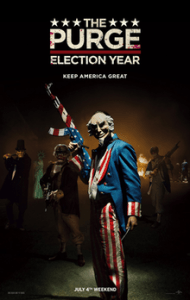
The Purge: Election Year

The Purge: Election Year: Absolutely the Greatest Movie Ever

Reviewed by Marcus Wells for DecimalPointless and HumbleHeckler.com.

(Editor’s note: Film critic Marcus Wells is an insufferably sarcastic man whose The_Purge_Election_Yearfather donates a lot of money to DecimalPointless.)

I was soooooo thrilled when I heard there was going to be another Purge film. Who wouldn’t be? After all, how could any cinephile possibly resist the opportunity to sit through another 105 minutes of completely gratuitous violence, infantile dialogue, and shot after ever-loving shot of psychos in stupid masks brandishing weapons as they cock their heads to one side in an attempt to appear more menacing? Not me. That’s for sure. And that brilliant storyline—you know the one. The one where all crime is legal for one full night. Genius!!! A story like this is in no way gimmicky or stupid at all, and it clearly possesses the narrative heft to accommodate multiple sequels. I wasn’t surprised at all to learn that Michael Bay—the creative mastermind behind Transformer and Bad Boys—is one of the producers of this masterpiece. And let’s not forget to give a shout-out to everybody at Platinum Dunes, the production company that just never ever stops innovating and creating original, groundbreaking movies. Let’s see … so far this collection of Rhodes scholars has produced such original classics as the remake of Friday the 13th, the remake of A Nightmare on Elm Street, the remake of Carrie, the remake of The Texas Chainsaw Massacre, and Ouija, a movie based on a board game from the good folks at Hasbro. So, with this group of cinematic/storytelling pioneers in charge, there’s just no way that The Purge: Election Year could be anything other than an all-time champ of a movie. Right?

Well, there’s no need to worry. I’m here to tell ya’ that this movie is—and I say this without hyperbole—the greatest, most important work of art ever rendered by any living organism in any solar system since the Big Bang started this whole crazy mess. This time around, the story turns on a senator whose entire family was killed during a previous Purge. Anyway, the senator is now running for president, and the largest plank in her platform just happens to be doing away with the annual Purge. But guess what? Some people don’t like her. Bet ya’ didn’t see that mind-blowing twist coming.

From that point onward, we are treated (and, man do I mean treated) to a dystopian nightmare of extreme violence that just doesn’t ever seem to end. And when the credits do finally roll, we walk out of the theater feeling refreshed and alive, secure in the belief that all people are psychopaths who relish every opportunity to inflict violence upon those who can’t protect themselves, and for nothing more than shits and giggles and financial gain. And isn’t that the perfect message to convey to audiences in these times of political divisiveness, overt bigotry, and fear. You bet it is! Nice job, Platinum Dunes. You’re a real class act!

I give The Purge: Election Year an A+++, and I can’t wait to see who’ll be senselessly slaughtered during next year’s Purge. Just terrific!

(The Purge: Election Year is rated R, but, for the life of me, I can’t understand why. This film should be seen—and celebrated—by people of all ages. It should be shown in grade schools and taught in film schools. Simply put, we are a better species for this film’s existence. So take the whole family and have a ball. I’m sure you won’t regret it.)

Day 22: Deathdream

Halloween Every Day (for a Month)

By Andrew Neil Cole

Day 22: Deathdream (1972).      DeathdreamPoster

George A. Romero’s Night of the Living Dead (1968) is rightly credited for forever redefining the zombie movie; but, perhaps more importantly, it is also the first independently produced low-budget horror gore-a-thon to subvert and attack establishment thinking. The film overtly criticizes media power run amok, speaks directly to the state of race relations in the country, and suggests the possibility of a coming revolution (e.g. masses of the Dead rising up to overthrow the status quo)—and all of this is accomplished while maintaining a pulse-pounding suspense narrative that never forgets its horror roots or skimps-out on moments of pure unadulterated terror. NotLD would go on to be become a midnight-movie phenomenon that would ultimately be accepted as an indispensable genre classic. It would also make a decade’s worth of exploitation horror cinema seem superfluous by comparison.

With the exception of one fatal flaw, director Bob Clark’s Deathdream (1972) could be seen as a worthy successor to the legacy created by NotLD. With its tale of a dead American soldier returning to his hometown to visit the horrors of Vietnam upon the sleepy denizens of suburbia, Deathdream, like NotLD, is most certainly a movie of and for its time. It can be seen as an obvious criticism of the Vietnam War itself, as a criticism of the way soldiers were treated upon returning home, or as a portrait of the naiveté of the average citizen who will never endure the physical and emotional burden of combat. And now, with the benefit of historical hindsight, the film could even be interpreted as an ex post facto PTSD allegory. (It wasn’t until 1980 that post-traumatic stress disorder was finally added to the third edition of the Diagnostic and Statistical Manual of Mental Disorders by the American Psychiatric Association.) The film’s intention to be much more than just another drive-in zombie splatter-fest is perhaps most evident in a scene in which Andy the zombie soldier visits his family’s doctor. After making the doctor listen to his complete lack of a heartbeat, Andy addresses the doctor’s stunned countenance by saying: “I died for you, Doc. Why shouldn’t you return the favor?”

For all its good intentions, Deathdream, like so many well-intentioned horror films, eventually devolves into little more than a series of gruesome (and seemingly random) bloodlettings. People start dying in horrific ways because … well … it’s a horror movie and people are supposed to die in horrific ways, right? Deathdream ultimately feels like a wasted opportunity, albeit a well-crafted wasted opportunity. Strangely, the movie reminds me of Damien: Omen II. Don’t worry, I’ll explain. Damien tells the story of a pre-teen boy coming to the overwhelming realization that he is the son of Satan. This could have been an interesting subject for a horror film. We could have been treated to a fascinating exploration of a boy on the cusp of becoming both a man and a monster, knowing that he is helpless to do anything about either. Instead, once Damien learns of his satanic lineage, he immediately starts killing people in particularly awful ways, and the film becomes just another body count movie.

While Deathdream ultimately betrays the lofty expectations it creates, it is still well worth seeing. The acting, filmmaking, and cinematography combine to create a Currier and Ives-style atmosphere of warmth and hominess (lots of picket fences and fluffy dogs—hell, you can almost smell the apple pie cooling in an open window), which perfectly contrasts the violence about to ensue, like red paint on a white canvas. Kudos to director Bob Clark (whose next horror film, Black Christmas, would become a slasher classic) for attempting to say something significant with a zombie film. Yeah, he couldn’t quite sustain the power of the metaphor for the entire running length of the film, but at least he gave it a hell of shot, which is more than I can say for Damien and so many others of its creatively bankrupt ilk.

Day 23: Korkarlen (The Phantom Carriage)

Halloween Every Day (for a Month)

By Andrew Neil Cole

Day 23: Korkarlen (The Phantom Carriage) (1921).       PhantomCarriage

It’s high time that this project include a movie from the silent era. Though I am an extravagant admirer of many of the now-infamous German Expressionist films, such as Nosferatu and The Cabinet of Dr. Caligari, I decided to use this platform to write about one of my favorite silent films of all time, the Swedish horror/drama Korkarlen (or The Phantom Carriage).

It’s easy to say that any decent silent film was ahead of its time; in fact, it’s kind of a cheap observation, since it’s ultimately a matter of opinion and therefore nearly impossible to disprove. That being said, The Phantom Carriage is a silent film that was way ahead of its time. For starters, the way in which the movie manipulates time is impressive, even by today’s standards. The story (which some interpret as a metaphor for the ravages of tuberculosis) unfolds through a series of flashbacks and flashbacks inside of flashbacks. There are even moments in which one character will begin telling a story in which a character within the story tells another story, setting up not only flashbacks within flashbacks but stories within stories inside of flashbacks (or something along those lines). All of this may prove confusing to modern film viewers who have little or no practice with active film viewing, since so much of modern cinema is dialogue driven and virtually everything is spelled out for you. Furthermore, modern cinema is routinely engineered to accommodate short attention spans. Consider how often characters in modern movies actually say what they’re thinking when what they’re thinking is readily evident: “You’re breaking my heart!” The Phantom Carriage is a different kind of viewing experience. The movie jumps around in time so often that even a quick trip to the fridge could leave you utterly confounded and confused.

Here’s the story in broad strokes: Each year on New Year’s Eve, the last person to die before the clock strikes midnight must spend the next full year driving Death’s carriage and collecting souls. Pretty cool, right? Regrettably, the film too often detours away from this timelessly eerie horror premise to effectuate a series of oversimplified moral judgments; it’s is one of those movies that deals in absolutes a little too completely. People are either good or bad, period. It’s a movie that suggests a few sips of alcohol will lead to your ruin. Its sexual politics are composed entirely of old-world thinking, e.g.: every woman needs a man; women fall instantly in love upon meeting a decent man, etc … This philosophical naiveté ends up freighting most of the relationships in the film with a preponderant dearth of authenticity.

Despite the film’s shortcomings, the basic idea of a recently deceased person being forced to work for Death is actualized with a wonderfully creepy atmosphere and surprisingly effective special effects. There is a scene in which a man dies in the ocean. To collect his soul, the ghostly carriage methodically rolls out onto the water, unstoppable as it pushes through the churning waves. Then, while the carriage sits atop the water, a cloaked-and-hooded figure descends the depths and, scythe in hand, trolls along the murky seafloor, amid swaths of hypnotically undulating seaweeds, in pursuit of the fresh soul in need of reaping. It’s a great scene in a film filled with outstanding imagery. Again, the story doesn’t live up to the potential presented by the core concept, but for serious fans of cinema The Phantom Carriage stands as an example of innovative film craft in a time when filmmakers had very limited technology at their disposal. It is also a towering achievement in set design, mise-en-scene, and visual storytelling that has made a lasting impact on the world of filmmaking; in fact, the film’s influence can clearly be seen in numerous landmark films, most notably Ingmar Bergman’s The Seventh Seal.

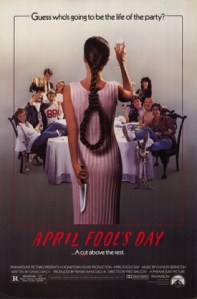
Day 24: April Fool’s Day

Halloween Every Day (for a Month)

By Andrew Neil Cole

Day 24: April Fool’s Day (1986).       AprilFool'sDay

(The following contains SPOILERS. You might not want to read beyond this point if you haven’t seen Halloween III: Season of the Witch, Friday the 13th: A New Beginning, and April Fool’s Day.)

There are arguably three ’80s-era horror films that have stoked the ire of hordes of horror fans more than any others. In 1982, Halloween III: Season of the Witch incurred the wrath of film audiences everywhere for one simple reason: Michael Myers, the escaped lunatic/butcher knife enthusiast/worst nightmare of teen babysitters and hospital employees/rampage killer from the first two Halloween films, was nowhere to be seen. Then, released to cacophonous hisses and boos in 1985, came Friday the 13th: A New Beginning, which is often referred to as the worst F13 of them all, due primarily to the fact that iconic, goalie-masked slaughter-hound Jason Voorhees is ultimately revealed not to be the killer. Finally, in 1986, April Fool’s Day was summarily dismissed by countless horror buffs because the film lived up to its title and revealed, in its final moments, that all the blood and guts and murderous goings-on were an elaborate hoax perpetrated by the plucky, endlessly resourceful hostess of a get-together attended by an assortment college friends/acquaintances.

It’s fair to hypothesize that the lack of audience appreciation for the above-mentioned films speaks more to audiences’ growing appetite for blood and extreme violence in mainstream horror than it does to the actual quality of the filmmaking. Don’t get me wrong, I am not a fan of F13: ANB; it is clearly a money-grab, no more than a cheap excuse to keep a broken franchise limping along. But I have to admit that I have a soft spot for both Halloween III and April Fool’s Day. While neither film has earned the right to be considered an unquestioned classic, both films at least attempted to take mainstream horror in fresh new directions. Consider the idea at the core of Halloween III. Producers John Carpenter and Debra Hill intended to make an original Halloween-themed film each year, starting with Halloween III—a concept meant to infuse the franchise with new and innovative ideas and move it away from the well-worn hack-and-slash construct of the first two films. (Don’t interpret this as a criticism of the first two Halloween films. The second film is certainly superior to most slasher sequels and the original is an all-time classic.) It’s disappointing that HIII: SotW was so reviled by fans. Even if the film itself failed to meet expectations, the effort should have been applauded. After all, how many times do you need to see a voiceless man in a mask stalk and kill people? The producers of the Halloween films had already given fans two feature-length movies of stalk-and-slash action—that’s approximately three hours of knife-wielding and bloodletting! Really, how much is enough? Why would people be so averse to a little narrative innovation? The answer is simple and a little disheartening: the slasher films of the ’80s created a new breed of horror fan, one that preferred extreme violence and ghastly F/X over storytelling and atmosphere. These fans were (and are) actually disappointed if a horror film didn’t provide the same tired story in which stereotypical characters are presented as potential victims … and then eventually served up as actual victims. In this terribly contrived cinematic scenario the body count is the story, the potential for blood is the attraction, and fans of creative storytelling need not apply.

This new audience-shift toward gory over story is exactly why a film like April Fool’s Day remains so despised by so many people decades after its release. Unlike HIII: SotW, which tells the very un-slashery tale of an insidious megacorporation’s plot to use cursed Halloween masks to kill millions of people, April Fool’s Day makes the unforgivable mistake of actually setting up a traditional slasher narrative before unceremoniously yanking the rug out from under the feet of horror fans who just wanted to see a group of college friends get picked off one at a time in increasingly distasteful ways. But I would argue that any horror fan who dismisses AFD because the horrors presented by the film are in fact not “real” (by the way, we shouldn’t forget that all horror films are not “real”) is missing out on a surprisingly good movie that works as a dark comedy and as a hearty lampooning of suspense/slasher cinema. It takes guts to make a movie that pokes fun at slasher films and then markets that film directly at slasher fans. Remember, this movie was released in 1986, right in the crucible of slashermania, when thousands of movie screens were being stained by a fresh crop of decapitations, throat cuttings, and disembowelments virtually every weekend.

I don’t want to overplay my hand, so I’ll now reiterate that April Fool’s Day, while competent and ultimately entertaining, is by no means a classic. But that doesn’t mean that the movie is to be avoided. Quite the contrary: AFD boasts a cast of believable and even likable characters played by a cast of solid professional actors, all of whom deliver their dialogue so believably that much of the film feels improvised … and well improvised, at that. Improvised or not, the dialogue in AFD is much better and much smarter than expected. In fact, the whole movie is much better and much smarter than expected. But then again, maybe my expectations have been lowered by so many uninspired, imagination-challenged, intellectually insulting slasher films that, by comparison, even a decent film can seem kind of great.

Day 25: The Hunger

Halloween Every Day (for a Month)

By Andrew Neil Cole

Day 25: The Hunger (1983).          TheHunger

Back in my college days, I remember The Hunger inspiring many a lunchroom debate among my fellow film majors. To this day, those who support the film argue that the tone is suitably creepy, the performances from Catherine Deneuve, David Bowie, and Susan Sarandon are pitch-perfect, and the story innovates by depicting vampires as something more than just blood-sucking monsters in constant search of their next fix. In addition, they’ve argued, the film deftly utilizes vampire lore to truly consider the ravages of time—specifically an eternity of time. These are all valid assertions, worthy of consideration, made by reasonable people.

And yet The Hunger represents everything I dislike about vampire movies. Regardless of how deeply philosophical the film wants to be, ultimately it is nothing more than a hyper-stylized cinematic orgy of writhing flesh and cascading blood in which beautiful creatures of the night lament the curse of immortality while propounding half-baked ideas about the profundity and timelessness of love in the face of death (or undeath or immortality or whatever the hell). Sure, these fanged lovelies may seem tortured and complex and even a little bit relatable, but don’t be fooled. In reality, regardless of what they may say, their actions are those of pretty people who want to live in pretty houses and wear pretty clothing and stay pretty forever—and nothing more.

And then there’s the overwhelming visual style of The Hunger, a style I like to refer to as “Vampire Chic,” a kind of neo-Gothic visual product derived from a combination of old-world European fashion sense and moneyed new-world excess. To wit: These vampires are stylish old-world Europeans who live in a hulking European-style mansion, which is located right smack in the middle of ’80s (or modern) New York City. They wear the latest designer clothing accented by old-world European jewelry. The décor of their home, with its vast empty spaces and great walls hung with European portraiture, suggests a bridging of snooty ’80s minimalism and something straight out of Vlad the Impaler’s sitting room. This confluence of contrasting styles allows the filmmakers to appeal to (or pander to) both old-school vampire enthusiasts (those from the Stoker tradition) as well as new-age vampire devotees whose allegiance to the fang was born in the Goth clubs that rose to pop-culture prominence in the early ’80s.

The Hunger is a film that luxuriates in Vampire Chic, constantly reminding the audience that it is indeed a vampire film. Much of the film takes place in the sparsely decorated rooms of a cavernous mansion that just screams: VAMPIRES LIVE HERE! And, lest we forget, nearly every shot features either horizontal shadows cast by pale light shown through window slats or the ridiculous rippling of silk curtains against an ethereal, almost supernatural breeze. I’m not kidding. I challenge anyone to watch this movie and not be shocked by how many times the characters are photographed near billowing curtains—or even through billowing curtains. Seriously, there are several (by “several” I mean way, way too many) shots in which the camera photographs the characters directly through silky, billowing curtains, as if to create some kind of bizarre, neo-Gothic Vaseline-lens effect. But it gets worse. In addition to the billowing curtains and the hardboiled, Mickey Spillane-style shadows, director Tony Scott introduces—you guessed it—fluttering doves into the mix. In scene after scene, the characters maneuver within absurdly ornate spaces, both interiors and exteriors, oddly occupied by a cote of doves, flapping and fluttering about, often in slow motion. Strangely, the presence of these birds is never questioned—by anyone! Ever! And before you even ask, the answer is yes. Of course there is a final sequence that prominently features both silky billowing curtains and fluttering doves.

The Hunger is one of those movies that would be fun if it didn’t take itself so seriously. As it stands, the movie unintentionally works as a metric to define where you stand on vampire cinema: If you love vampires unconditionally, you’ll find a lot to love about The Hunger. If vampires need to earn your love, The Hunger may well prove to be a grating experience that severely tests your patience.

Day 26: Willow Creek

Halloween Every Day (for a Month)

By Andrew Neil Cole

Day 26: Willow Creek (2013).        WillowCreek

Ah … found-footage horror movies. There’s not much left to be said, really. Either you find this particular gimmick to be fun or you don’t. Or maybe you once found it fun, back in those halcyon, sepia-toned days of Blair Witches and Paranormal Activities, but those times are now nothing but a blurry little shapeless mass in your rearview mirror. Found footage doesn’t usually work all that well because it almost always promotes the position that the method of storytelling is much more interesting than the story itself. The attraction is not the telling of a good old-fashioned creepy story but rather the haphazard jiggly-cam presentation of the story, which engenders obtuse, idiotic observations and forced character revelations (usually in the form of tearful confessions and phony, self-serving apologies). Ultimately, most found-footage movies are hollow viewing experiences. After all, the only thing worse than rooting for the monster/madman to hurry up and kill off all of the lame-o characters in a bad horror movie is having to do so while fighting off recurring bouts of nausea (from the absurdly unsteady camera work) and boredom (from the absurdly uninteresting story and characters). By definition, found-footage movies have to be lesser works of cinema, because in order for the gimmick to work in the first place, the story has to be so simplistic it can be captured adequately by a tiny crew working with extremely limited financial resources and equipment.

Which brings me to Willow Creek, a movie that illustrates the best and the worst attributes of found-footage horror. Like a lot of found-footage movies, the journey in Willow Creek is more interesting than the destination. The story of a boyfriend and girlfriend on a road trip to document the site of the infamous 1967 home movie of a casually strolling Sasquatch taken by Roger Patterson and Bob Gimlin is more believable than most found-footage setups, since literally thousands of people from all over the world descend upon Willow Creek, CA, each year to do exactly what these characters are attempting to do. The found-footage gimmick actually aids in creating believable (if not particularly interesting) characters who turn their camera on actual locations well known to the Bigfoot community. There’s even a fun moment at a Bigfoot-themed diner in which the characters banter playfully while consuming enormous burgers served on buns shaped like a Sasquatch footprint.

Once the characters are in the woods and in full-on camping mode, the film delivers not only the best scene of the movie but one of the best uses of the found-footage gimmick I’ve yet seen. The scene consists of one static shot that lasts approximately 18 minutes, most of which transpires in complete character silence, some of which in complete darkness. This sequence works because it allows the ambient sounds of the surrounding forest, and all the things that dwell within it, to be the source of suspense. There is nothing for the actors to do but react to what they hear outside of their tent. Their confusion and deepening terror is palpable. Kudos to director Bobcat Goldthwait for having the courage to let the scene simply play out and for trusting his actors, and kudos to the actors (Alexie Gilmore and Bryce Johnson) for delivering the goods. So often found-footage movies feel phony despite the implied reality of the gimmick; the performances and camera work feel forced, disjointed, like they are never really on the same page, like they are trying so hard to appear “realistic” that they’ve forgotten how to be compelling. That is not the case with much of Willow Creek.

That is, until the film’s finale.

This is where the worst attributes of found-footage gimmickry finally find the spotlight.  Willow Creek eventually dissolves, as do all found-footage movies, into scenes of characters arguing, then running, then running and screaming, then arguing, then back to running and screaming. The photography becomes shakier and shakier until it becomes nearly unwatchable. By this point, you could literally be watching the final moments of any found-footage movie, since they all end on the same note: chaos followed by abrupt, halting stillness.

The result: Willow Creek both wildly succeeds and wildly fails. There are enough strong moments to merit watching the film; however, the most promising moments (including some truly great ones) are ultimately wasted, as the film takes a disappointing narrative turn back toward inevitability and predictability.

Day 27: Q: The Winged Serpent

Halloween Every Day (for a Month)

By Andrew Neil Cole

Day 27: Q: The Winged Serpent (1982).        Q

Q: The Winged Serpent is a monster movie that constantly oscillates between the old and the new, with results that oscillate between surprisingly effective and terribly cheesy. For example, the story concerns an ancient terror being visited upon a modern metropolis; the old-school Ray Harryhausen-style stop-motion creature effects are employed to create the kind of gore-soaked decapitations and eviscerations that more modern-minded horror audiences have come to expect; and the classic monster-on-the-loose storyline shares narrative space with contemporary crime subplots that include a police investigation of apparent human sacrifices and a botched diamond heist attempted by a small-time criminal outfit. This bringing-together of “what was” and “what is” can be an effective horror/sci-fi device when properly applied. One could argue that the most compelling moments in Jurassic Park owe a debt to this very device. After all, it’s not simply the reintroduction of dinosaurs that is terrifying, it’s the idea of these prehistoric predators existing in an extrinsic era and environment that generates the film’s suspense. A T. rex stomping through the jungle is cool, but a T. rex attacking and dismantling a fully loaded, rail-guided tour car is much cooler. Similarly, velociraptors stalking prey is cool, but those same raptors stalking ’90s-era children in a state-of-the-art kitchen, their claws clacking on stainless steel prep tables, is much, much cooler. Regrettably, director Larry Cohen didn’t have anywhere near the resources available to him on Q: The Winged Serpent that were available to Steven Spielberg on Jurassic Park.

The titular Q in Q: The Winged Serpent is actually Quetzalcoatl, a vengeful Aztec god with giant wings, a beaklike mouth full of pointy teeth, a serpentine tail, and four sets of razor-sharp talons. Q swoops around Manhattan chomping on New Yorkers in a series of rather impressive aerial POV shots. There is also a climactic shoot-out that takes place in the spire of the Chrysler Building that is clearly meant to conjure memories of the final moments of King Kong. This sequence, which features scores of cops firing machine guns at the circling monster, works as another example of the film’s penchant to marry the old with the new; however, this time the monster attacks the building filled with armed men, the reverse of Kong, where the monster swats at circling biplanes from its perch atop the Empire State Building.

Unfortunately, for all the fun there is to be had with Q: TWS, the cockamamie story and outdated special effects drench the film in the unmistakably sticky sheen of B-movie stink. The film’s frequent attempts to portray its outrageous subject seriously are always undercut by laughable F/X sequences and/or absurd story revelations. But then again, don’t we watch movies like this precisely because of laughable F/X sequences and absurd story revelations? I know I do.

While it’s easy to nitpick the many faults of Q: TWS, it’s also not quite fair. This is a low-budget monster movie that completely succeeds as a low-budget monster movie. It is exactly what it is supposed to be. It could be argued that the film suffers most from a simple case of poor timing. Let’s not forget that Q: TWS was released in 1982, a time when monster movies were defined by more expensive studio projects like Jaws (1975), Alien (1979), and John Carpenters The Thing, a film often regarded as the best creature/monster movie ever, which happened to be released the same year as Q. All of these films, as well as the original Star Wars trilogy, whose creatures and monsters have been universally praised, had significantly more financial and material resources at their disposal than a film like Q.

In the end, like so many great B-movies, this film’s enduring charm will continue to endure precisely because of its shortcomings rather than in spite of them. People don’t still watch Plan 9 from Outer Space or Troll 2 because they’re perfect works of cinema; they still watch them because they’re fun. Genre fans would be wise to forgive the film’s smattering of annoying cinematic peccadilloes and enjoy it the way it was meant to be enjoyed—with a few slices of cold pizza and a beer, and without cynicism.

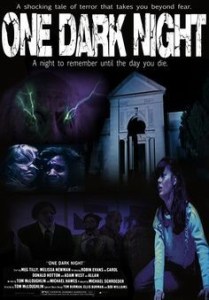
Day 28: One Dark Night (1983)

Halloween Every Day (for a Month)

By Andrew Neil Cole

Day 28: One Dark Night (1983).              OneDarkNight

One Dark Night is a movie with an identity problem—but an identity problem that actually works in its favor. The film bears all the hallmarks of early-’80s horror but is also clearly inspired by the Gothic horror tradition. This cinematic schizophrenia is exemplified by a screenplay that revels in rather violent shifts in tone and style, from boardwalk bumper cars to ornate mausoleum corridors, to create a unique stylistic fusion that could be describes as … I don’t know … ’80s Gothic?

The story concerns a teen “good girl” who wants to join a clique of not-so-good girls called The Sisters. Before officially joining The Sisters, Julie (the “good girl”) has to spend a night alone in a mausoleum. Unbeknownst to Julie and The Sisters, a Russian occultist/telekinetically gifted psychopath was interred in that very mausoleum earlier that very day … so … horrific shenanigans are just bound to ensue. The primary characters are straightforward ’80s teen-horror stereotypes (the “good girl,” the bitchy/sexy antagonist, the snotty girls who blindly follow the bitchy/sexy girl, and the hunky jock boyfriend with a heart of gold) whose converging storylines play out in a setting steeped in the iconography of Gothic horror cinema (coffins, candles, shadowy corridors, well-tended cemetery grounds).

This juxtaposition of ’80s-style teen-horror imagery and Gothic horror imagery is also made evident in the film’s production design and sound design. The kinetic/sonic chaos and flashing, multicolored madness of an ’80s video arcade is complemented by the overt stillness of a somber funeral scene set amid a muted visual landscape populated by mourners respectfully clad in black. Likewise, screaming teens in a speeding car with the radio volume maxed-out counterpoises the quiet echoing of light footfalls on the percussive floor of a mausoleum hallway, which in turn amplifies the fear-induced, labored breathing of a solitary teen surrounded by—literally—the stillness of the grave.

It’s also worth mentioning that One Dark Night is reminiscent of both ’80s horror and Gothic horror in terms of adult content, or, in this case, the lack of adult content. Despite the inclusion of numerous ’80s horror tropes, including too many story and character cliché’s to enumerate here, One Dark Night is, unlike virtually all of its contemporaries, a mostly bloodless, nudity-free, totally sexless film. Even the use of profanity is ratcheted way, way down. (In one scene, the bitchy/sexy girl refers to someone as a “turkey.”) Even during the climactic final 20 minutes, when coffins start popping open and dead bodies become featured players, the film never turns ghastly. There are no decapitations or disembowelments; no arterial spurting, no protruding shards of exposed bone. Instead, the final horrific rampage features flickering candles, swirling spirals of smoke and dust, and a recurring, strangely ethereal pink light—all of which is distinctly (and intentionally) Gothic. And it all works relatively well.

While the film’s unconventional mix of contrasting styles suggests innovation, the story and the characters offer absolutely nothing new. The idea of forcing (character name here) to spend a night alone in (name of spooky location here) in order to (win a contest/appease a blackmailer/pass a rite of initiation) is a narrative construct that has been repeated ad nauseam and needs to be put down like a wounded animal. As for the characters … Well, let’s just say that One Dark Night trades in character types rather than actual characters. We have “good” characters that we are supposed to like and “bad” characters that we are supposed to dislike. Actually, there is one exception. One of the bitchy/sexy girl’s friends has a change of heart and decides not to participate in the tormenting of the film’s “good girl” protagonist. However, this change-of-heart character is also a bit of a horror cliché, and when this moment of reconsideration occurs it is in no way revelatory.

Nonetheless, One Dark Night is a solid, entertaining movie with a truly interesting visual style and a finale that should satisfy most true horror fans, even those who will likely be irritated by the film’s deliberate pacing and slowly evolving narrative.

Day 29: The Howling (1981)

Halloween Every Day (for a Month)

By Andrew Neil Cole

Day 29: The Howling (1981).          TheHowling

The vast majority of werewolf movies tell basically the same story: The main character is attacked by a werewolf but survives; the main character then slowly comes to realize that he or she is now a werewolf as well, a discovery that normally leads to the realization that they, too, have taken lives, which, in turn, leads to the pursuit of resolution—i.e. finding a way to break the werewolf curse and return to normal life, or, more likely, the death of the main character. Music swells. Credits roll. Blah, blah, blah …

This is not the case with Joe Dante’s The Howling. Released in 1981, this surprisingly tight, well-crafted werewolf thriller mercilessly skewers the irresponsible nature of the media, the impact of television on the culture, and the self-help/pop psychology movement of the early ’80s that elevated countless academic/celebrity blowhards to the status of “guru,” all while doling out generous portions of fur-and-fang-induced mayhem. Dee Wallace stars (and rocks!) as Karen White, a TV news anchor who is traumatized by a terrifying confrontation with a serial killer. Her therapist/self-help author of some renown ships her off to The Colony, a remote treatment facility comprised of a collection of rustic cabins beneath a dense canopy of forest foliage. But the woodsy charm of The Colony quickly turns menacing. This is where The Howling really starts to howl.

The Howling is funny and intense in equal measure. The film’s satirical edge is by no means subtle, but it is also never preachy or pedantic; there is no political axe to grind, no moral judgments to render. Above all else, The Howling always remembers that its primary function is to be fun. Every role is perfectly cast; there are even some undeniably smile-inducing casting choices, such as the one and only Slim Pickens as the local law man, and genre favorite (and Dante regular) Dick Miller as the obligatory bookstore owner with a fully stocked occult section and, as luck would have it, a tray of silver bullets on display near the cash register.

Of course, you can’t have a successful werewolf movie without memorable werewolves. Thank the movie gods for the work of F/X makeup genius Rob Bottin. Bottin’s werewolves perfectly combine the physical attributes of both man and wolf to create tall, lean, hairy, bipedal beasts that stand nearly nine feet tall. These werewolves are so much more detailed and intimidating than the traditional lap-dissolve wolf-man hybrid creations introduced in the ’40s,   and they are leagues ahead of the snarling balls of computer-generated fur with glowing eyes that Hollywood seems so found of today. These werewolves feel like actual characters, like the primal, animal versions of their human selves. And the film’s iconic transformation sequence—elevated by a soundtrack of snapping bones and popping cartilage—deserves a position of honor in the Werewolf Hall of Fame. However, the F/X do occasionally remind you that this film was released in 1981. One shot depicts an extremely cartoony animated werewolf baying at the moon while having sex. Another shot focuses on a collection of old-school stop-motion werewolves that look so out of place Dante tries to hide them in the final seconds of a scene-ending dissolve. To my way of thinking, these instances of dated F/X work only add to the film’s overall charm. After all, the film was released in 1981, so there’s no shame in actually looking like a film released in 1981, since capturing and preserving moments in time is what cinema does best.

The only real problem that I have with The Howling is its rampant fanboyism. We get a cameo from horror legend (and Dante’s former employer) Roger Corman, who pokes fun at his reputation as a cheapskate in a scene where he enters a phone booth and makes sure to check the coin return for any forgotten change before placing his call. There’s also a cameo from Forrest J. Ackerman, the science fiction world’s original fanboy and the man responsible for the legendary magazine Famous Monsters of Filmland. Dante’s camera lingers on good ole’ Forry as he casually strolls the aisles of Dick Miller’s bookstore toting a few copies of Famous Monsters, their covers clearly visible within the frame. And then there are the incessant wolf and werewolf references. Werewolf cartoons and movies play on TVs in the background. A copy of Allen Ginsberg’s poetry collection Howl and Other Poems is prominently displayed on a characters desk. And, of course, many of the characters are named after directors of prominent werewolf films. For a movie that boasts one of the most original werewolf stories ever, The Howling spends an absurd amount of time doffing its cap to the Ghosts of Werewolves Past. There’s just something about the combination of the clever, often socially critical storyline and Rob Bottin’s groundbreaking werewolf creations that just doesn’t quite jibe with all of the insider genre references and cutesy personal tributes.

That said, The Howling is still a terrific piece of filmmaking and easily one of the best werewolf movies ever made.


(A portion of this article is excerpted in an essay by the same author.)