Day 5: Them!

Halloween Every Day (for a Month)

By Andrew Neil Cole

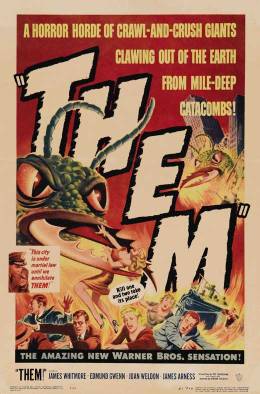
Day 5: Them! (1954). them-movie-poster-1954-1020544319
There exists, among horror fans and historians, a need to illuminate the ways in which the socioeconomic and political factors of a specific era have influenced the genre. This comes from an inherent need within those who love horror to legitimize the genre, make it appear more relevant and weighty to those who snootily dismiss the very idea that something meant to be scary can also be germane to a larger societal discussion. Unfortunately, this need to assign intrinsic cultural value to horror cinema often leads to some wild hypothesizing. For example, I agree that the zombies in Night of the Living Dead are more indelibly terrifying because they represent revolution in a time of social discord; however, I do not agree that the killer rabbits in Night of the Lepus (1972) are somehow scarier because, according to some, they symbolize the American people’s fear of government power run amuck in the wake of the Attica prison riot and the Kent State shootings. I mean, think about it: If you were trying to create a lasting, powerful metaphor for the government using violence against its own people to suppress individual thought and impose its own evil agenda, would you choose killer rabbits? I doubt it. Some horror films are just silly—or even stupid—and that’s the way it should be.

The one era that has had arguably the most obvious impact on the horror genre began when the end of World War II gave birth to the Cold War and all of its attendant hostilities and paranoia. Fear of atomic obliteration signified the inevitable dawn of mutant, giant monsters in the movies. In my opinion, the best of these atomic-age nightmares is Them!, the giant mutant atomic ant movie from 1954. As silly as this movie may seem at first blush (the exclamation point in the title certainly doesn’t instill in the viewer a sense of gravitas), the potential dangers of atomic energy are actually unpacked with great care, and the actors bring real life and much-needed urgency to characters that could have easily become genre clichés. James Whitmore is the local cop who first realizes the danger. Edmund Gwenn is the scientist called upon to solve the problem before the ants spread uncontrollably and kill us all! James Arness is the dashing, heroic G-man (a not-so-subtle reminder that the government employs its share of good guys). And Joan Weldon plays a scientist, who, while strikingly beautiful, is no screaming damsel in distress or wilting flower. No, she willingly plunges headfirst into the path of encroaching danger; moreover, she’s actually respected for her intellect, which is pretty rare for a female character in a horror film of this era. Of course, the ants look ridiculous—with their rubbery thoraxes and crooked mandibles in a state of constant shimmy—but, to be honest, even if this production had had access to the most amazing, groundbreaking, state-of-the-art special effects, we’re still talking about giant ants here. How cool could they possibly look?

Perhaps Them!’s crowning achievement is that it succeeds as a worthy and watchable giant-ant horror film despite the lack of believable giant ants—the rest of the movie is just that good. And, in the spirit of complete honesty, I have to admit to kind of loving the ants, no matter how cheesy.

Day 6: Creature from the Black Lagoon

Halloween Every Day (for a Month)

By Andrew Neil Cole

Day 6: Creature from the Black Lagoon (1954). creature-from-the-black-lagoon-movie-poster-1954-1010141460

Watching Creature from the Black Lagoon is like having a beer with a friend I haven’t seen in years. I’ve always been a sucker for the Universal Monsters, and I’ve always been a sucker for aquatic horror tales; therefore, Creature represents a lovely confluence of nostalgia and personal preference. Believe me, I’ve heard all of the criticism before, and, believe me, much of that criticism is deserved. The score is often screechy and obtrusive; Richard Carlson spends way too much time shirtless; Julie Adams’s character exists primarily to look sexy and scream at the slightest hint of danger; the Amazon River looks suspiciously like Florida; and the Gill-Man is obviously just a guy in a suit … But, come on … it’s one heck of a suit. Sure, in the grand pecking order of the Universal Monsters, this movie doesn’t compare to sheer the brilliance of James Whale’s Frankenstein films, nor does it hold a candle to the visual splendor of The Wolf Man, but such comparisons really aren’t fair. After all, Frankenstein isn’t nearly as much fun as Creature. And let’s not forget that the underwater sequences are actually pretty fantastic, particularly the extended scene in which Julie Adams glides effortlessly through the water, totally unaware that she is being pursued, while the creature keeps pace below her, safely out of sight in the murky depths of the Amazon.

Creature from the Black Lagoon isn’t a perfect movie, but, if you find yourself in the right frame of mind, it can be an integral part of a perfect movie night at home. (Note: I saw this film in 3D on Blu-ray. Honestly, I think it works better in good old-fashioned 2D. Something about the 3D made many of the scenes blurry to the point of inducing nausea.)

Day 7: Ouija

Halloween Every Day (for a Month)

By Andrew Neil Cole

Day 7: Ouija (2014).     Ouija_2014_poster

Here’s an unholy filmic trinity: a movie conceived in a boardroom, based on a board game, with a storyline and character arcs that are flat as an ironing board. Ouija represents everything that is wrong with mainstream Hollywood filmmaking today. It’s a lazy, cynical cash-grab utterly bereft of even the slightest hint of artistic integrity or innovation. This is one of those movies—like The Haunted Mansion or Battleship—that was just to bound to happen eventually because everyone—and I mean ever-y-one—has heard of Ouija boards. They’re an established brand, every bit as recognizable as a Campbell’s Soup can or a Nike swoosh, so there’s just got to be a built-in audience just dying to see a Ouija movie, right? … Right? … Anyone?

Right from the start, Ouija bombards us with one obligatory moment after another, ticking off the requisite genre banalities as it goes: Introduction of potential teen victims? Check. Scene (or scenes) in which the absence of all parents and/or legal guardians is made clear? Check. Creepy attic scene? Check. Creepy basement scene? Check. Even the actual Ouija board sequences are done entirely by the numbers—“Come on, guys. Someone’s making it move!” “It’s not funny anymore!”—and it gets old fast. Perhaps what’s most disappointing is the story, or, more to the point, the total lack of a decent story, since the Ouija board actually does have an inherently creepy history. Hell, the Internet is overflowing with truly terrifying tales of Ouija board experiences gone horribly wrong, so there’s just no excuse for a movie like Ouija to be so vanilla, so bland, so ultimately forgettable.

And yet, for all its faults, Ouija isn’t completely without its merits. There are moments where the dark, shadowy cinematography creates a palpable funhouse effect. And the young cast is actually rather likable. In particular, Olivia Cooke, the film’s star/final girl, I believe is destined for bigger and better things. Okay, we do have to put up with yet another annoying angsty teen sibling character, but that’s not the fault of the actress (Ana Coto) playing the role. And it’s always a joy to watch the great Lin Shaye chew the scenery into a soupy pulp. In the end, Ouija is an artistic failure, to be sure, but the blame for this failure needs to be placed at the feet of the big-money producers and studio executives who push movies like this through the development process to make a quick buck and not on the heads of the artists who are just trying to make a living in an industry that clearly favors style over substance.

Adults and more discerning teens will likely find Ouija a tedious affair, but this might be an effective Halloween sleepover film for young, burgeoning horror fans who are more susceptible to the thrill of the jump scare.

Day 8: Night of the Creeps

Halloween Every Day (for a Month)

By Andrew Neil Cole

Day 8: Night of the Creeps (1986).      creeps

Normally, I have a real problem with movies made by extreme fanboys. These movies are inspired by, informed by, and replete with references to other people’s movies. The lack of originality is often startling. Rather than tell stories derived from experience, intellect, and good old-fashioned creativity, these guys do little more than make cinematic Xeroxes of their all-time faves. This kind of filmmaking exemplifies homage, not art. And yet, Night of the Creeps is one fanboy film I find simply irresistible.

Writer/director/fanboy Fred Dekker does absolutely nothing new with Night of the Creeps; he even names all of his characters after famous horror directors (Cynthia Cronenberg, Ray Cameron, Chris Romero, and, my personal favorite, James Carpenter-Hooper). But if you like horror, particularly old-school horror, Creeps is for you. The story: alien slugs infiltrate a college campus and turn people into zombies. Along the way we meet a couple of wisecracking nerds, a beautiful but soulful sorority goddess, a group of knuckle-dragging frat boys, and the most butt-kickingest cop ever to walk a beat, played by genre favorite Tom “Thrill me!” Atkins. Creeps crash-landed at the box office with a booming thud and quickly disappeared into the shadowy netherworld of B-movie oblivion after its original release in the summer of 1986. It has had a much-deserved resurgence as a cult hit in recent years. I’m glad that a new generation of fans is starting to find this movie. It may not be deep or subversive or socially relevant (or worthy of comprehensive deconstruction in this post), but who cares? Chilly October nights are tailor-made for movies like this.

Day 9: The Haunted Palace

Halloween Every Day (for a Month)

By Andrew Neil Cole

Day 9: The Haunted Palace (1963). the-haunted-palace

Vincent Price, Roger Corman, Edgar Allen Poe, H. P. Lovecraft—sounds like Halloween to me. Creepy houses, fog-shrouded streets, death curses, a burning at the stake—so far, so good. Satanic allegiances, cloaked figures scampering in the dark, paranoid townspeople, an unknowably horrific creature awaiting release on an unsuspecting populace—it can only be The Haunted Palace!

This is one of those movies in which the sins of the past come back to wreak full-blown panic on the present. Vincent Price stars as Joseph Curwen, an evil warlock who is put to death by a handful of God-fearing townspeople who’ve had enough of the ominous goings-on regularly occurring behind the formidable walls of Curwen’s supremely Gothic mansion. While being burned at the stake, Curwen vows revenge from the beyond the grave and curses those who’ve had a hand in his death. Cut to 100 years later, when Charles Dexter Ward (also played by Price), a descendant of Curwen’s, arrives in town to take possession of the mansion. Soon the spirit of Curwen tries to possess the body of Ward and begin his season of resurrection and comeuppance. Of course, this all plays out within a series of creepy secret corridors, cobwebbed basement laboratories, and densely shadowed cobblestone streets where flickering gas lamps dance to a soundtrack of bone-rattling thunderclaps and otherworldly howling winds.

Movies like The Haunted Palace always come complete with their fair share of plot holes and unexplainable behavior. (For example, if the descendants of the men cursed by Curwen are so fearful of the curse actually coming true, why do they all still live in the same town generations later?) At the same time, the movie is delightfully creepy and absolutely dripping with atmosphere. So what if Roger Corman goes a bit too heavy on the fog machine? Who really cares if all of the thunderclaps sound exactly the same? Granted, those looking for excessive gore or heaping piles of naked young bodies (in other words, those who believe Nurse is a modern masterpiece) should probably seek their gooseflesh elsewhere. Even for true horror aficionados, The Haunted Palace might not be the scariest, most mind-blowingly terrifying place to spend an evening, but, luckily, you can rent by the hour.

Day 10: Popcorn

Halloween Every Day (for a Month)

By Andrew Neil Cole

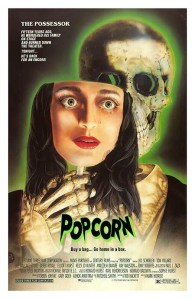
Day 10: Popcorn (1991).  popcornposter

Although it was released theatrically in 1991, Popcorn feels more like one of the last ’80s horror films than one of the first horror films of the ’90s. In fact, Popcorn could be seen as the movie that bridges the gap between dark ’80s slasher flicks and the sleek, meta, ironic-commentary horror shockers of the ’90s and beyond, as Popcorn works as both a serious slasher film and as a loving parody/homage to the history of horror cinema. As a slasher film about film students being stalked during an all-night horror movie marathon in a musty, dusty, old-timey theater from the William Castle days of yore, Popcorn is clearly a precursor to Scream’s wink-at-the-audience style of horror as a commentary on horror cinema as entertainment.

Subjectively, I much prefer this movie to the Scream movies. No offense to the Scream fans out there. I get it. Those movies certainly have their moments (thanks entirely to the direction of Wes Craven), but I just find them a little too cutesy, a little too pandering, a little too insular, and not nearly as clever as they clearly are trying to appear. Popcorn, however, knows exactly what it is: a fun, low-budget, unabashedly unpretentious B-movie slash-a-thon totally devoid of any delusions of grandeur. Popcorn is a movie that knows it’s not great, and that lack of self-consciousness provides the requisite creative freedom for it to at least be really good. I won’t bother unpacking the ebbs and flows of the storyline, and I wouldn’t dare reveal any spoilers. I will say that, with a few notable exceptions, slasher movies and I haven’t enjoyed a mutually beneficial relationship. I find the stories totally lacking in originality and the characters so lazily drawn that I stop caring what happens to them within seconds of their introduction. And yet, I really do enjoy watching this movie. And while Popcorn is admittedly not one of the great slashers, like Halloween or Black Christmas, it is a great entertainment and a great movie to kick back late at night and watch with a cold drink and a salty, buttery bowl of … well, you know.

Day 9: The Haunted Palace

Halloween Every Day (for a Month)

By Andrew Neil Cole

Day 9: The Haunted Palace (1963). the-haunted-palace

Vincent Price, Roger Corman, Edgar Allen Poe, H. P. Lovecraft—sounds like Halloween to me. Creepy houses, fog-shrouded streets, death curses, a burning at the stake—so far, so good. Satanic allegiances, cloaked figures scampering in the dark, paranoid townspeople, an unknowably horrific creature awaiting release on an unsuspecting populace—it can only be The Haunted Palace!

This is one of those movies in which the sins of the past come back to wreak full-blown panic on the present. Vincent Price stars as Joseph Curwen, an evil warlock who is put to death by a handful of God-fearing townspeople who’ve had enough of the ominous goings-on regularly occurring behind the formidable walls of Curwen’s supremely Gothic mansion. While being burned at the stake, Curwen vows revenge from the beyond the grave and curses those who’ve had a hand in his death. Cut to 100 years later, when Charles Dexter Ward (also played by Price), a descendant of Curwen’s, arrives in town to take possession of the mansion. Soon the spirit of Curwen tries to possess the body of Ward and begin his season of resurrection and comeuppance. Of course, this all plays out within a series of creepy secret corridors, cobwebbed basement laboratories, and densely shadowed cobblestone streets where flickering gas lamps dance to a soundtrack of bone-rattling thunderclaps and otherworldly howling winds.

Movies like The Haunted Palace always come complete with their fair share of plot holes and unexplainable behavior. (For example, if the descendants of the men cursed by Curwen are so fearful of the curse actually coming true, why do they all still live in the same town generations later?) At the same time, the movie is delightfully creepy and absolutely dripping with atmosphere. So what if Roger Corman goes a bit too heavy on the fog machine? Who really cares if all of the thunderclaps sound exactly the same? Granted, those looking for excessive gore or heaping piles of naked young bodies (in other words, those who believe Nurse is a modern masterpiece) should probably seek their gooseflesh elsewhere. Even for true horror aficionados, The Haunted Palace might not be the scariest, most mind-blowingly terrifying place to spend an evening, but, luckily, you can rent by the hour.

Day 10: Popcorn

Halloween Every Day (for a Month)

By Andrew Neil Cole

Day 10: Popcorn (1991).  popcornposter

Although it was released theatrically in 1991, Popcorn feels more like one of the last ’80s horror films than one of the first horror films of the ’90s. In fact, Popcorn could be seen as the movie that bridges the gap between dark ’80s slasher flicks and the sleek, meta, ironic-commentary horror shockers of the ’90s and beyond, as Popcorn works as both a serious slasher film and as a loving parody/homage to the history of horror cinema. As a slasher film about film students being stalked during an all-night horror movie marathon in a musty, dusty, old-timey theater from the William Castle days of yore, Popcorn is clearly a precursor to Scream’s wink-at-the-audience style of horror as a commentary on horror cinema as entertainment.

Subjectively, I much prefer this movie to the Scream movies. No offense to the Scream fans out there. I get it. Those movies certainly have their moments (thanks entirely to the direction of Wes Craven), but I just find them a little too cutesy, a little too pandering, a little too insular, and not nearly as clever as they clearly are trying to appear. Popcorn, however, knows exactly what it is: a fun, low-budget, unabashedly unpretentious B-movie slash-a-thon totally devoid of any delusions of grandeur. Popcorn is a movie that knows it’s not great, and that lack of self-consciousness provides the requisite creative freedom for it to at least be really good. I won’t bother unpacking the ebbs and flows of the storyline, and I wouldn’t dare reveal any spoilers. I will say that, with a few notable exceptions, slasher movies and I haven’t enjoyed a mutually beneficial relationship. I find the stories totally lacking in originality and the characters so lazily drawn that I stop caring what happens to them within seconds of their introduction. And yet, I really do enjoy watching this movie. And while Popcorn is admittedly not one of the great slashers, like Halloween or Black Christmas, it is a great entertainment and a great movie to kick back late at night and watch with a cold drink and a salty, buttery bowl of … well, you know.

Day 11: A Nightmare on Elm Street

Halloween Every Day (for a Month)

By Andrew Neil Cole

Day 11: A Nightmare on Elm Street (1984).     elm street

As I mentioned in my last post, I’m not crazy about slasher films. To my way of thinking, there are two types of horror movies: horror movies that tell horror stories and horror movies that depict horrific events and actions—that’s it. Slashers almost always fit securely into that second category. There are, however, exceptions to every rule. Movies such as Halloween and Black Christmas are well-regarded slashers because they take the subject matter seriously and their characters are realistic and believable and not archetypal caricatures whose worth can be measured only in surface values such as breast size or ab definition. Here’s a simple metric for determining the quality of any slasher movie: If at any time you find yourself rooting for the killer to eliminate all of the characters, you’re probably watching a bad slasher movie. However, there are plenty of bad slasher movies that are still lots of fun … but I digress.

A Nightmare on Elm Street is one of the most iconic, universally lauded slasher films ever, and rightly so. The story is original and conceptually terrifying. The characters are likable and likely to remind viewers of people they actually know (or knew in high school). These are not one-note characters that exist solely to whet the appetite of the audience for upcoming death scenes. No, in this movie, the bad boy rebel is also a loyal friend, and the mousey “good girl” finds the requisite courage to perform some pretty outrageously violent acts (as illustrated in a prolonged booby-trap sequence) when she needs it most. Like The Haunted Palace (the movie I watched on night number nine), A Nightmare on Elm Street is a multigenerational ghost story in which the sins of one generation will be remunerated with the innocent blood of the next generation. These characters were damned even before they were born, and right from the beginning their situation has an ominous sacrificial-lamb aura of inescapability about it. Unlike so many slasher victims, whose fates are decided by the inexplicable need for a late-night swim or the overwhelming desire to have sex in a forest where an infamous slaughter occurred, the characters in Nightmare are fully aware of their predicament and fight their seemingly unavoidable fate with every ounce of their strength. As a result, A Nightmare on Elm Street feels somehow more grounded in reality than most non-supernatural (or realistic) slasher flicks. In fact, I don’t really consider A Nightmare on Elm Street a slasher film at all but rather a ghost story that trains a white-hot spotlight on copious amounts of slashing. After all, Freddy Krueger is a malignant spirit, not a living, breathing masked lunatic with a machete and an ornery disposition.

It should also be noted that Nightmare is a fantastic piece of filmmaking. This is a tightly paced, thrilling tale that seamlessly blends horrific nightmare imagery with mundane, everyday suburban iconography. Consider the bleak dreamlike quality of one character’s (Tina) corpse in a body bag being dragged away by an unseen force, leaving a grisly trail of smeared blood behind. Now contrast that with the banal, well-worn imagery of the stereotypical suburban classroom from which another character (Nancy) is beckoned by that very corpse. Masterful moments like this (and there are many) more than make up for the ridiculous ending, particularly the instant when the blow-up sex-doll version of Ronee Blakley gets yanked through the miniscule window in her front door.

A Nightmare on Elm Street is a classic and an American original that will be remembered forever by horror fans the world over. Unfortunately, we recently lost Wes Craven, the writer and director of this gem. But he, too, was an American original who will never be forgotten. Rest peacefully, big guy. You earned it.

Day 12: Horror of Dracula

Halloween Every Day (for a Month)

By Andrew Neil ColeHorOfDrac

Day 12: Horror of Dracula (1958).

In previous posts I’ve mentioned that, with a few notable exceptions, I am not a fan of slasher films. Well … the same could be said for vampires. I don’t know … I just never really understood the fascination with these creatures—at least as far as movies, novels, and TV are concerned. I can certainly understand the allure of living forever, being beautiful, and having power over lowly human beings; but fictional incarnations of the vampire way of life (or undeath, I suppose) have mostly, to my way of thinking, been little more than simplistic retellings (and often shameless rip-offs) of what Bram Stoker created more than a century ago (and, to a lesser extent, what John William Polidori created almost two centuries ago with his short story “The Vampyre”). And yet, as with slasher films, there are notable exceptions. Movies like Near Dark, Martin, Fright Night (1985), Let the Right One In, and both the silent F. W. Murnau 1921 version and the full-audio 1979 Werner Herzog version of Nosferatu have become all-time favorites of mine. But for me, when I hear the word vampire, I think of Count Dracula and Abraham Van Helsing, and I when I think of Count Dracula and Abraham Van Helsing, I think of Christopher Lee and Peter Cushing, and when I think Christopher Lee and Peter Cushing, I think of the Hammer Films series of Dracula pictures. And then I smile like big slobbering baby.

Horror of Dracula, the first and arguably the best in Hammer’s Dracula series, is, to me, required viewing, an absolute necessity come each October. It should be noted that this Dracula has almost nothing in common with what Stoker produced; in fact, writer Jimmy Sangster and director Terrence Fisher seem to revel in completely reinventing Stoker’s narrative to suit their considerably limited resources and miniscule budget. And they make it work, effectively retooling Stoker’s overtly sexual narrative metaphor into a pure seek-and-destroy-the-monster tale … with overt sexual overtones still in play, of course.

Horror of Dracula proudly bears its blood-stained fangs, squeezing every ounce of moody atmosphere out of its Gothic setting through in-your-face art decoration and costuming, the not-so-realistic background matte paintings of looming mountains, the liberal use of blood the color of candied apples, and a surfeit of scenes set in ancestral graveyards, chilly crypts, and dank cellars. But perhaps the most fun to be had lies in the performances. This film provides the horror fan the rare opportunity to see iconic characters played by iconic actors at the height of their abilities. Peter Cushing as Van Helsing, Christopher Lee as Dracula, Michael Gough as Arthur Holmwood—no room for teen scream queens here. Isn’t that a novel concept?