Day 18: It Follows

Halloween Every Day (for a Month)

By Andrew Neil Cole

Day 18: It Follows (2014).       It Follows
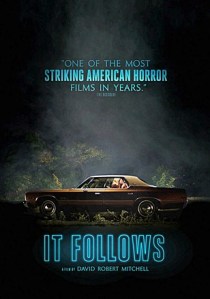
Writer/director David Robert Mitchell’s It Follows is one those rare modern American movies that pulls off a cinematic trifecta of sorts, in that it succeeds as a work of narrative art, as a work of cinematic art, and as entertainment. Its narrative artistry manifests itself in the telling of a multilayered story that utilizes allegory and metaphor without being heavy-handed or pedantic. It works as cinematic art because it revels in creating a nuanced visual style that amplifies the screenplay’s manifold recurring themes and concepts, and, in so doing, encourages and rewards multiple viewings. And it works as entertainment because it’s freakin’ cool as hell.

It would be reductive to think of It Follows as simply an allegory for STDs, even though the story of a sexually transmitted “demon” of sorts does certainly encourage that particular interpretation. But what these characters really seem to fear is the pain and misery of growing up and becoming adults (and having sex is probably the one act that most clearly represents the transformation from carefree youth to the unending concerns of adulthood). Consider the way in which Jay, our main character, prepares for a date with her new boyfriend in one of the film’s early scenes. Dressed in a sexy outfit, she stands in front of a mirror applying lipstick. When she finishes, she takes a long, disappointed look at her reflection. Her expression suggests that playing dress-up for a pretend date as a child is much more fun and less nerve-wracking than actually dressing up for a real date as a young adult. Much of this exact sentiment is repeated a few moments later in a monologue delivered by a melancholy Jay right after having sex in the backseat of her boyfriend’s car, while she playfully strokes a sprig of tiny flowers that has sprouted out of the surrounding concrete. This is just one of many beautifully executed, subtly symbolic sequences in the film.

I wouldn’t dare instruct viewers as to how they should interpret It Follows. But, for anyone who hasn’t seen it or for anyone interested in giving it another look, I would suggest that you turn off your phone, get comfortable, and pay close attention, otherwise you’re not really giving the film a fair shot. I would suggest listening closely to what actually is being said in the dialogue scenes. Also, pay attention to the use of color (particularly red); take note of the ways in which water is used, what the characters are named, the significance of photographs, the use of technology (and lack thereof). Consider the womblike safety of an old above-ground pool and what it means when that pool is eventually trashed. I’ll stop there, but I could go on for pages.

It Follows is a film that has caused much debate among horror fans. I know that a lot of people don’t like this movie, and they are certainly welcome to their opinions. But it is also possible that a lot of horror fans, particularly younger fans, are simply not used to seeing the kind of horror that requires active viewing. Granted, if exploding zombie heads and disembowelments are your cup of cinematic tea, It Follows is most assuredly not for you. And that’s okay. We are all aloud to like what we choose. It is possible, however, that many people are judging the film for what they want it to be (something more horrific, something more overtly graphic both in its depiction of violence and its narrative intentions) rather than what it actually is (an artfully rendered, thoughtful, deeper cinematic expression). Not all horror films require a body count and extreme violence to make an impact, in the same way that not all comedies should require gratuitous raunch and fart jokes to get laughs.

Day 19: Possession

Halloween Every Day (for a Month)

By Andrew Neil Cole

Day 19: Possession (1981).      Possession

Here’s something you don’t see every day: a gleefully esoteric horror film about the breakdown of a marriage, made by a serious filmmaker, starring serious actors, targeting a serious adult audience. With its outrageously gooey creature effects, green-eyed doppelgangers, over-the-top dialogue, and a loopy narrative high-wire act (including a spy-thriller subplot that bookends the film), Andrzej Zulawski’s Possession is perhaps the ultimate example of ’80s art-house horror done right. Isabelle Adjani and Sam Neil play a couple who clearly love each other yet whose marriage is apparently unsalvageable. He has been away on a secret mission for far too long; she has been unfaithful … and so much more.

Even though watching this couple scream, kick, punch, slap, and completely trash a café in the name of love (or lost love) can seem tedious at times, there is no denying the power of many of these argument/fight scenes, which somehow manage to feel savagely real and dreamily unreal at the same time, a quality also easily applied to the film as a whole. Adjani and Neil are perfectly cast (this role won Adjani numerous awards, including Best Actress at the Cannes Film Festival), as is Heinz Bennent as Heinrich, the creepily eccentric Renaissance man with whom Adjani’s character is having an affair.

The film was shot in Berlin amid a cluster of intertwining streets and colorless decaying buildings. The lighting is austere, punctuated by storm-cloud gray exteriors and muted, lived-in interior spaces with impossibly dark corners swathed in shadows as dense as black holes. Intermittent shots of armed guards patrolling the Berlin Wall mirror the couple’s failing relationship: they are physically so close to one another yet unable to communicate respectfully,  or even without the looming threat of violence, as evidenced in their many physical altercations.

Possession is ultimately a strange, challenging film that requires the viewer’s undivided attention and patience. It’s a film that asks difficult questions about human behavior, particularly concerning adult relationships, and attempts to answer none. It’s a film that trades in metaphor and allegory and refuses to make the experience easier or more palatable for its audience. In other words, Possession is not a traditional horror film: no jump scares, no bogeymen in masks. It is, however, a movie that will leave an indelible impression on anyone who has ever been in a relationship and wished they could mold their partner into an idealized version of a girlfriend, boyfriend, or spouse. Some fantasies are better left in Fantasyland.

(Oh, by the way, the infamous subway miscarriage scene earns every bit of its reputation and is well worth the price of admission on its own. Way to go Isabelle!)

Day 20: Trick ‘r Treat

Halloween Every Day (for a Month)

By Andrew Neil Cole

Day 20: Trick ‘r Treat (2007).      Trick'rTreat

There is perhaps no horror subgenre more difficult for filmmakers to conquer than the anthology film. On the positive side, anthologies are not bound to any one horror style, classification, or category; they are free to explore the entirety of the genre, from astral projection to zombie apocalypses, all within the same film. On the negative side, anthologies are, by their very nature, unable to spend much time on any one story; therefore, the freedom of anthologies to explore different styles of horror is usually stifled by the need to keep each individual tale simple enough to be told quickly. There simply is no room for narrative innovation or the fleshing out of complex characters in the storytelling. And so the result is usually a lazy assemblage of predictable tales rife with buckets of blood, mutilated bodies, and too many jump scares bother counting.

And then there’s Michael Dougherty’s Trick ‘r Treat.

The primary innovation that separates Trick ‘r Treat from so many by-the-numbers horror anthologies is the way in which the stories unfold. Traditional anthologies tell stories one at a time, often introduced by either some sort of macabre master of ceremonies (a la the Crypt Keeper) or through a simple narrative device that allows characters to take turns regaling each other with their personal nightmares. But Dougherty slyly subverts the one-story-at-a-time expectation by introducing all of his characters early in the film, then moving back and forth between their stories, even playing with the timeline along the way, until the film begins to feel like a complex singular story about one Halloween night in a banal suburban landscape rather than five individual stories. And yet, all of the traditional anthology fun is still here to be had. We get a serial killer story, a monster story, a ghost story, a curmudgeon-who-hates-Halloween-gets-his-comeuppance story, and a see-what-happens-when-you-don’t-follow-the-rules story—and all of them pay off in grimly satisfying ways.

In the years since its release in 2007, Trick ‘r Treat has become a bit of a cult classic and a must-watch on Halloween for hordes of horror fans. This is due largely to the film’s visual style. Very few films have ever captured the fun/nostalgic atmosphere of Halloween night like this sucker. In virtually every shot we see either people in costumes or trick-or-treaters or decorated houses or jack-o’-lanterns, all punctuated by the bright colors of autumn foliage spread out across windswept streets and leaf-strewn lawns.

Ultimately, Trick ‘r Treat succeeds as an inventive work of horror filmmaking and as a nostalgia-inducing homage to Halloween.

Day 21: The House of Seven Corpses

Halloween Every Day (for a Month)

By Andrew Neil Cole

Day 21: The House of Seven Corpses (1974).      House7co

In the history of American cinema, the 1970s is a decade marked by great contradictions. While the works of Coppola and Scorsese were sharpening the definition of the word auteur and Spielberg and Lucas were redefining the word blockbuster, the world of underground cinema was producing a veritable wellspring of low-budget exploitation pictures that perfectly suited the many thriving local grindhouse and drive-in circuits. Most of these films focused on extreme violence and outrageous sexual content. It was the time of gritty urban drama/action/blaxploitation pictures and kung-fu/horror pictures and monster/nudie pictures and funky soundtracks and big hairdos and loud fashion statements. Every street corner was home to a ho with a heart of gold and a pimp with a thirsty switchblade, and The Man was always hasslin’ somebody.

And then, in 1974, The House of Seven Corpses, a quiet, moody little PG-rated horror film, was released right in the middle of all the exploitation craziness. Though the film isn’t nearly as extreme as its fellow low-budget releases, its story of a film crew shooting a horror movie in a right-and-truly haunted house is every bit as contrived and underwhelming. The fake blood really hits the fan when, in an attempt to capture a more realistically sinister tone, an actress reads an incantation directly from The Tibetan Book of the Dead, stirring the property’s supernatural forces into a frenzy (and literally causing the dead to rise in a surprisingly effective sequence). Equally effective (and surprisingly subtle) is the way in which the film openly mocks Hollywood hierarchies. There’s the taskmaster-style director who is so driven to make his movie he doesn’t care whom he hurts along the way. There’s the aging leading lady, desperately clinging to her waning beauty and fading popularity. There’s the beautiful young ingénue, doe-eyed, simple, sweet, and naïve to both the ways of the film industry and to the simple fact that her presence is a constant reminder to the older actress of what once was and will never be again.

The House of Seven Corpses is not likely to really scare anybody, especially hardcore horror fans, but the performances are strong, the story, though contrived, is more clever than you might think, and the atmosphere is truly the stuff of good old-fashioned spook shows. For those true aficionados who appreciate that breed of ’70s-style horror that spotlights spooky mansions, creaky staircases, and fog aplenty, The House of Seven Corpses is well worth a visit.

Day 22: Deathdream

Halloween Every Day (for a Month)

By Andrew Neil Cole

Day 22: Deathdream (1972).      DeathdreamPoster

George A. Romero’s Night of the Living Dead (1968) is rightly credited for forever redefining the zombie movie; but, perhaps more importantly, it is also the first independently produced low-budget horror gore-a-thon to subvert and attack establishment thinking. The film overtly criticizes media power run amok, speaks directly to the state of race relations in the country, and suggests the possibility of a coming revolution (e.g. masses of the Dead rising up to overthrow the status quo)—and all of this is accomplished while maintaining a pulse-pounding suspense narrative that never forgets its horror roots or skimps-out on moments of pure unadulterated terror. NotLD would go on to be become a midnight-movie phenomenon that would ultimately be accepted as an indispensable genre classic. It would also make a decade’s worth of exploitation horror cinema seem superfluous by comparison.

With the exception of one fatal flaw, director Bob Clark’s Deathdream (1972) could be seen as a worthy successor to the legacy created by NotLD. With its tale of a dead American soldier returning to his hometown to visit the horrors of Vietnam upon the sleepy denizens of suburbia, Deathdream, like NotLD, is most certainly a movie of and for its time. It can be seen as an obvious criticism of the Vietnam War itself, as a criticism of the way soldiers were treated upon returning home, or as a portrait of the naiveté of the average citizen who will never endure the physical and emotional burden of combat. And now, with the benefit of historical hindsight, the film could even be interpreted as an ex post facto PTSD allegory. (It wasn’t until 1980 that post-traumatic stress disorder was finally added to the third edition of the Diagnostic and Statistical Manual of Mental Disorders by the American Psychiatric Association.) The film’s intention to be much more than just another drive-in zombie splatter-fest is perhaps most evident in a scene in which Andy the zombie soldier visits his family’s doctor. After making the doctor listen to his complete lack of a heartbeat, Andy addresses the doctor’s stunned countenance by saying: “I died for you, Doc. Why shouldn’t you return the favor?”

For all its good intentions, Deathdream, like so many well-intentioned horror films, eventually devolves into little more than a series of gruesome (and seemingly random) bloodlettings. People start dying in horrific ways because … well … it’s a horror movie and people are supposed to die in horrific ways, right? Deathdream ultimately feels like a wasted opportunity, albeit a well-crafted wasted opportunity. Strangely, the movie reminds me of Damien: Omen II. Don’t worry, I’ll explain. Damien tells the story of a pre-teen boy coming to the overwhelming realization that he is the son of Satan. This could have been an interesting subject for a horror film. We could have been treated to a fascinating exploration of a boy on the cusp of becoming both a man and a monster, knowing that he is helpless to do anything about either. Instead, once Damien learns of his satanic lineage, he immediately starts killing people in particularly awful ways, and the film becomes just another body count movie.

While Deathdream ultimately betrays the lofty expectations it creates, it is still well worth seeing. The acting, filmmaking, and cinematography combine to create a Currier and Ives-style atmosphere of warmth and hominess (lots of picket fences and fluffy dogs—hell, you can almost smell the apple pie cooling in an open window), which perfectly contrasts the violence about to ensue, like red paint on a white canvas. Kudos to director Bob Clark (whose next horror film, Black Christmas, would become a slasher classic) for attempting to say something significant with a zombie film. Yeah, he couldn’t quite sustain the power of the metaphor for the entire running length of the film, but at least he gave it a hell of shot, which is more than I can say for Damien and so many others of its creatively bankrupt ilk.

Day 24: April Fool’s Day

Halloween Every Day (for a Month)

By Andrew Neil Cole

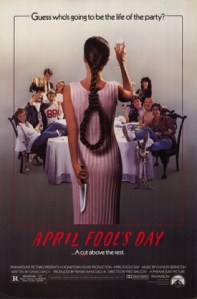
Day 24: April Fool’s Day (1986).       AprilFool'sDay

(The following contains SPOILERS. You might not want to read beyond this point if you haven’t seen Halloween III: Season of the Witch, Friday the 13th: A New Beginning, and April Fool’s Day.)

There are arguably three ’80s-era horror films that have stoked the ire of hordes of horror fans more than any others. In 1982, Halloween III: Season of the Witch incurred the wrath of film audiences everywhere for one simple reason: Michael Myers, the escaped lunatic/butcher knife enthusiast/worst nightmare of teen babysitters and hospital employees/rampage killer from the first two Halloween films, was nowhere to be seen. Then, released to cacophonous hisses and boos in 1985, came Friday the 13th: A New Beginning, which is often referred to as the worst F13 of them all, due primarily to the fact that iconic, goalie-masked slaughter-hound Jason Voorhees is ultimately revealed not to be the killer. Finally, in 1986, April Fool’s Day was summarily dismissed by countless horror buffs because the film lived up to its title and revealed, in its final moments, that all the blood and guts and murderous goings-on were an elaborate hoax perpetrated by the plucky, endlessly resourceful hostess of a get-together attended by an assortment college friends/acquaintances.

It’s fair to hypothesize that the lack of audience appreciation for the above-mentioned films speaks more to audiences’ growing appetite for blood and extreme violence in mainstream horror than it does to the actual quality of the filmmaking. Don’t get me wrong, I am not a fan of F13: ANB; it is clearly a money-grab, no more than a cheap excuse to keep a broken franchise limping along. But I have to admit that I have a soft spot for both Halloween III and April Fool’s Day. While neither film has earned the right to be considered an unquestioned classic, both films at least attempted to take mainstream horror in fresh new directions. Consider the idea at the core of Halloween III. Producers John Carpenter and Debra Hill intended to make an original Halloween-themed film each year, starting with Halloween III—a concept meant to infuse the franchise with new and innovative ideas and move it away from the well-worn hack-and-slash construct of the first two films. (Don’t interpret this as a criticism of the first two Halloween films. The second film is certainly superior to most slasher sequels and the original is an all-time classic.) It’s disappointing that HIII: SotW was so reviled by fans. Even if the film itself failed to meet expectations, the effort should have been applauded. After all, how many times do you need to see a voiceless man in a mask stalk and kill people? The producers of the Halloween films had already given fans two feature-length movies of stalk-and-slash action—that’s approximately three hours of knife-wielding and bloodletting! Really, how much is enough? Why would people be so averse to a little narrative innovation? The answer is simple and a little disheartening: the slasher films of the ’80s created a new breed of horror fan, one that preferred extreme violence and ghastly F/X over storytelling and atmosphere. These fans were (and are) actually disappointed if a horror film didn’t provide the same tired story in which stereotypical characters are presented as potential victims … and then eventually served up as actual victims. In this terribly contrived cinematic scenario the body count is the story, the potential for blood is the attraction, and fans of creative storytelling need not apply.

This new audience-shift toward gory over story is exactly why a film like April Fool’s Day remains so despised by so many people decades after its release. Unlike HIII: SotW, which tells the very un-slashery tale of an insidious megacorporation’s plot to use cursed Halloween masks to kill millions of people, April Fool’s Day makes the unforgivable mistake of actually setting up a traditional slasher narrative before unceremoniously yanking the rug out from under the feet of horror fans who just wanted to see a group of college friends get picked off one at a time in increasingly distasteful ways. But I would argue that any horror fan who dismisses AFD because the horrors presented by the film are in fact not “real” (by the way, we shouldn’t forget that all horror films are not “real”) is missing out on a surprisingly good movie that works as a dark comedy and as a hearty lampooning of suspense/slasher cinema. It takes guts to make a movie that pokes fun at slasher films and then markets that film directly at slasher fans. Remember, this movie was released in 1986, right in the crucible of slashermania, when thousands of movie screens were being stained by a fresh crop of decapitations, throat cuttings, and disembowelments virtually every weekend.

I don’t want to overplay my hand, so I’ll now reiterate that April Fool’s Day, while competent and ultimately entertaining, is by no means a classic. But that doesn’t mean that the movie is to be avoided. Quite the contrary: AFD boasts a cast of believable and even likable characters played by a cast of solid professional actors, all of whom deliver their dialogue so believably that much of the film feels improvised … and well improvised, at that. Improvised or not, the dialogue in AFD is much better and much smarter than expected. In fact, the whole movie is much better and much smarter than expected. But then again, maybe my expectations have been lowered by so many uninspired, imagination-challenged, intellectually insulting slasher films that, by comparison, even a decent film can seem kind of great.

Day 25: The Hunger

Halloween Every Day (for a Month)

By Andrew Neil Cole

Day 25: The Hunger (1983).          TheHunger

Back in my college days, I remember The Hunger inspiring many a lunchroom debate among my fellow film majors. To this day, those who support the film argue that the tone is suitably creepy, the performances from Catherine Deneuve, David Bowie, and Susan Sarandon are pitch-perfect, and the story innovates by depicting vampires as something more than just blood-sucking monsters in constant search of their next fix. In addition, they’ve argued, the film deftly utilizes vampire lore to truly consider the ravages of time—specifically an eternity of time. These are all valid assertions, worthy of consideration, made by reasonable people.

And yet The Hunger represents everything I dislike about vampire movies. Regardless of how deeply philosophical the film wants to be, ultimately it is nothing more than a hyper-stylized cinematic orgy of writhing flesh and cascading blood in which beautiful creatures of the night lament the curse of immortality while propounding half-baked ideas about the profundity and timelessness of love in the face of death (or undeath or immortality or whatever the hell). Sure, these fanged lovelies may seem tortured and complex and even a little bit relatable, but don’t be fooled. In reality, regardless of what they may say, their actions are those of pretty people who want to live in pretty houses and wear pretty clothing and stay pretty forever—and nothing more.

And then there’s the overwhelming visual style of The Hunger, a style I like to refer to as “Vampire Chic,” a kind of neo-Gothic visual product derived from a combination of old-world European fashion sense and moneyed new-world excess. To wit: These vampires are stylish old-world Europeans who live in a hulking European-style mansion, which is located right smack in the middle of ’80s (or modern) New York City. They wear the latest designer clothing accented by old-world European jewelry. The décor of their home, with its vast empty spaces and great walls hung with European portraiture, suggests a bridging of snooty ’80s minimalism and something straight out of Vlad the Impaler’s sitting room. This confluence of contrasting styles allows the filmmakers to appeal to (or pander to) both old-school vampire enthusiasts (those from the Stoker tradition) as well as new-age vampire devotees whose allegiance to the fang was born in the Goth clubs that rose to pop-culture prominence in the early ’80s.

The Hunger is a film that luxuriates in Vampire Chic, constantly reminding the audience that it is indeed a vampire film. Much of the film takes place in the sparsely decorated rooms of a cavernous mansion that just screams: VAMPIRES LIVE HERE! And, lest we forget, nearly every shot features either horizontal shadows cast by pale light shown through window slats or the ridiculous rippling of silk curtains against an ethereal, almost supernatural breeze. I’m not kidding. I challenge anyone to watch this movie and not be shocked by how many times the characters are photographed near billowing curtains—or even through billowing curtains. Seriously, there are several (by “several” I mean way, way too many) shots in which the camera photographs the characters directly through silky, billowing curtains, as if to create some kind of bizarre, neo-Gothic Vaseline-lens effect. But it gets worse. In addition to the billowing curtains and the hardboiled, Mickey Spillane-style shadows, director Tony Scott introduces—you guessed it—fluttering doves into the mix. In scene after scene, the characters maneuver within absurdly ornate spaces, both interiors and exteriors, oddly occupied by a cote of doves, flapping and fluttering about, often in slow motion. Strangely, the presence of these birds is never questioned—by anyone! Ever! And before you even ask, the answer is yes. Of course there is a final sequence that prominently features both silky billowing curtains and fluttering doves.

The Hunger is one of those movies that would be fun if it didn’t take itself so seriously. As it stands, the movie unintentionally works as a metric to define where you stand on vampire cinema: If you love vampires unconditionally, you’ll find a lot to love about The Hunger. If vampires need to earn your love, The Hunger may well prove to be a grating experience that severely tests your patience.

Day 26: Willow Creek

Halloween Every Day (for a Month)

By Andrew Neil Cole

Day 26: Willow Creek (2013).        WillowCreek

Ah … found-footage horror movies. There’s not much left to be said, really. Either you find this particular gimmick to be fun or you don’t. Or maybe you once found it fun, back in those halcyon, sepia-toned days of Blair Witches and Paranormal Activities, but those times are now nothing but a blurry little shapeless mass in your rearview mirror. Found footage doesn’t usually work all that well because it almost always promotes the position that the method of storytelling is much more interesting than the story itself. The attraction is not the telling of a good old-fashioned creepy story but rather the haphazard jiggly-cam presentation of the story, which engenders obtuse, idiotic observations and forced character revelations (usually in the form of tearful confessions and phony, self-serving apologies). Ultimately, most found-footage movies are hollow viewing experiences. After all, the only thing worse than rooting for the monster/madman to hurry up and kill off all of the lame-o characters in a bad horror movie is having to do so while fighting off recurring bouts of nausea (from the absurdly unsteady camera work) and boredom (from the absurdly uninteresting story and characters). By definition, found-footage movies have to be lesser works of cinema, because in order for the gimmick to work in the first place, the story has to be so simplistic it can be captured adequately by a tiny crew working with extremely limited financial resources and equipment.

Which brings me to Willow Creek, a movie that illustrates the best and the worst attributes of found-footage horror. Like a lot of found-footage movies, the journey in Willow Creek is more interesting than the destination. The story of a boyfriend and girlfriend on a road trip to document the site of the infamous 1967 home movie of a casually strolling Sasquatch taken by Roger Patterson and Bob Gimlin is more believable than most found-footage setups, since literally thousands of people from all over the world descend upon Willow Creek, CA, each year to do exactly what these characters are attempting to do. The found-footage gimmick actually aids in creating believable (if not particularly interesting) characters who turn their camera on actual locations well known to the Bigfoot community. There’s even a fun moment at a Bigfoot-themed diner in which the characters banter playfully while consuming enormous burgers served on buns shaped like a Sasquatch footprint.

Once the characters are in the woods and in full-on camping mode, the film delivers not only the best scene of the movie but one of the best uses of the found-footage gimmick I’ve yet seen. The scene consists of one static shot that lasts approximately 18 minutes, most of which transpires in complete character silence, some of which in complete darkness. This sequence works because it allows the ambient sounds of the surrounding forest, and all the things that dwell within it, to be the source of suspense. There is nothing for the actors to do but react to what they hear outside of their tent. Their confusion and deepening terror is palpable. Kudos to director Bobcat Goldthwait for having the courage to let the scene simply play out and for trusting his actors, and kudos to the actors (Alexie Gilmore and Bryce Johnson) for delivering the goods. So often found-footage movies feel phony despite the implied reality of the gimmick; the performances and camera work feel forced, disjointed, like they are never really on the same page, like they are trying so hard to appear “realistic” that they’ve forgotten how to be compelling. That is not the case with much of Willow Creek.

That is, until the film’s finale.

This is where the worst attributes of found-footage gimmickry finally find the spotlight.  Willow Creek eventually dissolves, as do all found-footage movies, into scenes of characters arguing, then running, then running and screaming, then arguing, then back to running and screaming. The photography becomes shakier and shakier until it becomes nearly unwatchable. By this point, you could literally be watching the final moments of any found-footage movie, since they all end on the same note: chaos followed by abrupt, halting stillness.

The result: Willow Creek both wildly succeeds and wildly fails. There are enough strong moments to merit watching the film; however, the most promising moments (including some truly great ones) are ultimately wasted, as the film takes a disappointing narrative turn back toward inevitability and predictability.

Day 27: Q: The Winged Serpent

Halloween Every Day (for a Month)

By Andrew Neil Cole

Day 27: Q: The Winged Serpent (1982).        Q

Q: The Winged Serpent is a monster movie that constantly oscillates between the old and the new, with results that oscillate between surprisingly effective and terribly cheesy. For example, the story concerns an ancient terror being visited upon a modern metropolis; the old-school Ray Harryhausen-style stop-motion creature effects are employed to create the kind of gore-soaked decapitations and eviscerations that more modern-minded horror audiences have come to expect; and the classic monster-on-the-loose storyline shares narrative space with contemporary crime subplots that include a police investigation of apparent human sacrifices and a botched diamond heist attempted by a small-time criminal outfit. This bringing-together of “what was” and “what is” can be an effective horror/sci-fi device when properly applied. One could argue that the most compelling moments in Jurassic Park owe a debt to this very device. After all, it’s not simply the reintroduction of dinosaurs that is terrifying, it’s the idea of these prehistoric predators existing in an extrinsic era and environment that generates the film’s suspense. A T. rex stomping through the jungle is cool, but a T. rex attacking and dismantling a fully loaded, rail-guided tour car is much cooler. Similarly, velociraptors stalking prey is cool, but those same raptors stalking ’90s-era children in a state-of-the-art kitchen, their claws clacking on stainless steel prep tables, is much, much cooler. Regrettably, director Larry Cohen didn’t have anywhere near the resources available to him on Q: The Winged Serpent that were available to Steven Spielberg on Jurassic Park.

The titular Q in Q: The Winged Serpent is actually Quetzalcoatl, a vengeful Aztec god with giant wings, a beaklike mouth full of pointy teeth, a serpentine tail, and four sets of razor-sharp talons. Q swoops around Manhattan chomping on New Yorkers in a series of rather impressive aerial POV shots. There is also a climactic shoot-out that takes place in the spire of the Chrysler Building that is clearly meant to conjure memories of the final moments of King Kong. This sequence, which features scores of cops firing machine guns at the circling monster, works as another example of the film’s penchant to marry the old with the new; however, this time the monster attacks the building filled with armed men, the reverse of Kong, where the monster swats at circling biplanes from its perch atop the Empire State Building.

Unfortunately, for all the fun there is to be had with Q: TWS, the cockamamie story and outdated special effects drench the film in the unmistakably sticky sheen of B-movie stink. The film’s frequent attempts to portray its outrageous subject seriously are always undercut by laughable F/X sequences and/or absurd story revelations. But then again, don’t we watch movies like this precisely because of laughable F/X sequences and absurd story revelations? I know I do.

While it’s easy to nitpick the many faults of Q: TWS, it’s also not quite fair. This is a low-budget monster movie that completely succeeds as a low-budget monster movie. It is exactly what it is supposed to be. It could be argued that the film suffers most from a simple case of poor timing. Let’s not forget that Q: TWS was released in 1982, a time when monster movies were defined by more expensive studio projects like Jaws (1975), Alien (1979), and John Carpenters The Thing, a film often regarded as the best creature/monster movie ever, which happened to be released the same year as Q. All of these films, as well as the original Star Wars trilogy, whose creatures and monsters have been universally praised, had significantly more financial and material resources at their disposal than a film like Q.

In the end, like so many great B-movies, this film’s enduring charm will continue to endure precisely because of its shortcomings rather than in spite of them. People don’t still watch Plan 9 from Outer Space or Troll 2 because they’re perfect works of cinema; they still watch them because they’re fun. Genre fans would be wise to forgive the film’s smattering of annoying cinematic peccadilloes and enjoy it the way it was meant to be enjoyed—with a few slices of cold pizza and a beer, and without cynicism.

Day 28: One Dark Night (1983)

Halloween Every Day (for a Month)

By Andrew Neil Cole

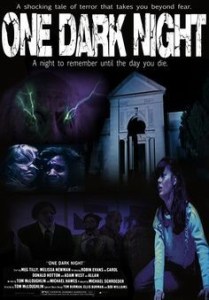
Day 28: One Dark Night (1983).              OneDarkNight

One Dark Night is a movie with an identity problem—but an identity problem that actually works in its favor. The film bears all the hallmarks of early-’80s horror but is also clearly inspired by the Gothic horror tradition. This cinematic schizophrenia is exemplified by a screenplay that revels in rather violent shifts in tone and style, from boardwalk bumper cars to ornate mausoleum corridors, to create a unique stylistic fusion that could be describes as … I don’t know … ’80s Gothic?

The story concerns a teen “good girl” who wants to join a clique of not-so-good girls called The Sisters. Before officially joining The Sisters, Julie (the “good girl”) has to spend a night alone in a mausoleum. Unbeknownst to Julie and The Sisters, a Russian occultist/telekinetically gifted psychopath was interred in that very mausoleum earlier that very day … so … horrific shenanigans are just bound to ensue. The primary characters are straightforward ’80s teen-horror stereotypes (the “good girl,” the bitchy/sexy antagonist, the snotty girls who blindly follow the bitchy/sexy girl, and the hunky jock boyfriend with a heart of gold) whose converging storylines play out in a setting steeped in the iconography of Gothic horror cinema (coffins, candles, shadowy corridors, well-tended cemetery grounds).

This juxtaposition of ’80s-style teen-horror imagery and Gothic horror imagery is also made evident in the film’s production design and sound design. The kinetic/sonic chaos and flashing, multicolored madness of an ’80s video arcade is complemented by the overt stillness of a somber funeral scene set amid a muted visual landscape populated by mourners respectfully clad in black. Likewise, screaming teens in a speeding car with the radio volume maxed-out counterpoises the quiet echoing of light footfalls on the percussive floor of a mausoleum hallway, which in turn amplifies the fear-induced, labored breathing of a solitary teen surrounded by—literally—the stillness of the grave.

It’s also worth mentioning that One Dark Night is reminiscent of both ’80s horror and Gothic horror in terms of adult content, or, in this case, the lack of adult content. Despite the inclusion of numerous ’80s horror tropes, including too many story and character cliché’s to enumerate here, One Dark Night is, unlike virtually all of its contemporaries, a mostly bloodless, nudity-free, totally sexless film. Even the use of profanity is ratcheted way, way down. (In one scene, the bitchy/sexy girl refers to someone as a “turkey.”) Even during the climactic final 20 minutes, when coffins start popping open and dead bodies become featured players, the film never turns ghastly. There are no decapitations or disembowelments; no arterial spurting, no protruding shards of exposed bone. Instead, the final horrific rampage features flickering candles, swirling spirals of smoke and dust, and a recurring, strangely ethereal pink light—all of which is distinctly (and intentionally) Gothic. And it all works relatively well.

While the film’s unconventional mix of contrasting styles suggests innovation, the story and the characters offer absolutely nothing new. The idea of forcing (character name here) to spend a night alone in (name of spooky location here) in order to (win a contest/appease a blackmailer/pass a rite of initiation) is a narrative construct that has been repeated ad nauseam and needs to be put down like a wounded animal. As for the characters … Well, let’s just say that One Dark Night trades in character types rather than actual characters. We have “good” characters that we are supposed to like and “bad” characters that we are supposed to dislike. Actually, there is one exception. One of the bitchy/sexy girl’s friends has a change of heart and decides not to participate in the tormenting of the film’s “good girl” protagonist. However, this change-of-heart character is also a bit of a horror cliché, and when this moment of reconsideration occurs it is in no way revelatory.

Nonetheless, One Dark Night is a solid, entertaining movie with a truly interesting visual style and a finale that should satisfy most true horror fans, even those who will likely be irritated by the film’s deliberate pacing and slowly evolving narrative.