Day 13: The Ruins

Halloween Every Day (for a Month)

By Andrew Neil Cole


Day 13: The Ruins (2008).       Ruins
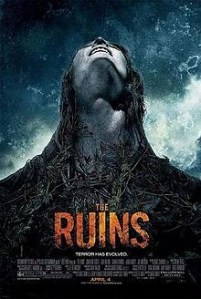
If The Ruins had not been based on a novel by Scott B. Smith, I probably would not have bothered to watch it. Luckily, I’ve been a fan of Smith’s prose ever since reading his novel A Simple Plan (which was later successfully translated to the big screen by Sam Raimi), so my curiosity eventually got the better of me, and I gave the film version of The Ruins a shot. I remembered that I enjoyed the novel, but I also remembered how grisly and ghastly much of that book was and worried that the film version of such a story may attempt to appeal to a specific blood-loving demographic by focusing on the gory rather than the story. Much of the movie is truly cringe-inducing, and yet, to my great relief, never at the expense of the narrative. The gore actually feels completely organic while simultaneously nauseating—which, in itself, is a pretty neat trick.

While the novel is much more comprehensive and—believe it or not—gorier than the movie, the movie is still quite satisfying. Much of the film’s success is due to the way Smith’s characters completely subvert the lackluster expectations created by the film’s college-friends-on-vacation- find-horror narrative template. Normally, a film about young people partying in an exotic locale inevitably disintegrates into a goopy, drippy series of cheap, gruesome thrills and obvious genre tropes, but Smith’s story quickly detours away from this well-trod horror territory by placing smart, capable, relatable characters in an horrific situation that actually forces the viewer to question the way in which he or she might react if it were happening to them.

Since supernatural stories only really work when characters react believably to unbelievable situations, the acting in a movie like this needs to be superb or the whole affair will devolve into a subpar cinematic version of cheese-ball Grand Guignol. Luckily, when horrible things happen to these characters (as played by Jena Malone, Jonathan Tucker, Laura Ramsey, Shawn Ashmore, and Joe Anderson) you feel it in your gut. Their performances elevate every single scene and transform the movie from a potential gross-out popcorn feature to something memorable and even somewhat haunting.

The Ruins plays like a road trip over rocky terrain in a car without shock absorbers. You will feel every bump in the road as it inexorably plows ahead toward its conclusion. I’m not sure that I would describe The Ruins as scary, at least not in the traditional “boogeyman” sense of the word, but I would definitely call it horror. (For the record, the ending to the novel is much more satisfying.)
Day 14: The Exorcist

Halloween Every Day (for a Month)

By Andrew Neil Cole

ExorcistPoster

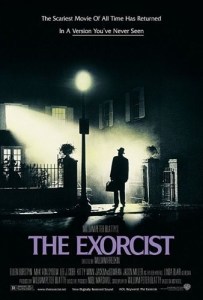
Day 14: The Exorcist (1973).

In recent years The Exorcist has become that rare movie that actually suffers from an iconic reputation. Younger horror fans find the movie boring and predictable. The reason for this is simple: The Exorcist, when it was released at the end of 1973, was so startlingly original, so shocking, so daring, and ultimately so profitable that it has become one of the most routinely and shamelessly) ripped-off films in the history of cinema. Over the last few years alone, it seems that nearly every horror movie that wasn’t a slasher film ended with an exorcism scene. Even supposedly true stories that don’t contain exorcisms were suddenly being adapted into mainstream movies with climactic exorcism sequences. Two of the most obvious (and egregious) examples of this trend are The Conjuring and The Possession. The Conjuring is the story of the Perron family’s battle with supernatural forces in their Rhode Island home. In actuality, there was never an exorcism performed on the family’s matriarch; however, the film spends its entire last hour setting the scene for a final confrontation between good and evil in the form of—you guessed it—a good old-fashioned exorcism. This is where The Conjuring stops being a compelling ghost story and becomes just another attempt to cash in on the popularity of exorcism movies created by The Exorcist. But that’s nothing compared to the ridiculous lengths taken by the makers of The Possession to avoid creating an original film. The true story that inspired The Possession concerns a haunted wine box and the many strange happenings and possibly supernatural coincidences experienced by the box’s numerous owners. However, the story the makers of The Possession decided to tell concerns a family dealing with divorce, an estate sale, and the purchase of a cursed wine box by the family’s youngest daughter, which, of course, leads to her possession, which, of course, leads to a final exorcism sequence replete with otherworldly winds, demonic voices, levitations, and lights that incessantly flicker for absolutely no reason. In the end, The Possession is clearly much more of a cheap retelling of The Exorcist than it is a first-telling of a story about a haunted wine box in which no one—not one single person—is ever possessed or exorcised. So I actually understand why younger viewers are often unimpressed by The Exorcist. By the time they finally get around to seeing the film, they’ve already experienced the story hundreds of times in scores of inferior film and television productions. Such is the fate of numerous iconic stories throughout history, such as Romeo and Juliet and A Christmas Carol.

Unfortunately for The Exorcist, few people remember that, in 1973, the word exorcism wasn’t really all that well known and almost never used in casual conversation. It was also not at all normal to see a film in which one of the main characters was a priest who’d lost his faith, although this, too, would become a well-worn genre trope in years to come. Most importantly, audiences need to be reminded that The Exorcist is about much more than possession and exorcism; it’s a film that actually depicts the debate between fact and faith, science and superstition, hard data and religious dogma. The Exorcist works as horror, philosophical drama, existential mystery, and, perhaps most importantly, pure entertainment, and you can’t say that about any of the rip-offs Hollywood has churned out in the film’s rightfully iconic wake.

Day 15: The Fly

Halloween Every Day (for a Month)

By Andrew Neil Cole

                                                                   The Fly

Day 15: The Fly (1986).

Between 1978 and 1988 four legendary science fiction/horror films were remade, and it is arguable that in each instance the remake topped the original. It all began with Philip Kaufman’s much more urban 1978 version of Invasion of the Body Snatchers. Next, in 1982, came John Carpenter’s now-legendary take on paranoia and xenophobia with The Thing. Then in 1986 David Cronenberg completely overhauled the overtly campy 1958 B-movie silliness of The Fly. And finally, Chuck Russell injected contemporary gore F/X and monster-movie mayhem into his 1988 retelling of The Blob. While John Carpenter’s The Thing is viewed by many of my generation (myself included) as the most entertaining film of this bunch (and maybe the greatest monster movie ever), it is David Cronenberg’s The Fly that is easily the most prophetic, intellectually curious, psychologically damaging, and intimately human film of any of the remakes and one of the best sci-fi/horror ever films ever created.

To say that the film is intimate is to state the obvious, but it would be easy for the casual fan to overlook just how intimate the film really is. There are, for example, only a handful of speaking parts and only a small collection of locations, each of which is, not coincidentally, extremely intimate. There are a few apartments, including one that doubles as a laboratory. There are a couple of offices. There is a bar (very casual, yes, even intimate). There is also a rooftop setting that becomes increasingly important to the story. But that’s about it. All of the film’s drama, tragedy, and horror plays out among a very few characters in only a few different locations. But the intimacy theme doesn’t stop there.

The Fly is, strangely enough, a very human story. It can be viewed as a metaphor for the life and death of romantic relationships or as yet another powerful example of a Frankenstein-style tragedy, in which the birth of a scientific discovery inevitably leads to calamitous horror and death. (Interestingly, The Fly even manages to inject great intimacy into the Frankenstein metaphor, allowing Dr. Seth Brundle to physically experience what he has wrought by casting him as both the creator of the monster and the monster itself.) The film also provides a refreshing take on overused story devices and narrative clichés. The idea of two obsessed workaholics trying to make a relationship work is explored without including the usual banal sitcom patter. When these two fight, they really fight. There is also a great performance by John Getz as the ex-boyfriend. This character begins the film as a weaselly, jealous letch and possible stalker. Slowly he becomes more and more sympathetic, and, before you realize it, you find yourself kinda liking the poor bastard; and then, by the time we reach the film’s dazzling conclusion, this character transforms into a fully realized heroic figure, willing to sacrifice his own safety to protect the woman he loves. This specific character arc provides the perfect counterpoint to the journey taken by the main character: The sleazy ex-boyfriend who resembles an insect ultimately finds his humanity after acting selflessly and courageously, while the noble, upstanding scientist (played to techno-geek perfection by Jeff Goldblum) loses his humanity in the hubristic pursuit of personal glory and literally transforms into an insect. That kind of commitment to character and theme is not something you see in most films, let alone horror films. But then again, The Fly is vastly superior to most films, regardless of genre.

Day 16: Paranormal Activity

Halloween Every Day (for a Month)

By Andrew Neil Cole

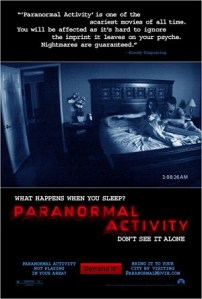
Paranormal Activity (2007).     ParanormalPoster

Over the last few years I have heard a number of filmmakers and fans say that they prefer realistic horror to supernatural horror. Their argument—and it’s a pretty good one—is that they are only truly afraid of things that they believe could actually happen in the real world. However, the real question should be: What do you find scarier, things known or things unknown? To me, the world of the unknown provides considerably more potential for gooseflesh and nightmares. After all, which is scarier, daylight or darkness? The explainable or the illogical? Hungry Hungry Hippos or a Ouija board? If, for example, a masked madman with an axe were chasing me, I would certainly be terrified, but I would at least be able to wrap my mind around what was happening. I would know that the man behind the mask is still just a man—a psychotic, horrifying monstrosity of a man, but just a man, nonetheless. Despite the approaching danger, I could diagnose my situation and logically attempt to extricate myself from that situation. On the other hand, if a demon were stalking me, I would have no logical means of recourse at my disposal. The laws of science and reason would be suddenly mutable. Logic would be a liability. I would be entirely at the mercy of an invisible, indefinable foe, whose motives are unknowable and whose methods are unfathomable.

Now that’s scary!

Movies like Paranormal Activity are most effective when exploring the inherent, genetically coded fear of the unknown shared by virtually all human beings who aren’t total sociopaths. The movie wisely and expertly eliminates the possibility of any safe haven for Katie and Micah, a young couple being tormented by a demon. For example, most people feel safe in their homes. Well, in this movie, literally all of the terror takes place within the boundaries of the tormented couple’s private property; in fact, only a very few shots occur outside of the house. Another example: Many people have been known to combat the late-night creeps by climbing into bed and pulling the covers up tightly around them. Well, in this movie, the bedroom serves as a focal point of the demon’s wrath, with much of the action taking place while our woebegone couple rest comfy-cozy in their big warm bed. This demon means business, and the film smartly allows its otherworldly villain to completely deny our besieged heroes any quarter … not anywhere … not ever.

Paranormal Activity also succeeds at making the illogical seem terrifying. So many movies destroy a perfectly creepy story by over-explaining the source of something that is intrinsically unexplainable, effectively sapping the scare-power from a tale by training a spotlight directly on what should clearly remain in the shadows. But Paranormal Activity cleverly suggests that this particular haunting isn’t the result of a voodoo curse or a Ouija board experiment gone horribly wrong or an ill-conceived night of dancing on graves at the local cemetery. No, this haunting is no one’s fault. This demon has been terrorizing Katie since childhood because … well, that’s what demons do. Making the Katie character a random victim implies that this could happen to anyone, even to movie fans who revel in Katie’s torment. Unfortunately, the sequels attempt to create an expository mythology for the demon’s presence, including a ludicrously weak narrative construct complete with satanic grannies striking Faustian deals. But the original film is still worthy of the occasional after-midnight viewing for those of us who prefer our horror treats served up with a dash of the supernatural and the illogical.

Day 17: Christine

Halloween Every Day (for a Month)

By Andrew Neil Cole

Day 17: Christine (1983).           Christine

John Carpenter and Stephen King are unquestionably two of the all-time great names in horror. And yet, when I think of Carpenter, although I enjoy and/or admire almost all of his movies, I tend to think of Halloween, The Thing, and Escape from New York. Not Christine. The same can be said for King. The mere mention of his name conjures indelible images from countless books and movies, particularly, Carrie, The Shining, and The Dead Zone ... But not Christine. I find this an odd phenomenon, since I really enjoy much of what Christine has to offer.

Adapting King’s story of a 1958 Plymouth Fury that more than lives up to its name could not have been an easy task. The book, which runs north of 600 pages, is a much more complex, comprehensive story than it would appear at first blush. Carpenter and company decided, out of necessity, to streamline the story by adding an introductory scene that takes place on an auto assembly line in late-’50s Detroit. The scene not-so-subtly suggests that Christine was evil right from the moment of her creation. This is a significant departure from the novel, in which the car’s owner, not the car itself, was the primary source of supernatural evil. With this one seemingly simple alteration the rules of adaptation are firmly established, producing a definitive roadmap for the journey from novel to film. Approaching the story from the evil-car-only angle means that some of the best scenes from the novel will inevitably be cut because they no longer make sense. At the same time, this approach creates the opportunity to innovate and create new scenes that further the filmic story while maintaining the spirit of the novel. To this end, we lose a scene in which Christine crashes into a house and chases an intended victim all the way up a flight of stairs; but we gain a beautifully shot sequence in which Christine emerges, almost fully engulfed in roiling flames, from a gas station explosion and tears down an adjacent street in pursuit of a potential victim, glowing bright orange and blood red against the surrounding darkness, her hungry flames licking at the heels of the poor bastard she’s about run over.

Perhaps the necessity of so many dramatic adaptations and narrative reinterpretations is to blame for the film’s strangely inconsistent tone. Moments of phenomenally striking cinematography and flawless technical execution are regularly subverted by hackneyed teen-movie characters whose teen-movie actions push the narrative into familiar, even predictable terrain. We have the lovable nerd whose best friend is the protective jock. We have the generic pretty girl who attracts the attention of both the nerd and the jock, which leads—predictably—to a friendship-testing love triangle. Then we have the school bully and his band of idiot followers who might as well wear red Star Trek shirts with big black bull’s-eyes spray-painted across their chests. And yet, strangely enough, there is still much to be admired in these characters. These people actually feel loss and pain. They have acne and suffer at the hands of bullies and are embarrassed when the pretty girl doesn’t like them back. So many horror films featuring teen characters simply skip the grief when something terrible happens, or only acknowledge it with a cursory “I should’ve been there!” before quickly refocusing emotionlessly on the demands of an idiotic, pot-boiled plot driven primarily by a body count. In Christine, actions have consequences and life-and-death decisions actually result in life or death. However, these moments of heartbreaking realism, as welcome and as well executed as they may be, act as a frustrating reminder of what could have been, had so much of the film not been so contrived; therefore, the film’s most haunting, powerful moments really do little more than further contribute to its inconsistent tone.

It should also be mentioned that, like a lot of Stephen King’s stories, Christine is actually a horror/tragedy. We know that this isn’t going to end well for these characters. The unavoidably tragic nature of this tale creates a sense of melancholy and fate which anchors the story in an emotional depth that most teen horror films actively avoid in order to sell popcorn to the target demographic and accommodate the potential for sequels. (By the way, the horror/tragedy is something that King has come to master over the years. Consider the doomed characters he has created in novels such as Carrie, Pet Sematary, The Dead Zone, and Cujo [the book ends quite differently than the film], just to name a few.)

     Christine isn’t a perfect film, but its visual style and tragiohorrific (that’s right, I said it) atmosphere make it a film well worth remembering and revisiting when considering the legendary careers of John Carpenter and Stephen King.

Day 18: It Follows

Halloween Every Day (for a Month)

By Andrew Neil Cole

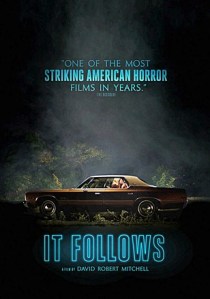
Day 18: It Follows (2014).       It Follows

Writer/director David Robert Mitchell’s It Follows is one those rare modern American movies that pulls off a cinematic trifecta of sorts, in that it succeeds as a work of narrative art, as a work of cinematic art, and as entertainment. Its narrative artistry manifests itself in the telling of a multilayered story that utilizes allegory and metaphor without being heavy-handed or pedantic. It works as cinematic art because it revels in creating a nuanced visual style that amplifies the screenplay’s manifold recurring themes and concepts, and, in so doing, encourages and rewards multiple viewings. And it works as entertainment because it’s freakin’ cool as hell.

It would be reductive to think of It Follows as simply an allegory for STDs, even though the story of a sexually transmitted “demon” of sorts does certainly encourage that particular interpretation. But what these characters really seem to fear is the pain and misery of growing up and becoming adults (and having sex is probably the one act that most clearly represents the transformation from carefree youth to the unending concerns of adulthood). Consider the way in which Jay, our main character, prepares for a date with her new boyfriend in one of the film’s early scenes. Dressed in a sexy outfit, she stands in front of a mirror applying lipstick. When she finishes, she takes a long, disappointed look at her reflection. Her expression suggests that playing dress-up for a pretend date as a child is much more fun and less nerve-wracking than actually dressing up for a real date as a young adult. Much of this exact sentiment is repeated a few moments later in a monologue delivered by a melancholy Jay right after having sex in the backseat of her boyfriend’s car, while she playfully strokes a sprig of tiny flowers that has sprouted out of the surrounding concrete. This is just one of many beautifully executed, subtly symbolic sequences in the film.

I wouldn’t dare instruct viewers as to how they should interpret It Follows. But, for anyone who hasn’t seen it or for anyone interested in giving it another look, I would suggest that you turn off your phone, get comfortable, and pay close attention, otherwise you’re not really giving the film a fair shot. I would suggest listening closely to what actually is being said in the dialogue scenes. Also, pay attention to the use of color (particularly red); take note of the ways in which water is used, what the characters are named, the significance of photographs, the use of technology (and lack thereof). Consider the womblike safety of an old above-ground pool and what it means when that pool is eventually trashed. I’ll stop there, but I could go on for pages.

It Follows is a film that has caused much debate among horror fans. I know that a lot of people don’t like this movie, and they are certainly welcome to their opinions. But it is also possible that a lot of horror fans, particularly younger fans, are simply not used to seeing the kind of horror that requires active viewing. Granted, if exploding zombie heads and disembowelments are your cup of cinematic tea, It Follows is most assuredly not for you. And that’s okay. We are all aloud to like what we choose. It is possible, however, that many people are judging the film for what they want it to be (something more horrific, something more overtly graphic both in its depiction of violence and its narrative intentions) rather than what it actually is (an artfully rendered, thoughtful, deeper cinematic expression). Not all horror films require a body count and extreme violence to make an impact, in the same way that not all comedies should require gratuitous raunch and fart jokes to get laughs.

Day 19: Possession

Halloween Every Day (for a Month)

By Andrew Neil Cole

Day 19: Possession (1981).      Possession

Here’s something you don’t see every day: a gleefully esoteric horror film about the breakdown of a marriage, made by a serious filmmaker, starring serious actors, targeting a serious adult audience. With its outrageously gooey creature effects, green-eyed doppelgangers, over-the-top dialogue, and a loopy narrative high-wire act (including a spy-thriller subplot that bookends the film), Andrzej Zulawski’s Possession is perhaps the ultimate example of ’80s art-house horror done right. Isabelle Adjani and Sam Neil play a couple who clearly love each other yet whose marriage is apparently unsalvageable. He has been away on a secret mission for far too long; she has been unfaithful … and so much more.

Even though watching this couple scream, kick, punch, slap, and completely trash a café in the name of love (or lost love) can seem tedious at times, there is no denying the power of many of these argument/fight scenes, which somehow manage to feel savagely real and dreamily unreal at the same time, a quality also easily applied to the film as a whole. Adjani and Neil are perfectly cast (this role won Adjani numerous awards, including Best Actress at the Cannes Film Festival), as is Heinz Bennent as Heinrich, the creepily eccentric Renaissance man with whom Adjani’s character is having an affair.

The film was shot in Berlin amid a cluster of intertwining streets and colorless decaying buildings. The lighting is austere, punctuated by storm-cloud gray exteriors and muted, lived-in interior spaces with impossibly dark corners swathed in shadows as dense as black holes. Intermittent shots of armed guards patrolling the Berlin Wall mirror the couple’s failing relationship: they are physically so close to one another yet unable to communicate respectfully,  or even without the looming threat of violence, as evidenced in their many physical altercations.

Possession is ultimately a strange, challenging film that requires the viewer’s undivided attention and patience. It’s a film that asks difficult questions about human behavior, particularly concerning adult relationships, and attempts to answer none. It’s a film that trades in metaphor and allegory and refuses to make the experience easier or more palatable for its audience. In other words, Possession is not a traditional horror film: no jump scares, no bogeymen in masks. It is, however, a movie that will leave an indelible impression on anyone who has ever been in a relationship and wished they could mold their partner into an idealized version of a girlfriend, boyfriend, or spouse. Some fantasies are better left in Fantasyland.

(Oh, by the way, the infamous subway miscarriage scene earns every bit of its reputation and is well worth the price of admission on its own. Way to go Isabelle!)

Day 20: Trick ‘r Treat

Halloween Every Day (for a Month)

By Andrew Neil Cole

Day 20: Trick ‘r Treat (2007).      Trick'rTreat

There is perhaps no horror subgenre more difficult for filmmakers to conquer than the anthology film. On the positive side, anthologies are not bound to any one horror style, classification, or category; they are free to explore the entirety of the genre, from astral projection to zombie apocalypses, all within the same film. On the negative side, anthologies are, by their very nature, unable to spend much time on any one story; therefore, the freedom of anthologies to explore different styles of horror is usually stifled by the need to keep each individual tale simple enough to be told quickly. There simply is no room for narrative innovation or the fleshing out of complex characters in the storytelling. And so the result is usually a lazy assemblage of predictable tales rife with buckets of blood, mutilated bodies, and too many jump scares bother counting.

And then there’s Michael Dougherty’s Trick ‘r Treat.

The primary innovation that separates Trick ‘r Treat from so many by-the-numbers horror anthologies is the way in which the stories unfold. Traditional anthologies tell stories one at a time, often introduced by either some sort of macabre master of ceremonies (a la the Crypt Keeper) or through a simple narrative device that allows characters to take turns regaling each other with their personal nightmares. But Dougherty slyly subverts the one-story-at-a-time expectation by introducing all of his characters early in the film, then moving back and forth between their stories, even playing with the timeline along the way, until the film begins to feel like a complex singular story about one Halloween night in a banal suburban landscape rather than five individual stories. And yet, all of the traditional anthology fun is still here to be had. We get a serial killer story, a monster story, a ghost story, a curmudgeon-who-hates-Halloween-gets-his-comeuppance story, and a see-what-happens-when-you-don’t-follow-the-rules story—and all of them pay off in grimly satisfying ways.

In the years since its release in 2007, Trick ‘r Treat has become a bit of a cult classic and a must-watch on Halloween for hordes of horror fans. This is due largely to the film’s visual style. Very few films have ever captured the fun/nostalgic atmosphere of Halloween night like this sucker. In virtually every shot we see either people in costumes or trick-or-treaters or decorated houses or jack-o’-lanterns, all punctuated by the bright colors of autumn foliage spread out across windswept streets and leaf-strewn lawns.

Ultimately, Trick ‘r Treat succeeds as an inventive work of horror filmmaking and as a nostalgia-inducing homage to Halloween.

Day 21: The House of Seven Corpses

Halloween Every Day (for a Month)

By Andrew Neil Cole

Day 21: The House of Seven Corpses (1974).      House7co

In the history of American cinema, the 1970s is a decade marked by great contradictions. While the works of Coppola and Scorsese were sharpening the definition of the word auteur and Spielberg and Lucas were redefining the word blockbuster, the world of underground cinema was producing a veritable wellspring of low-budget exploitation pictures that perfectly suited the many thriving local grindhouse and drive-in circuits. Most of these films focused on extreme violence and outrageous sexual content. It was the time of gritty urban drama/action/blaxploitation pictures and kung-fu/horror pictures and monster/nudie pictures and funky soundtracks and big hairdos and loud fashion statements. Every street corner was home to a ho with a heart of gold and a pimp with a thirsty switchblade, and The Man was always hasslin’ somebody.

And then, in 1974, The House of Seven Corpses, a quiet, moody little PG-rated horror film, was released right in the middle of all the exploitation craziness. Though the film isn’t nearly as extreme as its fellow low-budget releases, its story of a film crew shooting a horror movie in a right-and-truly haunted house is every bit as contrived and underwhelming. The fake blood really hits the fan when, in an attempt to capture a more realistically sinister tone, an actress reads an incantation directly from The Tibetan Book of the Dead, stirring the property’s supernatural forces into a frenzy (and literally causing the dead to rise in a surprisingly effective sequence). Equally effective (and surprisingly subtle) is the way in which the film openly mocks Hollywood hierarchies. There’s the taskmaster-style director who is so driven to make his movie he doesn’t care whom he hurts along the way. There’s the aging leading lady, desperately clinging to her waning beauty and fading popularity. There’s the beautiful young ingénue, doe-eyed, simple, sweet, and naïve to both the ways of the film industry and to the simple fact that her presence is a constant reminder to the older actress of what once was and will never be again.

The House of Seven Corpses is not likely to really scare anybody, especially hardcore horror fans, but the performances are strong, the story, though contrived, is more clever than you might think, and the atmosphere is truly the stuff of good old-fashioned spook shows. For those true aficionados who appreciate that breed of ’70s-style horror that spotlights spooky mansions, creaky staircases, and fog aplenty, The House of Seven Corpses is well worth a visit.

Day 22: Deathdream

Halloween Every Day (for a Month)

By Andrew Neil Cole

Day 22: Deathdream (1972).      DeathdreamPoster

George A. Romero’s Night of the Living Dead (1968) is rightly credited for forever redefining the zombie movie; but, perhaps more importantly, it is also the first independently produced low-budget horror gore-a-thon to subvert and attack establishment thinking. The film overtly criticizes media power run amok, speaks directly to the state of race relations in the country, and suggests the possibility of a coming revolution (e.g. masses of the Dead rising up to overthrow the status quo)—and all of this is accomplished while maintaining a pulse-pounding suspense narrative that never forgets its horror roots or skimps-out on moments of pure unadulterated terror. NotLD would go on to be become a midnight-movie phenomenon that would ultimately be accepted as an indispensable genre classic. It would also make a decade’s worth of exploitation horror cinema seem superfluous by comparison.

With the exception of one fatal flaw, director Bob Clark’s Deathdream (1972) could be seen as a worthy successor to the legacy created by NotLD. With its tale of a dead American soldier returning to his hometown to visit the horrors of Vietnam upon the sleepy denizens of suburbia, Deathdream, like NotLD, is most certainly a movie of and for its time. It can be seen as an obvious criticism of the Vietnam War itself, as a criticism of the way soldiers were treated upon returning home, or as a portrait of the naiveté of the average citizen who will never endure the physical and emotional burden of combat. And now, with the benefit of historical hindsight, the film could even be interpreted as an ex post facto PTSD allegory. (It wasn’t until 1980 that post-traumatic stress disorder was finally added to the third edition of the Diagnostic and Statistical Manual of Mental Disorders by the American Psychiatric Association.) The film’s intention to be much more than just another drive-in zombie splatter-fest is perhaps most evident in a scene in which Andy the zombie soldier visits his family’s doctor. After making the doctor listen to his complete lack of a heartbeat, Andy addresses the doctor’s stunned countenance by saying: “I died for you, Doc. Why shouldn’t you return the favor?”

For all its good intentions, Deathdream, like so many well-intentioned horror films, eventually devolves into little more than a series of gruesome (and seemingly random) bloodlettings. People start dying in horrific ways because … well … it’s a horror movie and people are supposed to die in horrific ways, right? Deathdream ultimately feels like a wasted opportunity, albeit a well-crafted wasted opportunity. Strangely, the movie reminds me of Damien: Omen II. Don’t worry, I’ll explain. Damien tells the story of a pre-teen boy coming to the overwhelming realization that he is the son of Satan. This could have been an interesting subject for a horror film. We could have been treated to a fascinating exploration of a boy on the cusp of becoming both a man and a monster, knowing that he is helpless to do anything about either. Instead, once Damien learns of his satanic lineage, he immediately starts killing people in particularly awful ways, and the film becomes just another body count movie.

While Deathdream ultimately betrays the lofty expectations it creates, it is still well worth seeing. The acting, filmmaking, and cinematography combine to create a Currier and Ives-style atmosphere of warmth and hominess (lots of picket fences and fluffy dogs—hell, you can almost smell the apple pie cooling in an open window), which perfectly contrasts the violence about to ensue, like red paint on a white canvas. Kudos to director Bob Clark (whose next horror film, Black Christmas, would become a slasher classic) for attempting to say something significant with a zombie film. Yeah, he couldn’t quite sustain the power of the metaphor for the entire running length of the film, but at least he gave it a hell of shot, which is more than I can say for Damien and so many others of its creatively bankrupt ilk.